
- All
- Product Name
- Product Keyword
- Product Model
- Product Summary
- Product Description
- Multi Field Search
English
Views: 282 Author: Young Mei Publish Time: 08-29-2026 Origin: Site


Content Menu
● Quick Answer: ABS vs. Soft Gel Nails
● What Are ABS Press-On Nails?
>> Why ABS Nails Remain Popular
>> Potential Limitations of ABS Nails
>> Why Soft Gel Nails Appeal to Premium Buyers
>> Potential Limitations of Soft Gel Nails
● ABS vs. Soft Gel Nails: Material Performance Compared
>> Durability and Everyday Wear
● Application: Glue Tabs, Nail Glue, and Gel Systems
>> UV-Cured Gel Adhesive Systems
● A Manufacturer’s Quality-Control Checklist
>> Example: Matching Material to a Retail Program
● Safety and Product Communication
● Which Material Should You Choose?
● Start Your Custom Nail Project
● FAQ
>> 1. Are ABS nails better than soft gel nails?
>> 2. Do soft gel press-on nails require a UV lamp?
>> 3. Are ABS press-on nails durable?
>> 4. Which is more comfortable: ABS or soft gel nails?
>> 5. Can ABS and soft gel nails be customized for private-label brands?
>> 6. Which material is better for extra-long press-on nails?
>> 7. Can press-on nails cause an allergic reaction?
Choosing between ABS vs. soft gel nails is not simply a design decision. For nail brands, wholesalers, retailers, and professional buyers, the material affects product positioning, unit economics, comfort, durability, packaging requirements, customization options, and repeat-purchase potential.
After more than 15 years in the nail-product manufacturing field, our team at Dongguan YoungMei Technology Co., Ltd. has seen the same pattern repeatedly: ABS press-on nails tend to suit value-driven, durable, high-volume collections, while soft gel press-on nails are often selected for premium collections that prioritize flexibility, a thinner feel, and a more natural-looking fit.
Neither material is universally “better.” The right choice depends on the customer, sales channel, design language, target price, and expected wear experience. This guide compares ABS nails and soft gel nails from the perspective of product development, sourcing, retail merchandising, and real-world use.
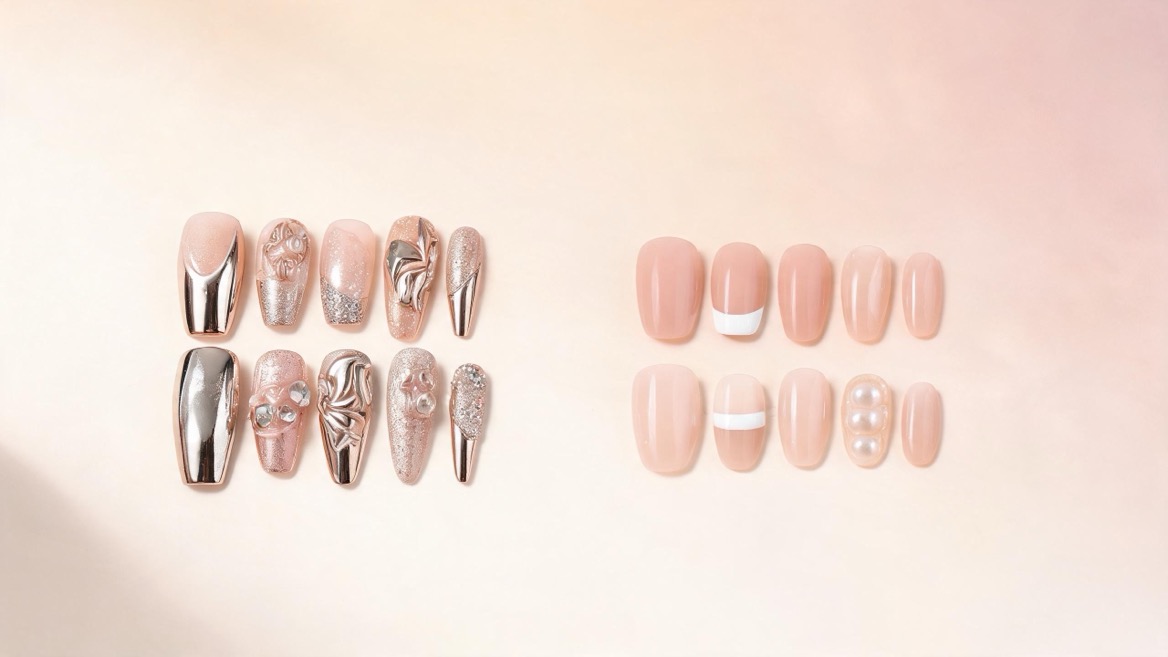
ABS nails are rigid, impact-resistant artificial nail tips commonly used in accessible press-on nail collections. They are practical, cost-efficient, easy to decorate, and well suited to designs that need stronger structure.
Soft gel nails are generally made with flexible gel-based materials designed to feel lighter and bend more naturally with the wearer’s nail. They are typically positioned as a more premium option because of their softer texture, more natural curve, and refined wearing experience.
For a fast comparison:
| Factor | ABS Press-On Nails | Soft Gel Press-On Nails |
|---|---|---|
| Material feel | Firmer and more structured | Softer and more flexible |
| Flexibility | Moderate | High |
| Impact resistance | Generally strong | Can be more prone to bending damage in some designs |
| Natural appearance | Good, depending on thickness and finishing | Often more natural-looking |
| Comfort | Good for many users | Often preferred for a lighter, closer fit |
| Design suitability | Ideal for bold shapes, 3D art, and durable collections | Ideal for thin, refined, premium-looking styles |
| Cost positioning | More accessible | Usually higher |
| Application | Commonly used with nail glue or adhesive tabs | Commonly used with glue or adhesive tabs; some gel systems require curing |
| Best for | Mass-market, fashion, novelty, and retail collections | Premium press-on lines and natural-look collections |
ABS stands for acrylonitrile butadiene styrene, a thermoplastic commonly valued for its balance of rigidity, toughness, and impact resistance. It is widely used across manufacturing industries, and its performance characteristics make it a practical material for molded press-on nail tips. ASTM’s ABS classification system includes performance considerations such as tensile strength, modulus, impact resistance, and heat-related properties, illustrating why material grade selection matters in manufacturing.
In the nail industry, ABS is commonly used for press-on nails because it can be molded into a wide range of lengths, shapes, and curvatures. It also accepts color, printing, chrome effects, painted art, and decorative elements effectively when the production process is properly controlled.
ABS press-on nails continue to be a major category because they offer a reliable balance between product performance and commercial scalability.
Key advantages include:
Strong structural support for long coffin, stiletto, square, almond, and extra-long nail shapes
Good resistance to everyday knocks compared with very thin, highly flexible tips
Efficient molding and mass-production potential for large retail and wholesale programs
Broad design compatibility, including solid colors, French tips, cartoon designs, 3D decorations, glitter, and printed patterns
More accessible price positioning for entry-level and mid-range beauty consumers
Consistent product presentation in multi-size press-on nail kits
ABS is often a smart material choice for a retailer that wants to launch seasonal collections at scale. For example, a supermarket chain, fashion accessory retailer, or online beauty store may prefer ABS collections for their stable cost structure and broad consumer appeal.
ABS is durable, but it is not always the preferred choice for customers who prioritize the thinnest possible nail tip or a highly flexible feel.
Common considerations include:
A thicker ABS tip may feel less natural than a thin soft gel alternative.
Poorly designed curvature can create pressure points around the cuticle area.
Very rigid, long tips may be less comfortable for users who type frequently or perform detailed handwork.
Lower-grade material or insufficient finishing can lead to a less refined appearance.
The material itself is only one part of quality. Tip thickness, apex design, C-curve, edge finishing, surface coating, glue compatibility, and sizing accuracy all have a major influence on customer satisfaction.
Soft gel nails refer to flexible gel-based artificial nail tips designed to provide a more natural fit and a softer wearing experience. In the professional nail market, “soft gel” can describe full-cover gel tips that are bonded and cured using a compatible gel adhesive system. In the press-on market, it may also refer to flexible gel-like nail tips supplied for glue-tab or nail-glue application.
For private-label buyers, the term must be used carefully. A product should not be described as a UV-cured soft gel extension if it is actually a conventional press-on tip made from a different material. Clear product specifications reduce customer confusion and support more accurate marketing claims.
Soft gel press-on nails are commonly chosen for a more elevated product experience. Their flexibility can help them sit closer to the natural nail plate, particularly when the tip curvature and sizing system are well designed.
Their main benefits include:
A flexible, lightweight feel that many consumers associate with comfort
A closer-to-natural appearance, especially in thin or semi-transparent designs
Smooth cuticle-area blending when the tip is properly engineered
Strong potential for premium packaging and branding
Suitability for minimalist, clean-girl, French manicure, sheer, glazed, and salon-inspired collections
Better perceived value for direct-to-consumer brands targeting beauty-conscious shoppers
Soft gel nails are particularly compelling for brands selling through premium e-commerce stores, salons, boutique retailers, subscription boxes, or social-commerce channels. When customers are purchasing based on visual detail and comfort, the softer material story can be commercially valuable.
Soft gel tips are not automatically superior in every category. Their flexibility can be an advantage, but it may also require more careful design and testing.
Potential limitations include:
Very thin or highly flexible tips may not be ideal for certain extra-long nail designs.
Product cost can be higher than comparable ABS collections.
The wrong curvature can still cause lifting, even if the material feels soft.
Flexible surfaces and coatings require compatibility testing with adhesives, top coats, printing inks, and decorations.
A premium material does not compensate for poor sizing, weak glue, or insufficient nail preparation.
For brands, the practical question is not “Is soft gel better?” It is: Does soft gel create a noticeable improvement for the intended buyer at the planned selling price?
ABS nails are often selected when impact resistance and shape retention are priorities. The material’s general strength profile supports structured nail designs and can make it a dependable option for everyday fashion press-ons. Technical references on ABS commonly describe it as a rigid, impact-resistant material with useful toughness and abrasion resistance.
Soft gel nails can offer excellent daily wear when the nail shape, thickness, adhesive, and user application are matched correctly. However, a very thin flexible tip may not be the best fit for users who frequently use their nails as tools, carry heavy items, or prefer dramatic extra-long shapes.
Best choice for durable statement nails: ABS.
Best choice for a natural, flexible wearing experience: Soft gel.
Comfort is strongly influenced by the relationship between the artificial tip and the natural nail plate. A tip that is too curved can pinch. A tip that is too flat can lift at the sidewalls. A tip that is too small may cause tension, while an oversized tip can look bulky and detach early.
Soft gel nails are frequently favored for comfort because their flexible structure can better accommodate small changes in natural nail movement. Yet a well-designed ABS tip can also be comfortable when it has the right thickness distribution and a smooth cuticle edge.
For either material, brands should test:
C-curve compatibility across common nail shapes.
Thickness at the cuticle edge to avoid a bulky transition.
Sidewall coverage to minimize visible gaps.
Sizing range for different nail widths.
Wear performance with glue and adhesive tabs.
Soft gel tips are often associated with a refined, salon-inspired look. They can be especially effective for sheer pinks, milky white designs, translucent jelly effects, pearl finishes, French tips, and glossy solid colors.
ABS tips are highly versatile and can support nearly every major visual trend. They are especially practical for bold graphic designs, colorful seasonal prints, chrome effects, 3D ornaments, hand-painted art, and novelty shapes.
A brand should choose the material based on its intended visual identity:
| Brand Positioning | Recommended Direction |
|---|---|
| Affordable trend-led retail | ABS |
| Children’s or teen fashion collections | ABS, with age-appropriate compliance and design choices |
| Bold 3D nail-art collections | ABS |
| Premium minimalist press-ons | Soft gel |
| Salon-inspired natural manicures | Soft gel |
| High-volume seasonal gift sets | ABS |
| Boutique direct-to-consumer beauty brand | Soft gel or a dual-material range |
The application method has just as much influence on the customer experience as the nail tip material.
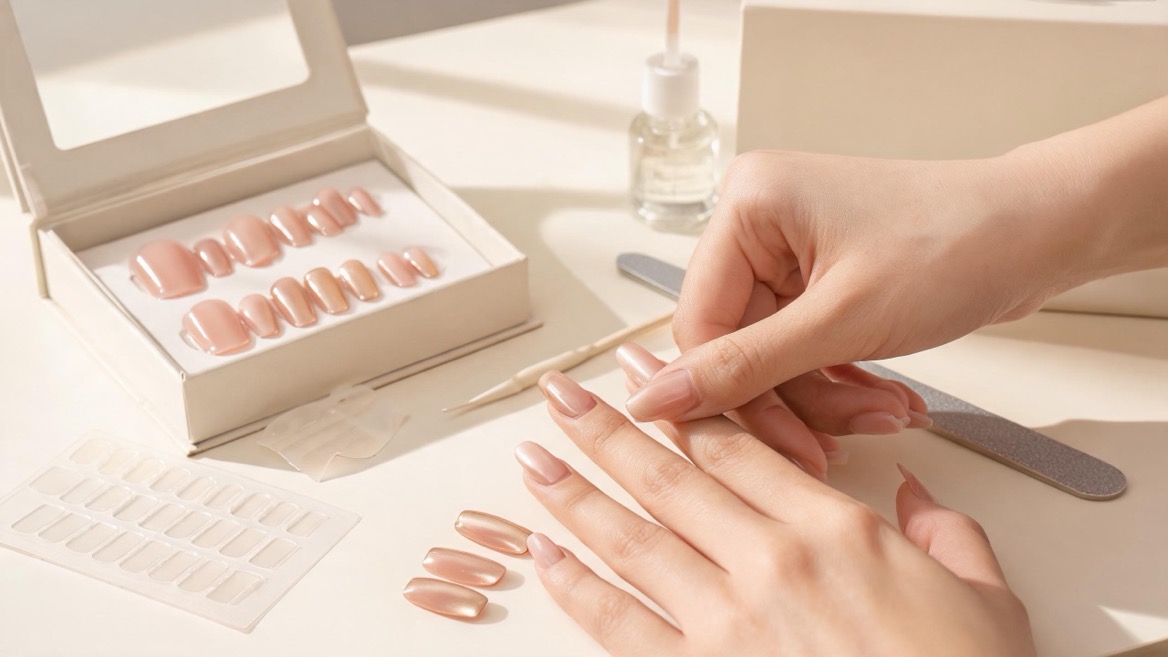
Adhesive tabs are convenient, beginner-friendly, and often chosen for short-term wear. They are suitable for customers who want an easy manicure for weekends, events, travel, photographs, or occasional use.
Advantages include:
Faster removal
Lower commitment
Less mess
Useful for first-time press-on users
Convenient for sampling different designs
For best results, the natural nail should be clean, dry, lightly buffed if appropriate, and free from oil or hand cream before application.
Liquid nail glue generally offers longer wear than adhesive tabs, depending on the adhesive formula, nail preparation, lifestyle, and application quality. It is often preferred for customers looking for a more secure multi-day press-on manicure.
Brands should clearly provide guidance on glue quantity. Too little glue can create air pockets and early lifting. Too much glue can overflow onto skin and increase mess or discomfort.
Some soft gel extension systems use gel adhesive that requires curing under a compatible UV or LED lamp. This method is different from ordinary press-on nail application and should be marketed with precise instructions.
Products that cure under UV or LED lamps deserve careful user education. Dermatology guidance notes that UV exposure is relevant during gel manicure curing, and some experts recommend risk-reduction measures such as broad-spectrum SPF 30+ sunscreen or dark, opaque fingerless gloves. A 2025 review found that the overall skin-cancer risk appeared negligible based on current evidence, while still noting that practical exposure-reduction measures may be sensible.
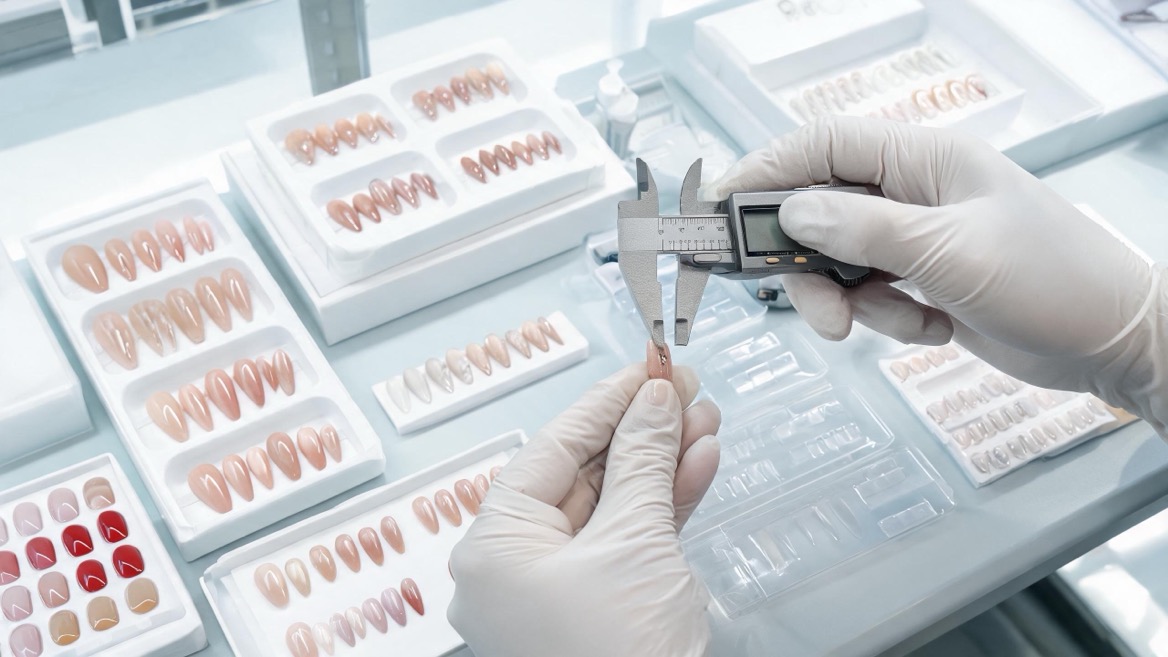
For buyers sourcing ABS or soft gel press-on nails, material selection should be followed by a practical quality-control plan. In our experience, long-term customer satisfaction is built through repeatable testing, not only attractive samples.
A useful pre-production checklist includes:
Tip thickness consistency across all sizes in one set
Smooth edges with no sharp burrs or unfinished cuticle areas
Stable curvature that suits the target market’s nail profiles
Accurate color matching between approved samples and bulk goods
Adhesion testing for glue, adhesive tabs, coatings, and decorations
Drop and transport testing for retail-ready packaging
Odor and surface inspection before packing
Size labeling accuracy for every nail tip
Artwork verification for logos, inserts, back cards, barcodes, and instructions
Batch-level inspection records for scalable quality control
Imagine two brands launching summer collections.
Brand A sells fun, colorful, affordable nail sets through large retail channels. Its collection includes bright fruit art, extra-long coffin nails, glitter, 3D bows, and multiple styles per display. ABS nails would likely be the more practical option because they support strong structures, broad design variety, and accessible pricing.
Brand B sells minimalist, neutral-toned nail sets through a premium online store. Its customer wants a natural curve, a lightweight feel, and polished “salon manicure” styling. Soft gel nails may better support the brand’s desired experience and premium price point.
The key is alignment. The best material supports the promise printed on the packaging.
Artificial nail products should always be paired with responsible instructions. The U.S. Food and Drug Administration explains that artificial nails are primarily composed of acrylic polymers, and it notes that reactive monomer traces can trigger redness, swelling, or pain in people who have become sensitized to methacrylates.
This does not mean every customer will experience a reaction. It means brands and manufacturers should avoid careless claims such as “allergy-proof,” “chemical-free,” or “safe for everyone.”
Good product communication should include:
Stop use if irritation, redness, pain, itching, or swelling occurs.
Avoid applying adhesives directly to broken or infected skin.
Keep nail glue away from eyes, mouth, and children.
Use products only as directed.
Recommend professional medical advice for persistent reactions.
Avoid applying a new artificial nail product over a suspected allergy or existing nail damage.
Dermatology resources also identify methacrylate-based glues as a potential cause of allergic contact dermatitis in sensitive individuals. Clear instructions and traceable ingredient information are therefore important for both customer care and brand credibility.
Choose ABS press-on nails if your business needs durable, versatile, cost-conscious products for fashion retail, promotional collections, fast-moving seasonal designs, or high-volume distribution.
Choose soft gel press-on nails if your brand is building a premium collection centered on flexibility, a lightweight feel, a natural look, and a refined unboxing experience.
Consider offering both if you serve multiple buyer segments. A two-tier collection can give customers a clear choice:
ABS Collection: Durable fashion nails for everyday trend expression.
Soft Gel Collection: Flexible, premium-feel nails for natural-looking manicures.
At Dongguan YoungMei Technology Co., Ltd., we help global brands, wholesalers, and chain retailers evaluate material options before bulk production. With more than 15 years of manufacturing experience, an in-house factory, and an integrated supply chain, we support OEM/ODM programs from concept development and fast sampling to quality control, packaging, and one-stop sourcing.
The right press-on nail material should support your design vision, target price, wear expectations, and retail strategy. Whether you need durable ABS press-on nails, flexible soft gel nail collections, custom packaging, branded accessories, or a complete private-label solution, our team can help turn your idea into a production-ready product.
Contact Dongguan YoungMei Technology Co., Ltd. to discuss your OEM/ODM press-on nail project, request material recommendations, or start a fast custom sample.
Neither is better for every use. ABS nails are generally more structured and cost-efficient, while soft gel nails are often chosen for a more flexible and natural-feeling experience. The best option depends on your product positioning and target customer.
Not always. Some soft gel full-cover extension systems use a UV- or LED-cured gel adhesive, while many flexible press-on nail products can be applied with regular nail glue or adhesive tabs. Brands should clearly state the required application method.
Yes. ABS is commonly valued for toughness and impact resistance, which makes it suitable for many press-on nail collections. Durability also depends on tip thickness, nail shape, adhesive quality, and how the wearer uses their hands.
Many users find soft gel nails more comfortable because they are flexible and may fit more closely to natural nail movement. However, a properly designed ABS nail with correct sizing and curvature can also be comfortable.
Yes. Both can be developed for OEM/ODM projects with custom shapes, lengths, colors, nail art, logo printing, packaging, application tools, and branded instruction cards.
ABS is often a practical choice for extra-long styles because its firmer structure can support dramatic shapes such as coffin, stiletto, and ballerina nails. Final performance should still be confirmed through prototype and wear testing.
Some people can develop sensitivity to ingredients in nail adhesives or artificial nail systems, particularly methacrylate-related substances. Customers should stop using the product if irritation occurs and seek medical advice if symptoms persist.
ASTM International — ASTM D4673: Standard Classification System for ABS Materials
American Academy of Dermatology — Gel Manicures: Dermatologists Share Tips to Keep Nails Healthy
SpecialChem — ABS Plastic: Properties, Applications, and Processing
Xianxing Beauty — ABS vs. Soft Gel Nails: A Comprehensive Comparison