
- All
- Product Name
- Product Keyword
- Product Model
- Product Summary
- Product Description
- Multi Field Search
English
Views: 210 Author: Young Mei Publish Time: 09-29-2026 Origin: Site


Content Menu
● Anemone vs MelodySusie: At-a-Glance Comparison
● Dust Capture: Why Technique Matters More Than a Power Claim
>> Anemone's Advantage for Mobile Filing
>> MelodySusie's Advantage for a Compact Setup
● Disposable vs Reusable Filters: The Daily Trade-Off
>> A Practical Filter-Cost Worksheet
● Noise, Ergonomics, and Bench Space
● What a Dust Collector Cannot Do
>> A Repeatable Workstation Test for Buyers
● Which Nail Dust Collector Should You Choose?
>> Is Anemone better than MelodySusie for a professional nail salon?
>> Is the MelodySusie XC320J nail dust collector rechargeable?
>> How long does the Anemone battery last?
>> How often should I replace the filters?
>> Does a nail dust collector remove chemical fumes?
>> Can I compare these models by watts or decibels alone?
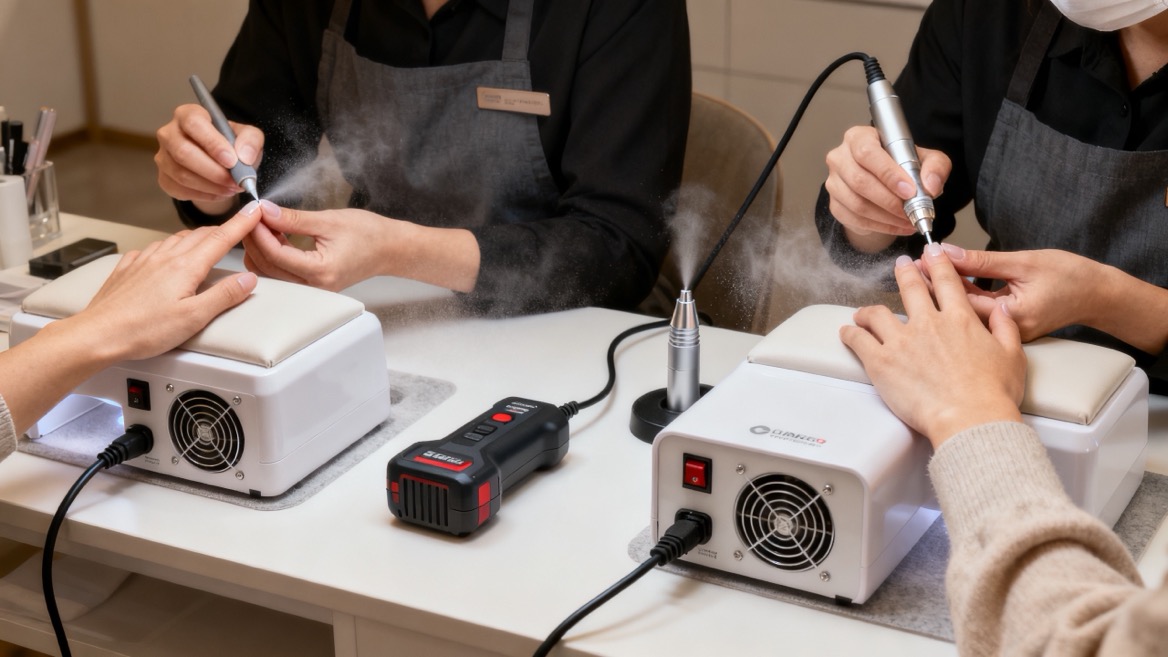
Anemone vs MelodySusie nail dust collectors is not simply a contest of suction. The Anemone cordless model prioritizes flexible placement and disposable filters for busy nail stations. The MelodySusie XC320J combines a dust collector with an optional detachable e-file, making it attractive for home users and technicians building a compact setup. The better choice depends on how often you file, where you work, and how you plan to maintain the filter.
This comparison draws on the brands' published specifications, a nail educator's side-by-side account, and workplace ventilation guidance. It is not a laboratory head-to-head test. Product descriptions can change, and neither unit should be treated as a substitute for an appropriate salon ventilation plan.
| Consideration | Anemone cordless dust collector | MelodySusie XC320J 2-in-1 |
|---|---|---|
| Best-fit workflow | Mobile technician or salon station that values cordless positioning and a fresh filter for each client | Home or mixed-use station that wants a collector and optional integrated nail drill |
| Power | Rechargeable; can also run from its adapter while charging | Adapter-powered collector; no cordless operation specified for this model |
| Filtration | Replaceable disposable filter sheets; 50 supplied | Reusable filter; manufacturer suggests replacement every 3–4 months |
| Nail drill | Not included | Detachable e-file in the 2-in-1 version; collector-only version also listed |
| Control | Adjustable suction dial | Touch controls and two suction modes |
| Published size | Approximately 10.5 × 8 × 2.5 inches | Approximately 12.13 × 11.42 × 3.03 inches with drill; 9.85 × 9.85 × 2.72 inches without |
| Published noise | 58 dB at maximum output; 54 dB at 80% output | 58 dB at high setting; 50 dB at low setting with vacuum and grinding |
| Published warranty | Main body up to one year; battery up to six months; charger up to three months | 15 months listed on the XC320J product page |
Important: These noise figures come from separate sellers, not a standardized side-by-side test. Likewise, motor power, fan speed, and inlet air speed measure different things. None alone proves which collector captures more dust at your workstation.
Both products are designed to pull filing debris toward a tabletop intake. In the nail educator's comparison, both appeared to collect visible dust during use, while Anemone was favored for salon work and MelodySusie for DIY work. That account is useful experience, but it does not establish measured capture efficiency or an occupational exposure reduction for either model.
The Anemone listing describes a broad intake surface, a 48 W output, and an adjustable dial. MelodySusie lists a maximum inlet wind speed of 4 m/s for the XC320J and two selectable suction modes. Do not compare 48 W directly with 4 m/s: one is an electrical or device-output specification, while the other describes air speed at a particular point. Neither tells us the airflow at a filing hand or how much airborne dust escapes around it.
For real-world performance, keep the nails over the active intake while filing. Shift the client's hand rather than working off to one side. Check whether the intake remains effective as the filter loads with dust. If you can see a persistent cloud moving toward your face, adjust position and work method rather than assuming a higher fan setting will solve everything.
A cordless collector can be repositioned between a manicure table and a pedicure chair without rerouting a power cable. Anemone publishes approximately 90 minutes of use at maximum output or three hours at 80% output, with a stated charging time of three to four hours. Those are seller specifications, not a promise that every battery will perform identically after extended use.
For a technician with back-to-back appointments, the key question is whether a cordless window covers the dust-producing portions of the service. The seller says the machine can also operate from its adapter while charging. Test the outlet location, cable route, and table clearance before relying on that fallback during a fully booked day.
The XC320J gives buyers a different kind of convenience. Its detachable e-file can be used with the collector, while the collector can operate on its own. The brand lists an adjustable drill speed up to 30,000 rpm for the 2-in-1 package. This can reduce the number of separate devices on a small work surface if you need to purchase both tools.
However, do not assume every MelodySusie collector includes a drill. The XC320J page also lists a collector-only version. Confirm the exact model, package contents, plug, and local availability before ordering. The collector is adapter-powered; a rechargeable nail drill sold in another bundle does not make this collector cordless.
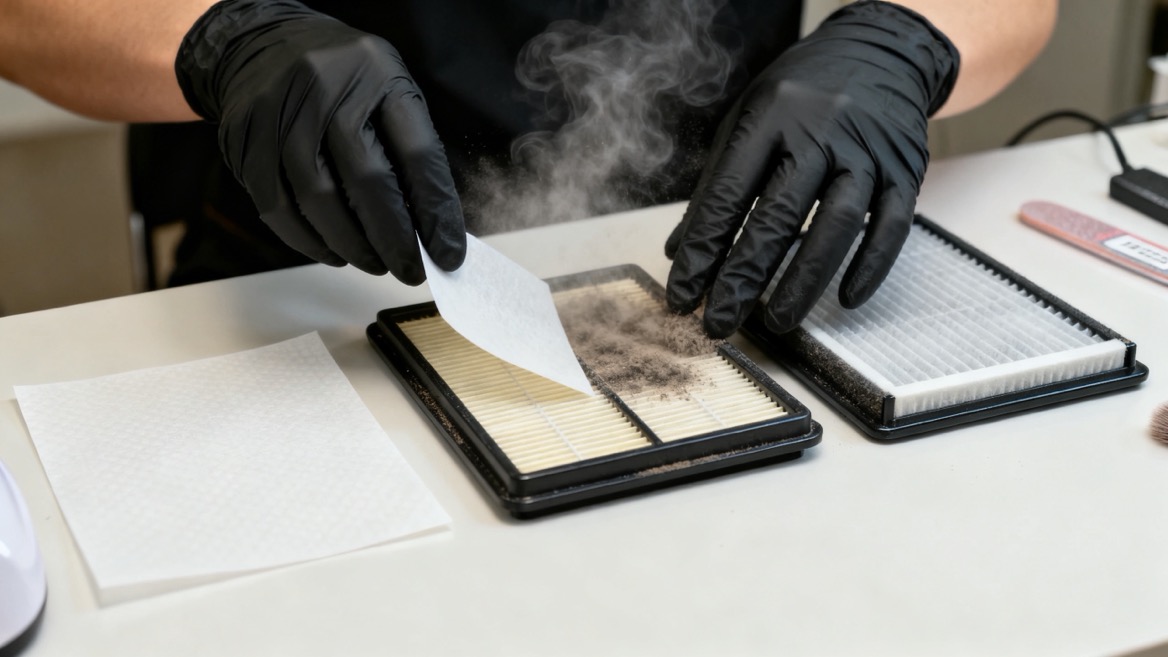
Filter maintenance is where the two machines feel most different. Anemone includes 50 disposable filters and recommends replacing a sheet after each use. This creates a simple client-to-client routine: remove the used sheet carefully, dispose of it, wipe accessible surfaces as directed, and install a fresh sheet. The official replacement sheets are sold in packs of 50. The approach saves cleaning time but creates recurring purchases and waste.
MelodySusie's XC320J uses a reusable filter. Its product instructions suggest clearing accumulated dust and replacing the filter every three to four months. A reusable filter can lower the number of replacements, but only if someone actually cleans it without spreading captured powder around the room. Follow the instructions for your exact filter model; do not assume that a reusable insert is washable. MelodySusie's guidance for this unit advises removing dust and drying thoroughly if the filter is washed, while its separate product guidance advises against washing. When directions differ, seek confirmation for the supplied insert before using water.
For either machine, switch it off before opening the filter compartment. Handle dusty filters away from clients and food, avoid shaking dust into the breathing zone, and inspect the seal before restarting. A dirty or poorly seated filter may undermine the benefit of a powerful fan. Keep spare filters in stock, especially if your supplier ships internationally.
Instead of relying on an old review's accessory prices, calculate your own operating cost:
1. Record the current delivered price of compatible replacement filters.
2. For Anemone, divide the price of a 50-sheet pack by 50, then multiply by the number of filters you expect to use monthly.
3. For MelodySusie, divide the delivered cost of each replacement filter by its realistic service life in months, then add the time spent cleaning it.
4. Include shipping, local taxes, replacement lead time, and any filter waste generated by damaged or heavily loaded inserts.
As an illustration, a technician handling five clients daily for 20 days could use around 100 disposable sheets per month if they change one after every client. That is a planning example, not a claim about a typical salon. A DIY user filing twice a month will face a very different cost equation.
The published high-setting noise value is 58 dB for each device, but measurement methods and working conditions are not established as equivalent. Drill use, table resonance, filter loading, and the distance from the ear all affect what the user hears. If conversation or client comfort is a priority, compare the units at the same distance while performing the same filing task, rather than shopping by a single decibel figure.
Anemone's stated footprint is narrower. The MelodySusie 2-in-1 version takes more published desk space than its collector-only configuration, but may remove the need for a separate drill controller. Before buying, place a paper template of each footprint on your actual table. Allow room for both hands, an LED lamp, products, and safe cable routing. A compact machine is only useful if hands can stay over its intake without uncomfortable reaching.
Posture matters as much as desk width. If you have to lean forward to capture dust, move the collector closer or redesign the station. Workplace guidance identifies repeated awkward posture as another concern for nail technicians. The best layout keeps the filing zone, operator, and intake aligned without forcing either person to hunch over the table.
A tabletop collector mainly targets particles generated near its intake. It should not be marketed as proof of a dust-free room, a complete chemical-vapor solution, or protection from every inhalation hazard. Adhesives, solvents, and other nail products introduce exposure routes that a dust filter specification alone does not address.
Workplace guidance recommends combining local capture with suitable general ventilation and good handling practices. Keep product containers closed, review relevant safety information, and assess whether additional protective equipment is appropriate for the task. A claim such as "100% vacuum effect" on a product page is marketing language, not a verified guarantee that no particles escape during real use.
This distinction matters for press-on nails, too. A retail shopper applying a finished set at home may create relatively little filing dust. A production or customization team sanding tips, refining edges, or preparing repeated sets can have a very different exposure pattern. Match equipment and ventilation to the actual dusty process, not merely to the product category on the box.
If you are purchasing for a salon chain or comparing samples for multiple stations, use the same simple protocol for both machines:
1. Document the exact model, filter type, charge level or power connection, and suction setting.
2. Position a practice hand in the same spot over each intake and use the same bit or hand file on comparable material.
3. Observe visible escape from the front, sides, and operator's breathing zone without deliberately disturbing the airflow.
4. Repeat with a clean filter and again after a normal work interval; note how easy each filter is to remove without releasing dust.
5. Record setup time, cord interference, reach, perceived noise, cleaning time, and consumables used per appointment.
This is a procurement screen, not a scientific particle-exposure assessment. If worker exposure is the decision point, seek qualified industrial-hygiene advice and appropriate measurement. The benefit of the protocol is consistency: a dramatic social-media dust test means little when the hand position, material, and filter condition change between clips.
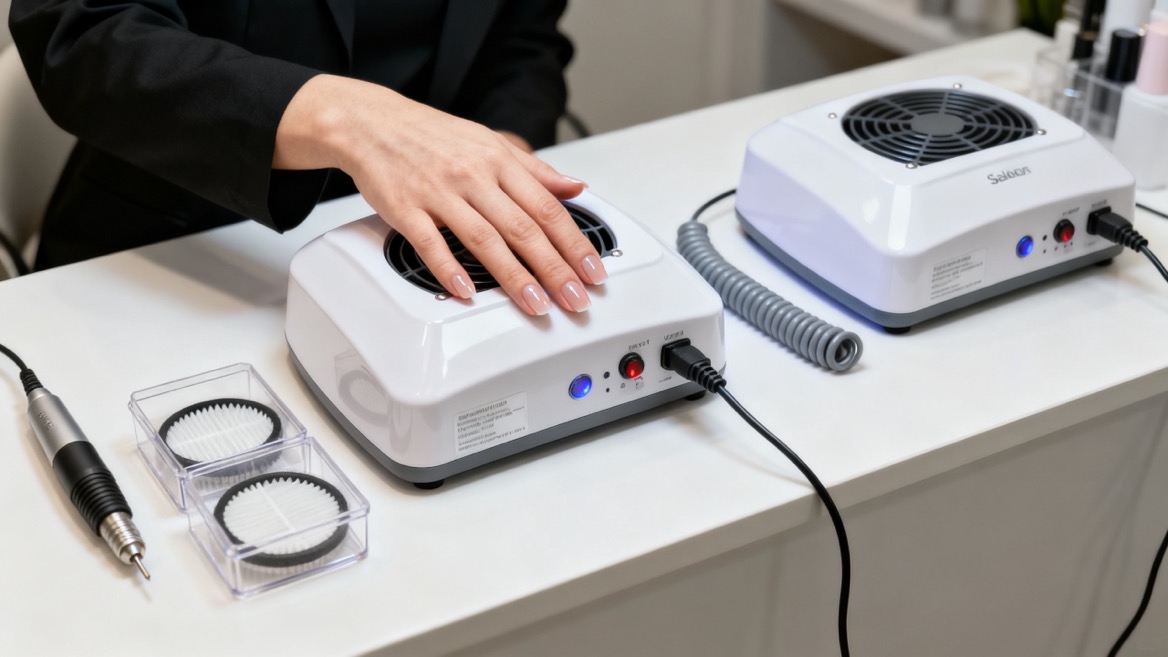
Choose Anemone if you move among stations, value cordless placement, and prefer a fresh disposable filter as part of each client turnover. It is especially compelling when the cost and reliable supply of replacement sheets fit your salon's operating model. Check battery runtime against your busiest services, and read the different limited-warranty periods for the body, battery, and charger.
Choose MelodySusie XC320J if you want a collector and optional e-file in one coordinated setup, can work beside an outlet, and are comfortable maintaining a reusable filter. It makes sense for an at-home user or a space-conscious professional who does not already own a drill. A salon buyer should still test it under their actual appointment load rather than dismissing or endorsing it based on its DIY positioning.
Neither purchase should be made on suction adjectives alone. Ask for exact replacement-filter availability, warranty terms in your country, electrical compatibility, and support arrangements. For multi-location buying, standardizing a model only makes sense if staff can maintain it consistently and consumables can arrive on time.
As a manufacturer focused on press-on nails, nail stickers, and related products, Dongguan YoungMei Technology Co., Ltd. sees workstation design as part of product execution: cleaner preparation supports a more controlled, repeatable process. Our 15-plus years of manufacturing experience and in-house factory inform our OEM/ODM perspective, but we have not independently tested or certified either collector. For your next private-label nail range, contact YoungMei with your target designs, order volume, packaging needs, and sampling timeline to discuss customization and one-stop sourcing.
Anemone may suit professionals who prioritize cordless movement and disposable filter changes. MelodySusie's 2-in-1 can also fit professional work when its adapter-powered layout, e-file integration, and reusable-filter routine suit the station. Neither product has been shown here to outperform the other in an independent capture test.
The XC320J product instructions describe a collector connected to its power adapter. Do not confuse it with separate rechargeable drills or other MelodySusie collector models. Confirm the specific product code and configuration before purchase.
The seller lists up to one hour and 30 minutes at maximum output or three hours at 80% output, with three to four hours of charging. Actual runtime can vary with setting, battery condition, and use. Adapter operation while charging is also listed.
Anemone describes disposable sheets that can be changed after each use. MelodySusie recommends replacing the XC320J reusable filter every three to four months while cleaning it between replacements. Heavy filing, visible loading, damage, or manufacturer updates may change the practical schedule.
Do not assume that capturing filing dust controls solvent or adhesive vapors. Use the collector alongside appropriate room ventilation, product handling, and a task-specific assessment of exposure. A dust-collection claim does not establish vapor-removal performance.
No. Watts, inlet air speed, and noise describe different properties, and the sellers do not provide a shared test protocol. Compare each machine under the same filing task, hand position, filter condition, and operating mode before making a bulk purchase.
- Paola Ponce Nails, ["Dust Collectors Anemone (PRO) vs MelodySusie (DIY)"]. First-person comparison and context for the two products; prices mentioned there should not be treated as current quotations.
- Zillabeau, ["Anemone Cordless Dust Collector"]. Seller specifications, included accessories, runtime, noise ratings, and warranty terms.
- Zillabeau, ["Anemone Dust Collector Extra Filters"]. Replacement-filter pack and dimensions.
- MelodySusie, ["XC320J 2 In 1 Nail Dust Collector"]. Product configurations, size, power, noise, e-file, filter care, and warranty.
- MelodySusie, ["2 in 1 Nail Dust Collector"]. Additional brand guidance on filter care and operation; check the instructions supplied with the specific unit.
- CDC National Institute for Occupational Safety and Health, ["Nail Technicians: Workplace Safety and Health"]. Workplace exposure, ventilation, and ergonomic guidance.
- U.S. Occupational Safety and Health Administration, ["Health Hazards in Nail Salons—Chemical Hazards"]. Ventilation, product handling, and respiratory-protection guidance.