
- All
- Product Name
- Product Keyword
- Product Model
- Product Summary
- Product Description
- Multi Field Search
English
Views: 289 Author: Young Mei Publish Time: 10-09-2026 Origin: Site


Content Menu
>> What Is a Natural Nail Overlay?
● Matching Gel to Natural Nails
>> Start With Condition and Lifestyle
>> Choose Support for the Length
>> Evaluate Handling Before Committing
● Application, Safety, and Maintenance
>> Follow a System-Based Workflow
>> Treat Curing as a Safety Requirement
>> Troubleshoot Before Changing Products
>> Plan Removal and Maintenance Early
● Product Development for Nail Brands
>> Turn Feedback Into Specifications
>> Distinguish Overlays From Press-Ons
>> Build a Clear Sampling Brief
>> Is Structure Gel Builder Gel?
>> Can Builder Gel Support Nail Growth?
>> Is Rubber Base Enough for Long Nails?
>> Is Hard Gel Better Than Soft Gel?
>> Are Press-Ons Natural Nail Overlays?
Choosing the right structure gel for natural nail overlays starts with the nail, not the popularity of the product. Nail length, flexibility, condition, daily activities, and removal preferences should guide your decision before you compare colors or packaging.
My recommendation is to evaluate the complete system: preparation, base, builder, lamp, maintenance, and removal. A beautiful finish matters, but a suitable overlay must also be manageable to apply and maintain without unnecessary damage.
This guide explains how to compare builder gel, soft gel, and hard gel, troubleshoot common problems, and translate salon requirements into clearer product briefs for nail brands.

A natural nail overlay reinforces the existing nail without deliberately extending its length. Unlike ordinary gel polish, a structured overlay adds a shaped layer of supporting product.
That support does not permanently change the underlying nail. It remains a coating that needs appropriate application, maintenance, and removal.
The apex is the raised area that contributes to the overlay's structure. Its placement and height depend on nail length, shape, and the product system. More product everywhere does not automatically create better support.
Many soft builder gels are designed for acetone removal, while traditional hard gels require filing. However, marketing names are not enough to establish either removal method or suitability.
| Product category | Potential use | What to verify |
|---|---|---|
| Soak-off builder gel | Natural nail reinforcement | Supported length, base requirements, removal instructions |
| Hard builder gel | Reinforcement or extensions within system limits | Filing requirements, application training, maintenance |
| Rubber base | Flexible base or reinforcement where permitted | Whether structural use is actually approved |
| Builder in a bottle | Convenient brush application | Formula type, layer limits, curing, removal |
A bottle describes packaging, not chemistry. The GelBottle's Hard BIAB range demonstrates that bottled builders can include hard gel formulations. Do not assume every bottled builder is flexible or soak-off.
Similarly, viscosity describes how readily uncured gel flows. It does not independently prove how strong or flexible the cured product will be.
Before choosing builder gel for natural nails, assess the starting surface and the wearer's routine.
- Check for thinning, peeling, existing lifting, or visible changes.
- Discuss typing, cleaning, frequent handwashing, and impact exposure.
- Confirm the preferred length and acceptable maintenance commitment.
- Review previous reactions to nail products.
- Ask whether removal will involve soaking or professional filing.
Do not cover painful, inflamed, discolored, or separating nails simply to improve their appearance. Persistent or unusual changes deserve medical assessment before another cosmetic service.
For thin, flexible nails, avoid automatically selecting the hardest available builder. Consider a manufacturer-approved system intended for that nail condition, and evaluate preparation and wear together.
Length increases the importance of structure, but there is no universal ratio that determines which gel every client needs. Use the following framework as a starting point rather than a technical specification.
| Nail profile | Selection priority | Avoid |
|---|---|---|
| Short, practical nails | Suitable reinforcement without excess bulk | A tall apex added only for appearance |
| Medium natural nails | Controlled structure and documented length suitability | Assuming every base gel is a builder |
| Long natural nails | A system expressly intended for longer reinforcement | Compensating for an unsuitable formula with thicker layers |
| Very long or demanding shapes | Specialist assessment and appropriate training | Treating an extreme shape like a routine short overlay |
Imagine two clients with similar medium-length nails. One types all day; the other regularly handles cartons. Their exposure to stress differs, so identical styling does not necessarily justify identical product selection.
For long natural nail overlays, prioritize documented application limits and maintenance needs. A thick gel may offer handling control, but thickness alone is not evidence of durability.
Self-leveling can simplify surface refinement, but faster flow is not always easier. A product that moves too quickly for the technician may approach the skin before it is cured.
Compare how candidate products behave under consistent working conditions. Assess brush control, leveling time, visibility around the sidewalls, and the ability to build the intended shape within permitted layer limits.
I would favor predictable handling over a fashionable label. The best choice is one you can apply accurately and maintain consistently.
A safe natural nail overlay routine should follow product-specific training rather than a generic social-media recipe.
1. Assess the nail and agree on a practical length and shape.
2. Prepare according to the system instructions without aggressive thinning of the nail plate.
3. Apply the prescribed base or bonding layer where required.
4. Build the overlay within the manufacturer's thickness and application limits.
5. Keep uncured product away from surrounding skin; remove accidental contact before curing.
6. Cure with the recommended lamp, exposure time, and hand positioning.
7. Refine and finish as directed, then explain maintenance and removal.
There is no universal curing time for every structure gel. For example, one manufacturer's BIAB application guide specifies a low-heat curing program for particular layers. That instruction cannot safely be copied to an unrelated formula.
Do not interchange bases, builders, and lamps merely because they appear to work together. Ask for documented compatibility before changing the system.
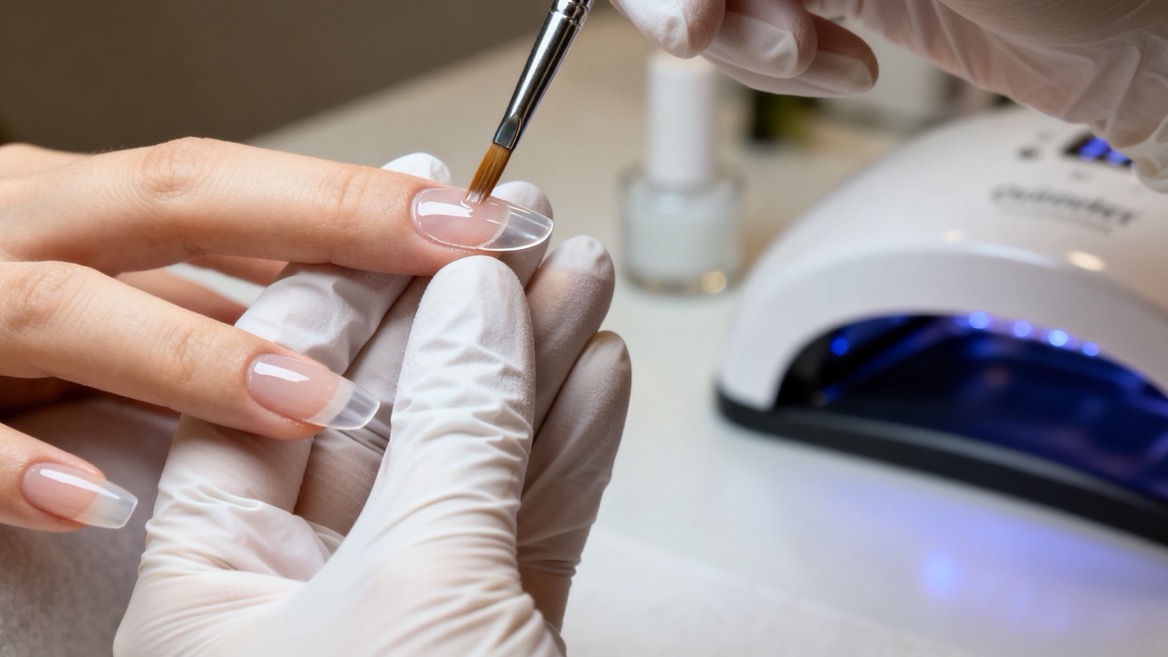
Insufficient curing and contact with uncured nail products can increase the risk of developing an allergy. A hardened appearance is not a reason to disregard the specified lamp or application limits.
Avoid promising that HEMA-free products cannot cause reactions. Removing one ingredient does not establish that the remaining formula is suitable for someone with a diagnosed allergy.
If itching, redness, swelling, blistering, or nail separation develops, stop using the suspected product and seek medical advice. Do not trial another gel over the affected area to identify the culprit.
For lamp exposure, dermatologists recommend protective measures such as broad-spectrum, water-resistant SPF 30 or higher sunscreen on the hands, or dark, opaque fingerless gloves.
Repeated service problems need a documented review, not an automatic switch to stronger gel.
| Observation | Factors to investigate | Next step |
|---|---|---|
| Lifting near the cuticle | Skin contact, preparation, application control | Review technique and system instructions |
| Free-edge separation | Existing damage, length, daily stress | Reassess suitability and practical length |
| Cracks or breaks | Structure, impact, unsupported length | Review the shape and approved product use |
| Persistent burning during curing | Application thickness and curing procedure | Stop if painful and review the system |
| Itching or swelling | Possible irritation or allergy | Discontinue use and seek medical advice |
These are investigation prompts, not diagnoses. Record the product, lamp, preparation, nail length, and location of failure so repeat issues become easier to evaluate.
Choose the removal method before application. Soak-off products should be removed according to their instructions, allowing additional time when necessary rather than forcing resistant material away.
Hard gel filing requires appropriate training and careful control near the natural nail. Avoid picking, peeling, aggressive scraping, or excessive filing.
An infill may be appropriate when the system permits it and the existing overlay remains suitable. The GelBottle's removal guide describes two-to-three-week infills for its BIAB services; this is a brand-specific example, not a universal schedule.
Book maintenance around growth, length, wear, and product guidance. New lifting or discomfort warrants attention before the planned appointment.
For brands, wholesalers, and retailers, the useful question is not simply whether a manicure looks attractive. It is whether the customer understands the product and can use it as intended.
The following feedback themes are hypothetical research prompts, not verified customer testimonials:
- "It looks too bulky": assess thickness, profile, and length options.
- "The instructions are confusing": review application diagrams and removal guidance.
- "The fit feels uncomfortable": assess sizing, curvature, and edge finish.
- "It did not suit my routine": clarify intended wear conditions and maintenance.
Collect actual feedback with product identifiers and usage details before changing a specification. Separate preference issues from defects, misuse, or unrealistic claims.
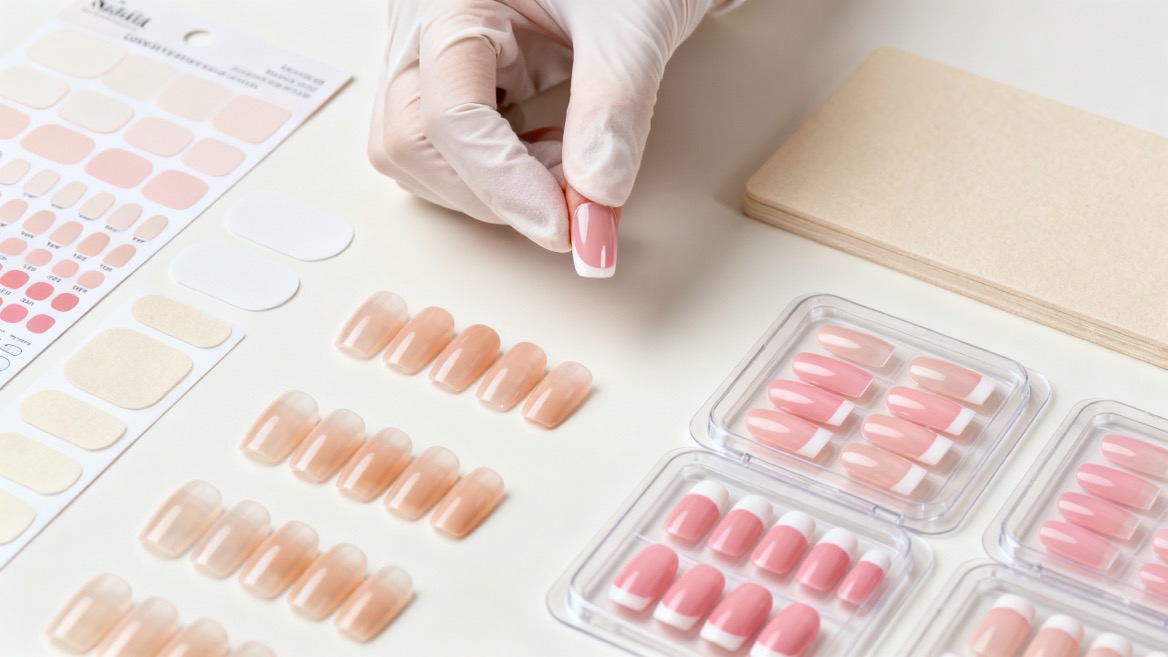
A structure gel overlay is created and cured on the natural nail. A finished press-on nail is a separate manufactured component attached using its designated adhesive method. Nail stickers form another category with their own application requirements.
These products may deliver related visual styles, but their performance and safety instructions are not interchangeable. Do not market press-ons as equivalent to a salon builder-gel overlay without relevant evidence.
For a custom press-on collection, I would prioritize consistent sizing, comfortable curvature, smooth edges, repeatable finish quality, and clear application and removal instructions. Evaluate the adhesive system separately from the nail shell.
A useful OEM/ODM brief should state the target customer, intended application method, shapes, lengths, finishes, packaging, and destination market.
Define sample acceptance criteria before approving production. Compare appearance, sizing consistency, packaging protection, and instruction clarity against the agreed brief rather than relying only on attractive photographs.
Dongguan YoungMei Technology Co., Ltd. brings more than 15 years of nail-product manufacturing experience, with an owned factory and an established supply chain. Its services include OEM/ODM customization, rapid sampling, quality-focused production, and one-stop sourcing for press-on nails, nail stickers, and related products.
Developing a custom collection? Send YoungMei your target market, preferred shapes, lengths, finishes, packaging concept, and quantity requirements. Request a sampling proposal that defines acceptance criteria, production expectations, and product-specific instructions before placing a bulk order.
Often, but terminology varies. Structure gel describes a reinforcement purpose, while builder gel identifies a product category. Check whether the specific formula is approved for natural nail overlays.
An overlay can provide temporary reinforcement while the nail grows. It does not treat medical nail conditions or permanently strengthen the underlying nail. Application and removal remain important.
Not automatically. Use it structurally only within the manufacturer's stated limits. Adding thickness does not replace documented suitability for the intended length.
Neither is universally better. Compare intended use, handling, removal, nail condition, and maintenance. A suitable complete system matters more than the category name.
Only where compatibility is documented. A satisfactory appearance does not establish proper curing or reliable adhesion. Follow the relevant manufacturers' guidance for products and lamps.
No. Press-ons are separately manufactured nails attached to the nail surface. Overlays are built directly on the existing nail. Choose based on the desired look, application method, and maintenance needs.
- Paola Ponce. [How to Choose the Right Structure Gel for Natural Nail Overlays]. Original topic reference and practitioner perspective on system selection, viscosity, and nail length. The article above uses an independently developed structure and wording. [paolaponcenails]
- The GelBottle Inc. [Hard BIAB™]. Manufacturer documentation demonstrating that builder-in-a-bottle products can include hard gel formulations intended for natural nail reinforcement and extensions. [thegelbottle]
- The GelBottle Inc. [How to Apply BIAB™]. Product-specific guidance on application layers, apex construction, lamp selection, and curing programs. [thegelbottle]
- The GelBottle Inc. [The Ultimate Guide for BIAB™ Removal]. April 2025. Manufacturer guidance on removal, avoiding forced removal and over-filing, and brand-specific infill intervals. [thegelbottle]
- The GelBottle Inc. [Troubleshooting & Pro Tips for Nail Technicians]. March 2025. Application and curing considerations relevant to investigating lifting and service breakdown. [thegelbottle]
- British Association of Dermatologists. [Dermatologists Reiterate Artificial Nails Warning and Risk of At-Home Kits]. Published April 14, 2023; modified January 23, 2024. Authoritative guidance on uncured product exposure, insufficient curing, recommended lamps, and allergy risks. [bad.org]
- American Academy of Dermatology. [Gel Manicures: Tips for Healthy Nails]. Dermatologist recommendations on hand protection during lamp exposure, avoiding picking, careful removal, and assessment of persistent nail problems. [aad]