
- All
- Product Name
- Product Keyword
- Product Model
- Product Summary
- Product Description
- Multi Field Search
English
Views: 255 Author: Young Mei Publish Time: 10-13-2026 Origin: Site


Content Menu
● Press-On Nails vs. Gel Extensions: Understanding the Retail Difference
● Quick Comparison for Wholesale and Chain Retail Buyers
● Which Product Creates Better Retail Economics?
>> Compare Complete Offers, Not Isolated Unit Prices
>> Use Contribution Margin Instead of Headline Markup
● Application, Wear, and Removal: What Customers Need to Know
>> Application Convenience Favors Press-On Nail Kits
>> Wear Duration Should Be Tested, Not Assumed
>> Removal Instructions Are Part of Product Quality
● Safety and Compliance: Neither Category Is Automatically Risk-Free
>> Separate Convenience Claims From Safety Claims
>> Build Documentation Into the Purchase Specification
● Market Insight: Growth Supports Testing, Not Unlimited Inventory
● High-Volume Inventory Planning: Control Variety Before Expanding It
>> Press-On Nails: Manage Design and Fit Complexity
>> Gel Extensions: Manage System Completeness
● A Practical Pilot: Test Before Committing to a Large Rollout
>> Step 1: Define One Customer and Channel
>> Step 2: Approve the Complete Product
>> Step 3: Track Commercial and Experience Metrics
>> Step 4: Reorder Winners and Correct Problems
● OEM/ODM Quality Control for Bulk Nail Orders
● Which Should Your Business Order?
● Build a Retail-Ready Nail Collection With YoungMei
>> Are Press-On Nails Better Than Gel Extensions for Wholesale Orders?
>> Can Gel Press-On Nails Be Applied Without a Lamp?
>> Which Product Has the Higher Retail Profit Margin?
>> Are Press-On Nails Reusable?
>> What Should Buyers Request Before a Bulk Order?
>> Can One Manufacturer Supply a Complete Retail Collection?
For most high-volume retail orders, press-on nails are the stronger starting point. They deliver a finished manicure in a shelf-ready format without requiring shoppers to purchase a curing lamp or learn a complete gel application system. Gel extensions remain attractive for professional beauty distributors, salon networks, and retailers serving experienced users.
When comparing press-on nails vs. gel extensions, I would begin with the sales channel—not the finish alone. The better product is the one customers can confidently buy, apply, and purchase again, while leaving the retailer with manageable inventory and acceptable margins.
At Dongguan YoungMei Technology Co., Ltd., our manufacturing perspective comes from more than 15 years of experience developing and producing press-on nails, nail stickers, and related nail products. With our own factory and established supply chain, we support global brands, wholesalers, and chain retailers through OEM/ODM customization, rapid sampling, and one-stop sourcing.
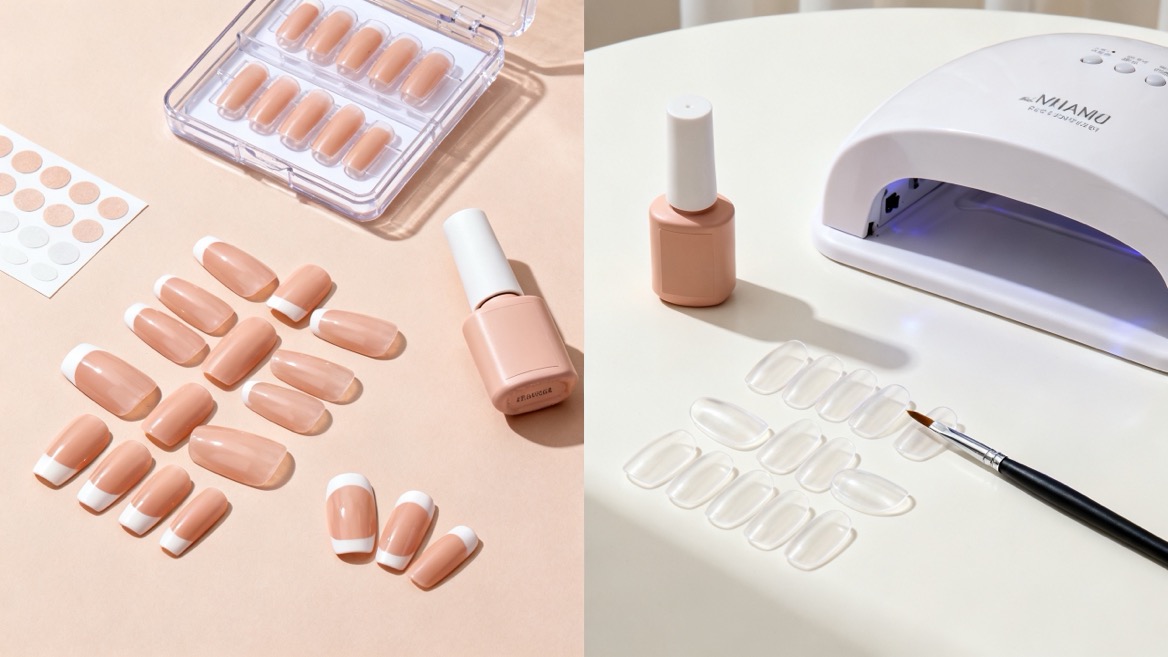
Press-on nails are preformed artificial nails supplied as finished or ready-to-decorate products. Consumers attach them using adhesive tabs or nail glue, depending on the kit.
For retail buyers, the main advantage is product completeness. A branded kit can combine nails, adhesive, preparation accessories, and instructions in one package.
However, "gel press-on nails" does not necessarily mean consumers must cure them. The term may describe the material, coating, or finish. Buyers should confirm the actual application method rather than rely on the product name.
Gel extensions add length using a light-cured gel system. They may involve sculpted extensions or full-cover tips attached with a compatible gel.
The buying proposition is different: customers are purchasing part of a manicure system, not always a ready-to-wear manicure.
Some hard-gel systems require filing for removal, while soak-off soft-gel systems follow different procedures. Retailers should clearly identify which system they stock, its application requirements, and its removal instructions.
| Purchasing factor | Press-on nails | Gel extensions |
|---|---|---|
| Best-fit channels | General beauty retail, online stores, gift assortments | Professional distributors, salons, specialist beauty stores |
| Application | Adhesive tabs or glue | Compatible gel, preparation products, curing equipment |
| Customer learning curve | Generally simpler, but fit and preparation still matter | Greater dependence on technique and system instructions |
| Retail proposition | Finished designs and convenient style changes | Customizable extension system and professional-style results |
| Inventory structure | Kits organized by design, shape, length, and fit | Tips or gels plus supporting products and equipment |
| Quality priorities | Sizing, finish, consistency, adhesive performance | Product compatibility, application performance, curing instructions |
| Main commercial risk | Poor fit, detachment, misleading wear claims | Incomplete kits, incorrect use, compatibility problems |
| Strongest opportunity | Broad consumer access and frequent assortment refreshes | Specialist customers and complementary product sales |
Neither format is universally superior. Press-on nails simplify the initial purchase; gel extensions can support a more involved purchasing journey.
A press-on nail kit and a box of gel extension tips are not equivalent products. Comparing their factory prices alone can produce a misleading purchasing decision.
For press-on nails, calculate the cost of the complete sellable kit. Include packaging, adhesive, accessories, inspections, freight, and any required labeling.
For gel extensions, define the offer first. Are you selling replacement tips, a professional consumable, or a beginner kit containing gel and a lamp? Each has a different cost structure and customer expectation.
My procurement recommendation is to compare products that solve the same customer problem.
A practical calculation is:
Contribution per sold unit = net selling price − landed cost − channel fees − fulfillment costs − expected returns and support costs.
Consider an illustrative example—not a YoungMei quotation or industry benchmark:
| Item | Press-on kit | Gel extension starter kit |
|---|---|---|
| Net selling price | $12.00 | $30.00 |
| Landed cost | $3.00 | $12.00 |
| Channel and fulfillment costs | $4.00 | $8.00 |
| Returns and support allowance | $0.50 | $2.00 |
| Contribution per sold unit | $4.50 | $8.00 |
The gel kit produces more contribution per sale in this scenario. However, it also requires more inventory investment.
The stronger commercial choice depends on sales velocity, markdown exposure, and replenishment performance—not simply the highest selling price.
Press-on nails reduce the number of products shoppers need to understand before starting. That makes them a practical option for event purchases, travel assortments, and customers seeking frequent design changes.
Convenience still depends on clear instructions. Incorrect sizing, inadequate preparation, and unsuitable adhesive use can undermine an otherwise well-made product.
Gel extensions require more coordinated steps. A full-cover soft-gel system may involve preparation, bonding products, extension gel, flash curing, and final curing with compatible equipment.
Retail listings should make those requirements visible before checkout.
Avoid universal promises such as "every set lasts two weeks" or "gel extensions always last longer."
Actual wear depends on:
- Nail preparation and application technique.
- Nail shape and product fit.
- Adhesive or gel performance.
- Exposure to water, impact, and everyday activities.
- Removal habits and maintenance.
For wholesale press-on nails, test adhesive tabs and glue separately. A claim supported by one attachment method should not automatically appear on another version's packaging.
For gel extensions, evaluate the complete specified system rather than the tips alone.
Customers should never be encouraged to force or peel off attached nails.
Removal guidance must match the adhesive, coating, or gel system supplied. Dermatology guidance also recognizes that artificial nails and gel procedures can contribute to nail brittleness, peeling, or other damage.
A clear removal panel can help customers understand correct use and reduce avoidable dissatisfaction.
Press-on nails applied with conventional glue or tabs do not require a curing lamp. That is a valid application distinction—not proof that they are harmless.
Adhesives and other nail products can cause adverse reactions. Gel systems also require careful handling, particularly to avoid skin contact with reactive ingredients and to follow curing instructions.
Avoid unsupported terms such as "allergy-free," "damage-free," or "safe for everyone."
Customers experiencing irritation should discontinue use and seek appropriate medical advice.
For either category, request documentation appropriate to the product and destination market:
1. Material and ingredient information where applicable.
2. Safety data for relevant chemical components.
3. Supported application, storage, and removal instructions.
4. Batch identification and traceability arrangements.
5. Evidence supporting performance or marketing claims.
6. Packaging and labeling review for the intended market.
A safety data sheet is useful, but it does not replace a complete compliance assessment.
If a gel kit includes a lamp, review the equipment requirements separately. Do not assume documentation for the nail product covers the electrical device.
Grand View Research estimates that the global press-on nails market was worth $738 million in 2024 and projects it to reach approximately $1.075 billion by 2030.
These figures concern press-on nails specifically. They should not be treated as sales figures for gel extensions or the entire artificial-nail category.
The useful purchasing lesson is not "order more immediately." It is that the category deserves structured evaluation.
A growing market can still contain weak designs, unsuitable price points, and poor regional fit. Your own sell-through, return reasons, and repeat-purchase data should determine the next order.
Press-on collections can expand quickly across shapes, lengths, finishes, and artwork.
A practical opening assortment might include:
- Core neutrals for ongoing replenishment.
- A smaller seasonal collection.
- Selected statement designs for promotional displays.
- Clearly differentiated shapes and lengths.
Treat this as an assortment framework, not a fixed purchasing ratio.
Size coverage deserves particular attention. Attractive artwork cannot compensate for a kit that repeatedly leaves customers without a suitable fit.
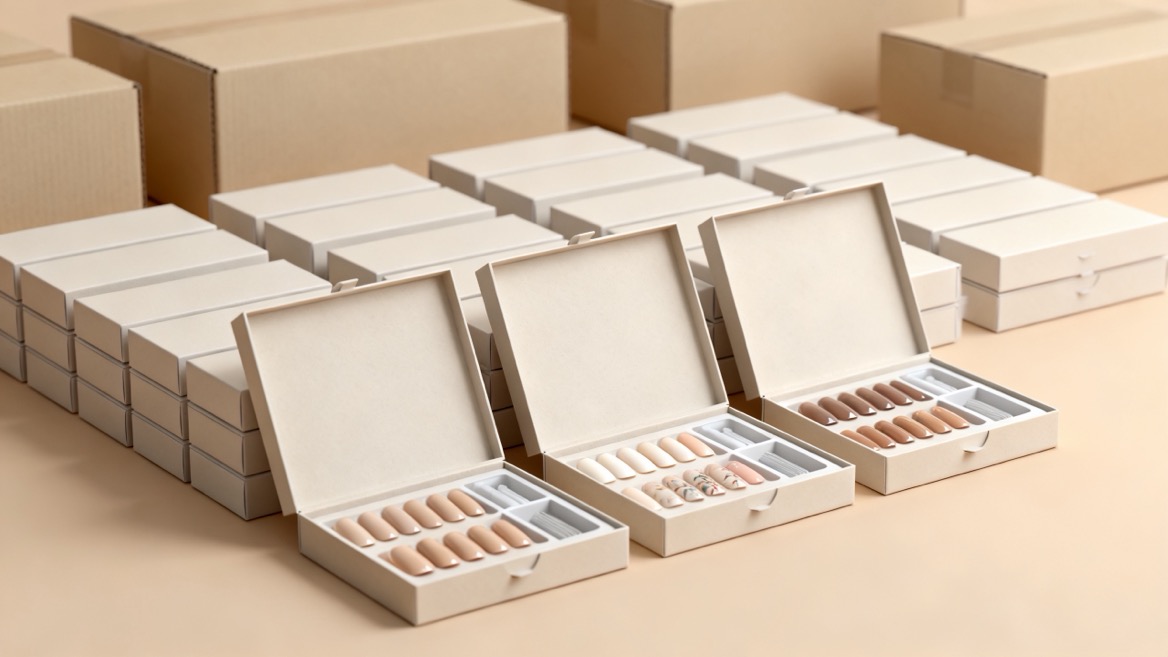
Gel extension inventory introduces another risk: customers may buy one component without understanding what else they need.
Separate replacement products from complete starter kits. Identify compatible products clearly and avoid implying that any lamp, gel, or tip combination will perform identically.
For specialist retailers, this system structure can support complementary purchases. For general retail, it can increase explanation and support requirements.
I would use a staged pilot rather than begin with a nationwide assortment.
Choose a specific audience, such as general beauty shoppers buying finished press-on kits or experienced users buying extension-system refills.
Do not combine fundamentally different customer groups into one performance assessment.
Review the nails, attachment method, accessories, packaging, and instructions together. For gel products, include the specified system requirements.
Measure:
- Units sold per store or listing per week.
- Contribution after returns and fulfillment.
- Fit-related or application-related complaints.
- Defects, missing components, and packaging damage.
- Repeat purchases and reorder demand.
- Support questions that reveal unclear instructions.
Expand products that perform well. Revise instructions where misunderstandings recur, and investigate defects before replenishing affected batches.
This process creates a stronger basis for scaling than relying on initial buyer enthusiasm alone.
An approved sample is a reference point, not proof that every production batch will match it.
For press-on nails, agree on measurable acceptance criteria covering:
- Dimensions, curvature, and size consistency.
- Edge smoothness and visible molding defects.
- Decoration alignment, color, and finish.
- Correct nail counts and accessory inclusion.
- Adhesive packaging and storage requirements.
- Carton identification and pack configuration.
For gel extension products, add relevant compatibility checks and documented application requirements.
Request inspection methods and agreed sampling criteria in writing. Also establish how the supplier will investigate nonconformities and communicate corrective actions.
At YoungMei, buyers can use our OEM/ODM development and rapid sampling services to evaluate a proposed collection before approving bulk production. Project-specific lead times, minimum quantities, and testing requirements should be confirmed during quotation.

Choose press-on nails when your priority is a finished consumer product, straightforward merchandising, accessible application, and frequent design refreshes.
Choose gel extensions when your customers understand extension systems or your channel provides the education and supporting products needed for correct use.
Consider a mixed assortment when your business serves both audiences—but keep their positioning separate.
For most general retail programs, I would launch press-on nails first, validate demand and fit, and expand into gel extensions only when customer behavior supports the additional complexity.
Planning a private-label press-on nail collection or reviewing your current assortment?
Contact Dongguan YoungMei Technology Co., Ltd. with your target market, sales channel, expected order quantity, preferred shapes, design references, and packaging requirements.
Our team can discuss OEM/ODM options, develop samples, and prepare a project-specific quotation. Start with a clearly defined product brief and an approved sample before committing to high-volume production.
Usually for general consumer retail, but not automatically for professional distribution. The better choice depends on the customer, channel, complete product cost, and support requirements.
Some can. "Gel" may describe a finished coating or material rather than a light-cured attachment method. Confirm whether the product uses tabs, conventional glue, or curing gel.
There is no universal answer. Compare contribution after landed cost, fees, fulfillment, returns, and support. A higher-priced gel kit may generate more profit per sale but require greater inventory investment.
Some products are designed for reuse. Actual reuse depends on the nail material, adhesive, removal method, and condition afterward. Make reusable claims only when supported by product-specific testing.
Request an approved sample, detailed specifications, packaging artwork, relevant documentation, inspection criteria, and confirmed commercial terms. Review all included accessories—not just the nail design.
Potentially, but buyers should verify the scope. Ask which components are produced in-house, which are sourced, and who controls their quality. One-stop purchasing should not obscure component-level accountability.
- Grand View Research. "Press-on Nails Market Size And Share Report, 2025–2030." Source for the market estimate and forecast; these are research-provider estimates, not audited retail sales. [grandviewresearch]
- U.S. Food and Drug Administration. "Nail Care Products." Source for U.S. product-safety principles, potential adverse reactions, and precautions concerning reactive nail-product ingredients. [fda]
- American Academy of Dermatology. "Artificial Nails: Dermatologists' Tips for Reducing Nail Damage." Source for nail-damage considerations and distinctions involving soak-off gels and artificial-nail removal. [aad]
- American Academy of Dermatology. "Gel Manicures: Tips for Healthy Nails." Source for removal precautions and advice against picking off gel coatings. [aad]
- Aprés Nail. "Gel-X Durability: Separating Fact From Fiction." Manufacturer-specific source illustrating preparation, fitting, gel application, and curing steps; not independent comparative evidence. [apresnail]
- Aprés Nail. "Extend Gel for Gel-X Tips Nail Extensions." Manufacturer-specific source illustrating a soft-gel extension system and compatible curing requirements. [apresnail]