
- All
- Product Name
- Product Keyword
- Product Model
- Product Summary
- Product Description
- Multi Field Search
English
Views: 264 Author: Young Mei Publish Time: 10-10-2026 Origin: Site


Content Menu
● Press-On Nails vs. Traditional Nail Salon Extensions: The Business Models
● Why Press-On Nails Usually Scale More Efficiently
>> Manufacturing Separates Sales Growth From Appointment Capacity
>> One Product Platform Can Support Multiple Channels
● What Market Data Means for B2B Buyers
● Cost and Profitability: Compare Contribution, Not Headline Margins
>> Press-On Nails Carry Product and Inventory Costs
>> Salon Extensions Carry Capacity and Service Costs
>> An Illustrative Capacity Test
● Customization: Repeatable Branding or Individual Artistry?
>> Private-Label Press-On Nails Support Repeatable Differentiation
>> Salon Extensions Offer More Individualized Results
● Quality Control: Where Scalable Nail Programs Succeed or Fail
>> Press-On Nail Quality Starts With Fit
>> Salon Quality Depends on Service Execution
● Safety and Compliance: Different Responsibilities, Not Zero Risk
● Inventory and Sustainability: The Hidden Trade-Off
● A Practical OEM/ODM Press-On Nail Launch Framework
>> Step 1: Define the Buyer and Channel
>> Step 2: Build a Controlled Pilot Assortment
>> Step 3: Validate the Complete Customer Experience
>> Step 4: Scale Against Commercial Evidence
>> Step 5: Protect Repeatability
● When Salon Extensions—or a Hybrid Model—Make More Sense
● Build a Nail Product Program Designed for Repeat Orders
>> Are press-on nails more scalable than salon extensions?
>> Which model offers higher profit margins?
>> What should buyers confirm before an OEM/ODM order?
>> Can press-on nails replace professional salon services?
>> Are press-on nails suitable for chain retailers?
>> How can buyers reduce inventory risk?
Press-on nails generally offer better B2B scalability than traditional nail salon extensions for brands, wholesalers, and retail chains. They turn a technician-delivered service into a repeatable product that businesses can manufacture, distribute, and replenish across multiple markets. Salon extensions remain valuable for personalized treatments and relationship-driven revenue, but expansion depends more directly on skilled labor, appointments, and physical locations.
At Dongguan YoungMei Technology Co., Ltd., our manufacturing perspective starts with one question: can your next thousand customers receive a consistent experience without a proportional increase in operating complexity?
With more than 15 years of experience developing and manufacturing press-on nails, nail wraps, and related products, we help buyers evaluate scalability through production consistency, customization, inventory exposure, and repeat purchasing—not appearance alone.
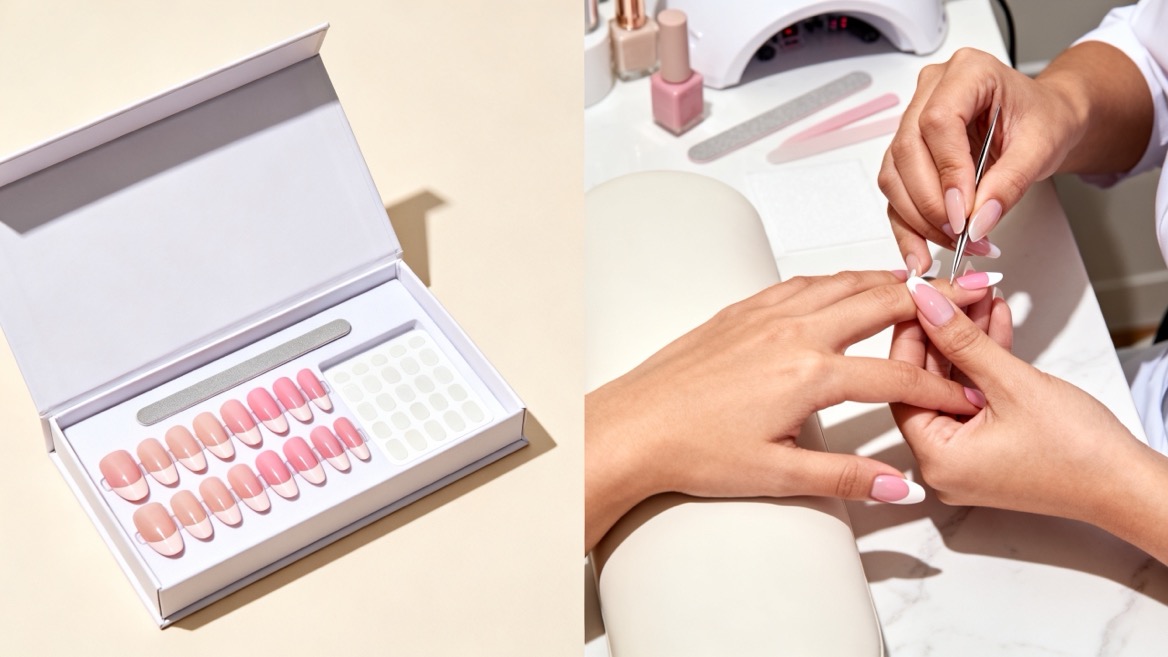
Press-on nails are preformed artificial nails supplied as packaged sets. Depending on the product, customers attach them using adhesive tabs or nail glue. Brands can sell these sets through distributors, stores, marketplaces, and their own websites.
Traditional nail salon extensions are enhancements applied and shaped by technicians, commonly using acrylic or gel systems. The customer buys a professional service, not simply a finished product.
That distinction shapes the entire comparison.
A press-on nail business scales primarily through manufacturing and distribution. A salon extension business scales through service capacity. Salon franchises and professional product suppliers can also expand substantially, but their economics differ from those of a packaged consumer product.
| B2B consideration | Press-on nails | Traditional salon extensions |
|---|---|---|
| Main growth engine | Product distribution and repeat orders | Technician capacity and appointments |
| Expansion requirements | Inventory, fulfillment, channel access | Staff, premises, training, local compliance |
| Customization | Repeatable designs, shapes, finishes, packaging | Individual shaping and client-specific artistry |
| Quality control | Approved specifications and batch inspection | Technician skill and service procedures |
| Inventory exposure | Finished sets and packaging | Materials and consumables |
| Customer relationship | Brand, retailer, product experience | Technician, salon, treatment experience |
| Strongest commercial fit | Brands, wholesalers, retail chains | Service operators and premium studios |
Neither model automatically wins on profit. The better choice depends on the buyer's distribution strengths, available capital, and customer expectations.
Every salon extension appointment occupies technician time. Expanding service volume therefore requires more productive hours, additional staff, or more locations.
In the United States, manicurists and pedicurists typically need a state-approved training program and a licensing examination. This creates a real staffing consideration for service expansion, although requirements vary by jurisdiction.
Press-on nails move much of the application work outside the business. Once production specifications are approved, buyers can distribute additional sets without creating an appointment for every sale.
Production still has limits. Capacity, decoration complexity, packaging availability, and inspection requirements must grow with demand. The advantage is not unlimited output; it is a more repeatable route to expansion.
A coordinated press-on nail range can serve:
- Private-label beauty brands.
- Regional wholesalers.
- Chain retailers.
- Online stores.
- Salon retail counters.
- Promotional and gifting programs.
The same nail design may support several channels, but packaging, pack configuration, barcodes, and pricing may require adjustment.
For wholesale press-on nails, the critical question is therefore broader than "Can we manufacture this design?" It is "Can we supply it consistently in the formats each channel requires?"
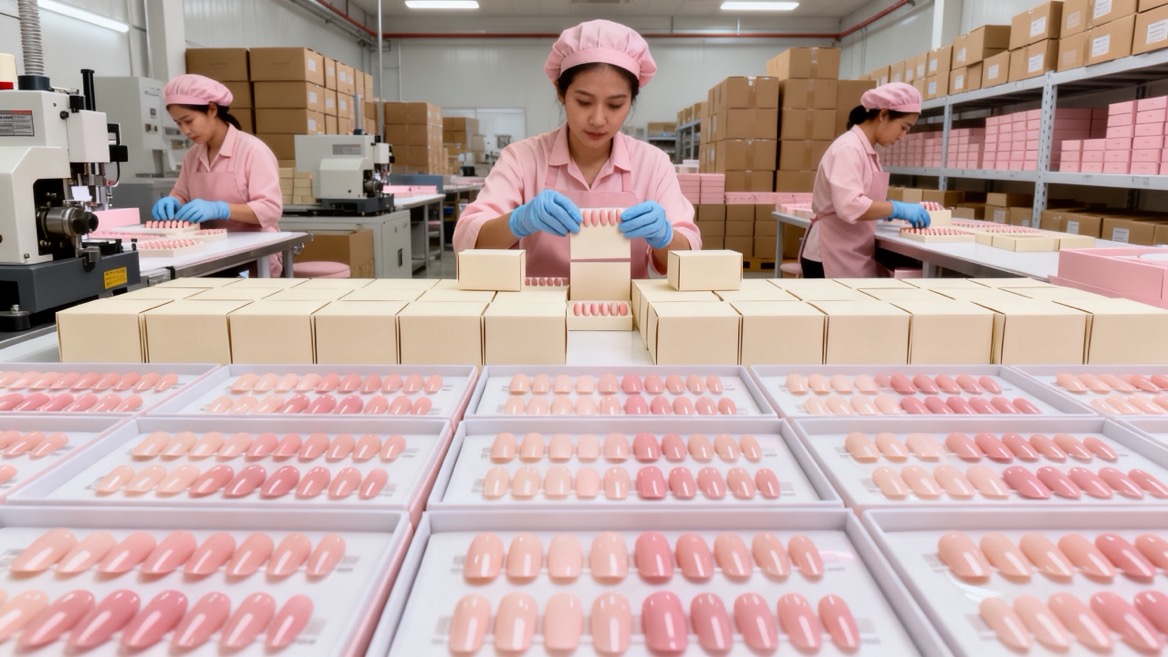
Grand View Research estimates that the global press-on nails market was worth USD 738 million in 2024 and projects approximately USD 1.075 billion by 2030, with a reported compound annual growth rate of 6.5% during 2025–2030.
These are research estimates and forecasts, not audited industry sales or guaranteed outcomes.
Nevertheless, they indicate a category large enough to justify structured commercial evaluation. They do not prove that every new private-label press-on nail brand will succeed.
For buyers, the more useful signals are local:
1. Which shapes and lengths sell repeatedly?
2. What proportion of customers reorder?
3. How frequently do fit or adhesive complaints occur?
4. How much inventory sells without discounting?
5. Can successful designs be replenished before stockouts?
Category growth creates opportunity. Reliable product-market fit determines whether an individual business captures it.
A low factory quotation is not the final cost of selling a set.
Buyers should include:
- Nails, accessories, and packaging.
- Inspection and testing.
- Freight, duties, and applicable taxes.
- Warehousing and fulfillment.
- Retailer deductions or marketplace fees.
- Returns, replacements, and promotional discounts.
- Unsold or obsolete inventory.
A useful calculation is:
Contribution per set = net sales revenue minus landed product cost, selling fees, fulfillment, and expected returns.
This contribution must still cover overhead, marketing, development, and profit.
Salon operators must account for technician compensation, materials, rent, utilities, administration, customer acquisition, and unfilled appointments.
Their comparable measure is contribution per appointment after directly attributable service costs.
Premium pricing and loyal clients can produce attractive economics. However, a profitable appointment does not necessarily translate into easily expandable capacity.
Consider a hypothetical salon with four technicians. If each completes four extension appointments per day over 22 operating days, monthly capacity is 352 appointments.
A hypothetical press-on nail brand selling 2,000 sets monthly is not limited by those appointment slots. However, it must finance inventory, coordinate replenishment, and manage customer acquisition.
These figures are illustrative assumptions, not industry benchmarks. Appointments and sets are also different units of value.
The lesson is to compare each model's bottleneck—not declare a winner from revenue alone.
OEM/ODM press-on nails can help buyers develop a recognizable product range through:
- Shapes, lengths, and curvature.
- Colors, patterns, and decorative finishes.
- Set composition and sizing.
- Adhesive options.
- Branded packaging and instructions.
- Coordinated nail wraps and accessories.
OEM projects typically follow buyer-defined requirements. ODM projects generally begin with supplier-developed options that buyers adapt, subject to the agreed scope.
Greater customization can increase tooling costs, sampling time, minimum order quantities, and production complexity. Confirm whether minimums apply per design, color, packaging format, or total order.
Technicians can adjust shape, length, and structure during an appointment. This flexibility is valuable for clients whose preferences or nail profiles do not suit a standardized set.
However, bespoke artistry is harder to reproduce uniformly across a large network.
A practical distinction is that press-on nails favor repeatable brand identity, while salon extensions favor individual adaptation. Premium businesses can combine both instead of treating them as mutually exclusive.
An attractive design can still disappoint if customers cannot find suitable sizes.
Before approving bulk production, evaluate:
- Width coverage and size distribution.
- Curvature and fit across representative users.
- Edge smoothness and thickness consistency.
- Color matching and decoration placement.
- Adhesive performance under defined conditions.
- Packaging integrity and accessory completeness.
Keep an approved reference sample and written acceptance criteria. Define defects before inspection, not after a disagreement.
Wear testing should specify preparation, adhesive, user activities, and removal method. Avoid promising identical wear duration for every customer.

Salon networks need consistent consultation, application, hygiene, maintenance, and removal procedures.
The American Academy of Dermatology notes that artificial nail application and removal can damage natural nails, particularly where filing or repeated treatments are involved.
Press-on nails should not therefore be marketed as universally "damage-free." Adhesives, application practices, and forced removal can also create problems. Responsible instructions protect customers and reduce avoidable complaints.
Both business models require product-specific and market-specific checks.
The U.S. Food and Drug Administration discusses allergic reactions associated with methacrylate ingredients in artificial nail products. OSHA also identifies chemical hazards in nail salons and relevant employer responsibilities.
For press-on nail buyers, documentation needs depend on the complete kit. Nails, glue, adhesive tabs, preparation wipes, and removers should not be treated as one interchangeable material category.
Request, where applicable:
- Material and ingredient information.
- Safety data sheets for chemical components.
- Relevant test reports and their scope.
- Batch identification and traceability.
- Destination-market labeling review.
- Clear application, removal, and warning instructions.
Do not treat a supplier's general certificate as proof that every product configuration meets every market's requirements.
Press-on nails scale through inventory, which creates working-capital exposure.
Launching too many designs can fragment demand and leave slow-moving stock. Salon businesses usually hold consumables rather than large quantities of finished designs, although they face unused appointment capacity instead.
From a sourcing perspective, a smaller validated assortment is often more manageable than a broad launch supported only by trend predictions.
Sustainability also requires evidence. Neither model is automatically the greener option. Consider packaging, manufacturing waste, transportation, chemical use, and actual product life.
Claims such as "reusable," "recyclable," or "biodegradable" should describe verified conditions and relevant limitations—not serve as unsupported selling points.
A drugstore customer, salon client, and online fashion shopper may need different price points, lengths, packaging, and instructions.
Write a product brief covering the target user, destination market, channel, and intended positioning.
Start with a manageable mix of core styles and trend-led designs.
Use common packaging components where appropriate. Confirm minimum quantities, development charges, and reorder terms before expanding the range.
Evaluate fit, appearance, application, removal, and packaging together.
Collect structured feedback rather than asking only whether testers like the design. Record complaints by cause so corrective action is specific.
Monitor sell-through, returns, contribution, and repeat orders.
Replenish validated designs before adding unnecessary complexity. Agree production lead times and escalation procedures with the manufacturer.
Retain specifications, approved samples, inspection records, and change-control agreements.
Successful scaling means the second and fifth orders perform consistently—not just that the first sample looks impressive.
Traditional nail salon extensions remain compelling when a business competes through premium craftsmanship, personalized consultation, and strong local relationships.
Press-on nails are generally the stronger starting point when the goal is broad retail distribution, wholesale growth, or a private-label product portfolio.
A hybrid model can connect both advantages. Salons can retail coordinated press-on sets for travel or between appointments. Brands can use salon partnerships to obtain structured customer feedback.
These are potential commercial approaches, not documented YoungMei client results. Each requires testing for channel conflict, margins, and customer demand.
For brands, wholesalers, and retail chains, press-on nails generally provide the more scalable distribution model. The strongest programs combine attractive design with validated fit, disciplined inventory planning, and repeatable quality.
Dongguan YoungMei Technology Co., Ltd. brings more than 15 years of manufacturing experience, an owned factory, and an established supply chain to OEM/ODM nail product development, rapid sampling, and one-stop sourcing.
Send YoungMei your target market, sales channel, preferred styles, packaging requirements, and expected order volume. Request a tailored sampling and quotation plan that confirms specifications, minimum quantities, inspection expectations, and replenishment timing before bulk production.
Usually, for product brands and distributors. Additional sales do not require equivalent appointment capacity. Growth still depends on manufacturing reliability, inventory funding, and effective distribution.
There is no universal answer. Press-on nail profitability depends on landed costs, channel fees, returns, and sell-through. Salon profitability depends heavily on pricing, staffing, occupancy, and appointment utilization.
Confirm specifications, approved samples, minimum quantities, packaging, adhesive options, inspection criteria, documentation, production timing, and reorder conditions. Put important requirements in writing.
They can meet some convenience and styling needs, but they do not reproduce every benefit of individualized shaping, professional assessment, or a salon experience.
Yes, provided the program supports consistent packaging, barcodes, documented quality, dependable replenishment, and the retailer's commercial requirements. Suitability must be validated for the intended assortment.
Pilot a focused range, monitor sell-through by design, and expand based on evidence. Evaluate minimum order quantities alongside replenishment flexibility rather than choosing solely by unit price.
1. [Grand View Research — Press-on Nails Market Size and Share Report, 2025–2030]. Source for global market estimates and growth forecasts; figures are research estimates rather than guaranteed outcomes. [grandviewresearch]
2. [U.S. Bureau of Labor Statistics — Manicurists and Pedicurists, Occupational Outlook Handbook]. Source for U.S. training, licensing, and occupational context; requirements vary by state. [bls]
3. [U.S. Food and Drug Administration — Nail Care Products]. Source for artificial nail materials, methacrylate sensitivity, and regulatory context. [fda]
4. [Occupational Safety and Health Administration — Health Hazards in Nail Salons: Chemical Hazards]. Source for salon chemical exposure and safety-data-sheet responsibilities. [osha]
5. [American Academy of Dermatology — Artificial Nails: Dermatologists' Tips for Reducing Nail Damage]. Source for application, maintenance, and removal-related nail damage considerations. [aad]