
- All
- Product Name
- Product Keyword
- Product Model
- Product Summary
- Product Description
- Multi Field Search
English
Views: 277 Author: Young Mei Publish Time: 08-30-2026 Origin: Site


Content Menu
● What Is a Structured Overlay Manicure?
● 5 Key Benefits of a Structured Overlay Manicure
>> 1. It Creates a Stronger-Looking Natural Nail
>> 2. It Improves Nail Shape and Surface Appearance
>> 3. It Can Improve Wear Performance Compared With Thin Gel Polish
>> 4. It Supports a More Efficient Maintenance Routine
>> 5. It Creates Premium Opportunities for Salons and Brands
● Structured Overlay vs. Other Nail Services
● How to Choose the Right Structured Overlay Product
>> Questions Professional Buyers Should Ask
● Expert Application Workflow for a Balanced Overlay
● Build a Better Structured Overlay Collection
● FAQ
>> 1. What is the difference between a structured overlay and gel polish?
>> 2. Can a structured overlay help weak or flexible nails?
>> 3. How long does a structured overlay manicure last?
>> 4. Are structured overlay manicures suitable for short nails?
>> 5. Can a structured overlay be used with nail art?
>> 6. What should I do if gel causes itching or redness?
>> 7. Can brands create customized structured overlay products?
A structured overlay manicure is one of the most practical ways to give natural nails a smoother appearance, added support, and a polished finish without relying on long extensions. For salons, beauty brands, and product buyers, it is also a high-value service category because it combines a natural look with repeatable maintenance and customization potential.
At Dongguan YoungMei Technology Co., Ltd., we have spent more than 15 years developing and manufacturing press-on nails, nail stickers, and related nail products for global brands, wholesalers, and retail chains. From a product-development perspective, the appeal of a structured gel overlay is clear: customers want nails that look like their own—only more even, stronger-looking, and better finished.
This guide explains the real benefits of structured overlays, how they differ from ordinary gel polish and extensions, what affects durability, and how brands and nail professionals can select safer, more consistent products.

A structured overlay manicure is a nail service in which a thicker-viscosity gel is applied over the natural nail to create a balanced, supportive shape. Unlike a thin gel-polish application, the product is placed strategically to build a subtle apex—the highest point of the nail's structure—before curing.
The goal is not to create an artificial-looking, bulky nail. A well-executed overlay should make the natural nail look smoother, more balanced, and more refined.
Depending on the product system and service style, it may also be described as:
- Builder gel manicure
- Builder-in-a-bottle manicure
- Gel overlay
- Structured gel manicure
- Natural nail strengthening manicure
- Soft gel overlay
Although service names differ, the principle is similar: use a suitable gel system to create a more stable-looking natural nail surface while retaining a lightweight and wearable result.
The apex is important because nails experience pressure during everyday tasks—typing, opening packages, washing dishes, buttoning clothing, and using a phone. A carefully placed apex can distribute visual and physical stress more effectively than a completely flat gel layer.
However, more product does not automatically mean a better manicure. Excessive thickness can make nails look heavy, affect comfort, and lead to an uneven side profile. The strongest-looking result is usually balanced rather than bulky.
Many clients struggle with nails that appear thin, uneven, flexible, or prone to splitting at the free edge. A structured overlay does not change the biology of nail growth, but it can provide a supportive cosmetic layer over the natural nail.
This added layer can help clients maintain a more polished look between appointments, especially when their natural nails need time to grow out after frequent trimming, picking, or past enhancement removal.
A properly selected structured gel should offer a useful balance between:
- Adhesion, so the coating remains attached during normal wear
- Flexibility, so it can move with a naturally flexible nail
- Viscosity, so the technician can build shape without flooding the cuticle
- Self-leveling performance, so the surface settles smoothly
- Curing compatibility, so the formula cures correctly with the recommended lamp
For brands, this is one reason formula selection matters more than marketing language. A product may be labeled "builder gel," but its real-world usability depends on how it flows, cures, adheres, and performs across different nail types.
A structured overlay is particularly effective for nails with shallow dents, uneven growth patterns, flat nail beds, or minor surface irregularities. It can visually improve the nail plate by creating a smoother canvas before color, nail art, chrome powder, or a glossy top coat is applied.
The result is often subtle. Rather than looking like an extension, the manicure can give the impression of naturally healthy, carefully maintained nails.
This benefit is especially valuable for clients who want:
- Short or medium-length nails
- A clean, office-appropriate manicure
- A natural "your nails but better" finish
- A smooth surface for minimalist nail art
- A refined base under sheer, nude, milky, or French-style colors
In commercial terms, the structured overlay trend also aligns well with the continuing demand for wearable, low-maintenance nail designs. It provides an elevated service option for clients who do not want dramatic length but still expect a premium result.
Traditional gel polish is designed primarily as a color coating. It can look beautiful, but a thin application may not provide the same level of surface support as a structured overlay.
When the product is appropriate for the client's nail flexibility and is applied with correct preparation, thickness control, and curing, a structured overlay may help reduce visible chipping and edge wear. It can also make the manicure feel more substantial without requiring extensions.
Wear performance is influenced by several practical factors:
| Factor | Why It Matters | Professional Best Practice |
|---|---|---|
| Nail preparation | Residue, moisture, and improper surface preparation can contribute to lifting | Use a consistent preparation protocol without over-filing |
| Product viscosity | A gel that is too thin may not hold structure; one that is too thick may be difficult to control | Match viscosity to nail length and service style |
| Product flexibility | Natural nails flex during daily activity | Select a formula designed for natural-nail overlays |
| Curing process | Under-curing can affect performance and increase avoidable exposure to uncured material | Use the lamp and cure times validated for the formula |
| Application technique | Flooding the skin or creating an unbalanced apex can reduce finish quality | Keep product off skin and build a controlled structure |
| Client aftercare | Nails are tools only in appearance—not in function | Encourage gloves for cleaning and avoidance of picking |
A common misconception is that a gel overlay should be made as thick as possible to last longer. In practice, poor balance can create problems. The most reliable application is one that respects the nail's length, shape, flexibility, and daily use.
For many clients, structured overlays create a practical maintenance cycle. Instead of replacing full extensions or repairing repeated chips from thin coatings, clients may return for a fill, rebalance, color change, or complete refresh based on their nail growth and the product system used.
This can be attractive for customers who value consistency. Their manicure can remain visually tidy while the natural nail continues to grow underneath.
A structured overlay can be a good fit for clients who:
- Prefer regular salon maintenance
- Want to grow their natural nails gradually
- Need a more polished result than standard polish offers
- Want less visual bulk than many extension services
- Like changing colors or nail art without changing nail length
- Want a premium manicure that still looks natural
For a salon, the service can also support better appointment planning. A clear structured-overlay menu allows technicians to explain the value of the extra shaping and product-control work involved, rather than positioning every gel manicure as the same basic service.
Structured overlays are not only a technical service; they are also a strong category for product positioning. Salons can offer a more personalized natural-nail service, while brands can build product collections around viscosity options, color systems, top coats, lamps, preparation products, and aftercare.
For private-label buyers, a structured overlay range can be developed as a complete system rather than a single standalone gel. This approach helps create a more coherent customer experience.
A private-label structured overlay collection may include:
1. Clear builder gel in multiple viscosities
2. Sheer nude, pink, milky white, and natural cover shades
3. Rubber base or flexible base products
4. No-wipe top coat and high-gloss top coat
5. Compatible primer or bonder options
6. Professional curing lamp
7. Brush tools and sample color displays
8. Training materials, packaging, and care instructions
At YoungMei, we understand that professional buyers often need more than a product formula. They may require OEM/ODM customization, shade development, packaging design, logo application, rapid sample support, stable production capacity, and consolidated sourcing for wider nail-product collections.
The best nail service depends on the desired result, nail condition, maintenance preference, and technician skill. A structured overlay is not automatically better than every alternative, but it fills a useful position between thin gel polish and more dramatic enhancements.
| Service Type | Main Purpose | Typical Look | Best For |
|---|---|---|---|
| Traditional nail polish | Temporary color | Thin, natural | Short-term wear and easy removal |
| Gel polish | Longer-lasting color | Natural, thin | Clients who want color with limited added structure |
| Structured gel overlay | Surface support and shape | Natural but refined | Clients seeking stronger-looking, balanced nails |
| Hard gel extension | Length and durability | Can be natural or dramatic | Clients wanting sculpted length |
| Acrylic extension | Strong extension enhancement | Often more rigid and customizable | Clients wanting length, bold shapes, or detailed designs |
| Press-on nails | Fast removable transformation | Varies from natural to statement | Retail consumers, events, and quick style changes |
| Nail stickers | Decorative enhancement | Minimal to artistic | Fast, accessible nail-art options |
For brands serving both professionals and consumers, these categories can complement one another. A salon may offer structured overlays as a service, while a retail collection may include press-on nails and nail stickers for customers seeking quick, no-appointment beauty options.
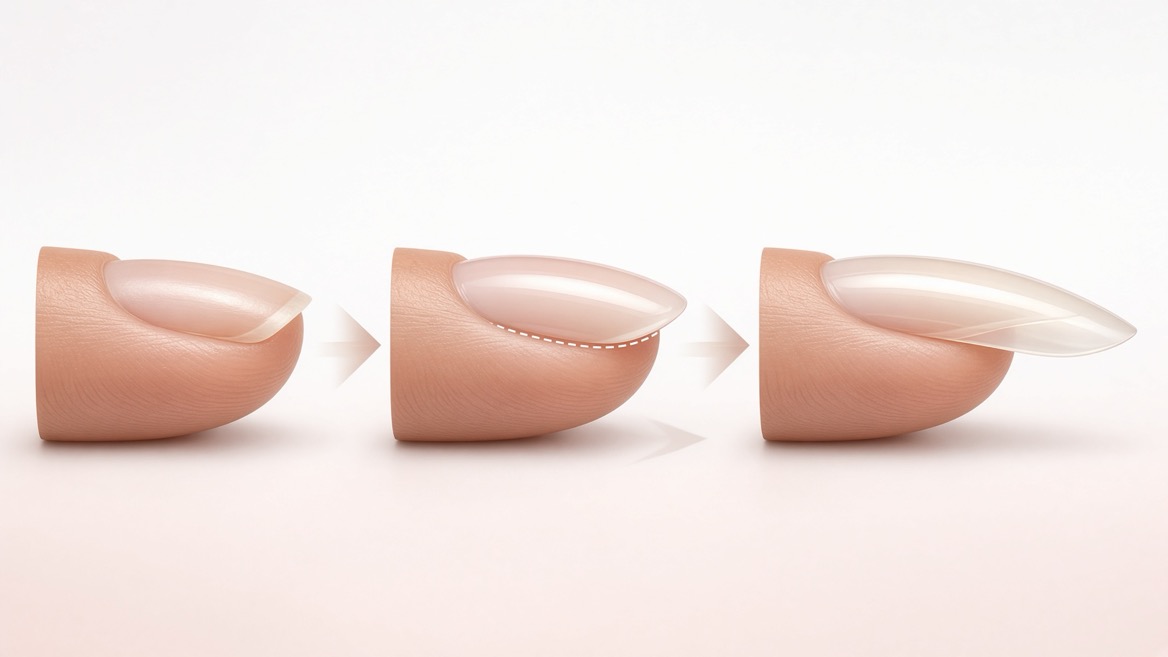
A reliable structured overlay begins with responsible product selection. Product buyers should look beyond color charts and packaging claims and assess whether a supplier can provide appropriate technical documentation, controlled production, stable batches, and transparent communication.
Before selecting an OEM or ODM supplier, ask:
- Is the formula designed for natural-nail overlays, extensions, or both?
- What is the product's viscosity and self-leveling behavior?
- Which lamp specifications and cure times are recommended?
- What testing and quality-control procedures are used during production?
- Can the supplier provide ingredient documentation and safety information appropriate for the target market?
- Is the product packaged to reduce leakage, contamination, and transport issues?
- Can the manufacturer support custom shades, bottles, labels, cartons, and branding?
- What is the minimum order quantity for stock formulas versus customized projects?
- Can the supplier provide samples before larger production?
- How is batch consistency managed across repeat orders?
A responsible purchasing decision should consider not only initial unit cost but also product consistency, complaint risk, packaging reliability, delivery time, communication quality, and long-term scalability.
Gel systems are designed around a specific relationship between formula, layer thickness, lamp output, and cure time. Using an incompatible lamp or applying overly thick layers may interfere with complete curing.
This is an important safety and quality issue. Uncured or improperly cured acrylate-based material should not contact the skin. Dermatology sources have documented allergic contact dermatitis linked to acrylate-containing nail products, and risk reduction includes avoiding direct skin contact with uncured materials and following appropriate product instructions.
For professionals, the practical rule is simple: use the recommended system, avoid skin flooding, and do not improvise cure times without validation.
A structured overlay requires technical control. The following workflow is a general framework; always follow the product manufacturer's instructions for use.
1. Assess the natural nail. Check for visible damage, lifting from a previous service, irritation, signs of infection, or possible allergy. Do not proceed if the nail or surrounding skin needs medical assessment.
2. Prepare gently. Remove old product correctly, tidy the cuticle area, shape the free edge, and lightly refine the surface only as needed. Avoid aggressive filing that can thin the natural nail.
3. Clean and dehydrate as directed. Use the preparation products recommended by the system. Keep the nail plate free of dust, oil, and loose debris.
4. Apply a thin slip layer. Brush on a controlled, thin base layer if the product system requires one. Do not cure until the next step if the technique calls for a wet-on-wet application.
5. Build the structure. Place a small bead of builder gel in the stress area and guide it into a balanced apex. Turn the finger if needed to help the product self-level without pooling around the cuticle.
6. Check the side profile. Look at the nail from the front, side, and free-edge view. The surface should be smooth, symmetrical, and proportional to the nail length.
7. Cure according to instructions. Use the validated lamp and cure time. Do not shorten the process for speed.
8. Refine and finish. File only if needed, apply color or nail art, seal with top coat, and provide aftercare guidance.
A beautiful manicure should never come at the expense of nail or skin health. Encourage clients to avoid peeling, biting, or forcefully removing gel products, as these habits can damage the nail plate.
Clients should stop using a product and seek professional medical advice if they experience symptoms such as persistent itching, swelling, redness, blistering, skin cracking, nail separation, or a rash around the nails, face, neck, or eyelids. Acrylate-related allergic contact dermatitis is a recognized concern in nail cosmetics, and once sensitization occurs, it can have broader implications for future exposure.
Routine care can also improve the appearance and longevity of an overlay:
- Wear gloves when cleaning or handling harsh chemicals
- Use cuticle oil regularly
- Avoid using nails to pry, scrape, or open objects
- Schedule maintenance before extensive lifting develops
- Follow removal instructions instead of peeling product away
- Tell the technician about previous reactions to nail products
The structured overlay manicure has lasting appeal because it answers a simple client need: natural nails that look more even, polished, and supported. When paired with appropriate products, correct curing, careful application, and responsible aftercare, it can be a valuable service for salons and a compelling category for beauty brands.
For global buyers seeking a trusted manufacturing partner, Dongguan YoungMei Technology Co., Ltd. offers more than 15 years of experience in nail-product development and manufacturing. We support brands, wholesalers, and retail chains with OEM/ODM customization, fast sampling, reliable quality control, flexible packaging development, and one-stop sourcing for press-on nails, nail stickers, and related nail products.
Contact our team to discuss your custom nail collection, request samples, or develop a product range built for your target market.
Gel polish is mainly a color coating applied in thin layers. A structured overlay uses a thicker gel application to create a more balanced nail surface and a subtle apex for added cosmetic support.
It can create a more supported-looking surface and may help protect the appearance of flexible natural nails during everyday wear. However, it does not treat underlying medical nail conditions, and clients with persistent nail problems should consult a qualified healthcare professional.
Wear time depends on the product system, preparation, curing, client nail growth, and daily habits. Many clients schedule maintenance every two to four weeks, but the correct interval varies by individual and service protocol.
Yes. Short nails are often an excellent candidate because a subtle overlay can improve surface smoothness and visual balance without adding length or bulk.
Yes. It provides a smooth, stable-looking base for sheer colors, French designs, chrome effects, decals, hand-painted art, and other decorative finishes.
Stop using the product, avoid further exposure, and seek medical advice—particularly if symptoms persist, worsen, or include swelling, blisters, nail lifting, or a rash beyond the nail area.
Yes. Experienced manufacturers can support customized shades, viscosity preferences, packaging, labels, branding, and product bundles. Buyers should confirm formulation suitability, documentation, testing, minimum order quantities, sample availability, and destination-market requirements before production.
- Paola Ponce Nails. "[5 Amazing Benefits of a Structured Overlay Manicure]." [paolaponcenails]
- PubMed Central. "[Dermatologic Conditions Associated With Various Types of Popular Nail Cosmetics]." [pmc.ncbi.nlm.nih]
- Dascalu J, et al. "[Is the Use of the Extended (Meth)acrylate Series—Nails Appropriate for the Diagnosis of Nail Cosmetic Allergy?]." [pmc.ncbi.nlm.nih]
- Contact Dermatitis. "[Contact Allergy to Acrylate-Containing Nail Cosmetics: A Systematic Review]." [onlinelibrary.wiley]
- DermNet. "[Allergy to Acrylates]." [dermnetnz]
- DermNet. "[Nail Cosmetics Allergy]." [dermnetnz]
- Journal of Cutaneous and Aesthetic Dermatology. "[Cosmetically Induced Disorders of the Nail With Update on Contemporary Nail Manicures]." [jcadonline]