
- All
- Product Name
- Product Keyword
- Product Model
- Product Summary
- Product Description
- Multi Field Search
English
Views: 228 Author: Young Mei Publish Time: 10-12-2026 Origin: Site


Content Menu
● Why Source Cat Eye Press-on Nails From China?
>> An Established Manufacturing and Development Network
>> A Growing Market, With Important Data Limitations
● How These Suppliers Were Selected
● Manufacturer Comparison: Capacity, MOQ, and Certification Claims
● The Top 10 Sourcing Candidates
>> 1. Dongguan YoungMei Technology Co., Ltd.
>> 2. Ennio
>> 3. Gisele (Tianjin) Crafts Co., Ltd.
>> 4. Zhongshan Senboma Artware Co., Ltd.
>> 7. OEMnail
>> 8. Nailystal
>> 9. HUIZI
>> 10. Dalian Nailway Arts Co., Ltd.
● Technical Buying Guide: What Defines a Reliable Cat Eye Product?
>> Specify the Product Construction
>> Define the Visual Effect, Not Just "Cat Eye"
>> Do Not Treat CE or RoHS as Universal Nail Certifications
● Practical Procurement Workflow
>> 1. Verify the Contracting Company and Production Site
>> 3. Establish Inspection and Change-Control Rules
>> 4. Compare Landed Cost and Logistics Scope
● An Overlooked Sourcing Trap: Sample Approval Without Process Approval
● Select a Production Partner, Not Just a Catalog
>> 1. How Can I Verify Whether a Supplier's ISO Certificate Is Expired or Suspended?
>> 2. How Can I Establish That Bulk Nails Use the Approved Material?
>> 3. How Can We Judge Whether a Low MOQ Is Commercially Useful?
>> 4. How Should We Compare Capacity When One Supplier Quotes Pieces and Another Quotes Sets?
Choosing a cat eye press-on nail manufacturer requires more than comparing attractive designs and unit prices. Professional buyers need a production partner that can reproduce magnetic effects consistently, control material changes, support private-label development, and deliver repeat orders with reliable documentation.
China offers a broad supplier base covering nail-tip molding, decorative finishing, handmade gel application, packaging, and nail accessories. Manufacturing locations represented in this guide include Dongguan, Guangzhou, Zhongshan, Foshan, Tianjin, Dalian, and Jiangsu. Their different production models give buyers options ranging from small handmade collections to automated retail programs.
This guide evaluates ten sourcing candidates through manufacturing transparency, product-development capability, quality controls, commercial flexibility, and export experience. It is an editorial shortlist—not an independently audited ranking of production volume or product quality.
Disclosure: This article was commissioned for Dongguan YoungMei Technology Co., Ltd., which appears first. Factory figures and service descriptions below come primarily from suppliers' published information. Buyers should independently verify legal identities, certifications, capacity, and current quotation terms before placing an order.
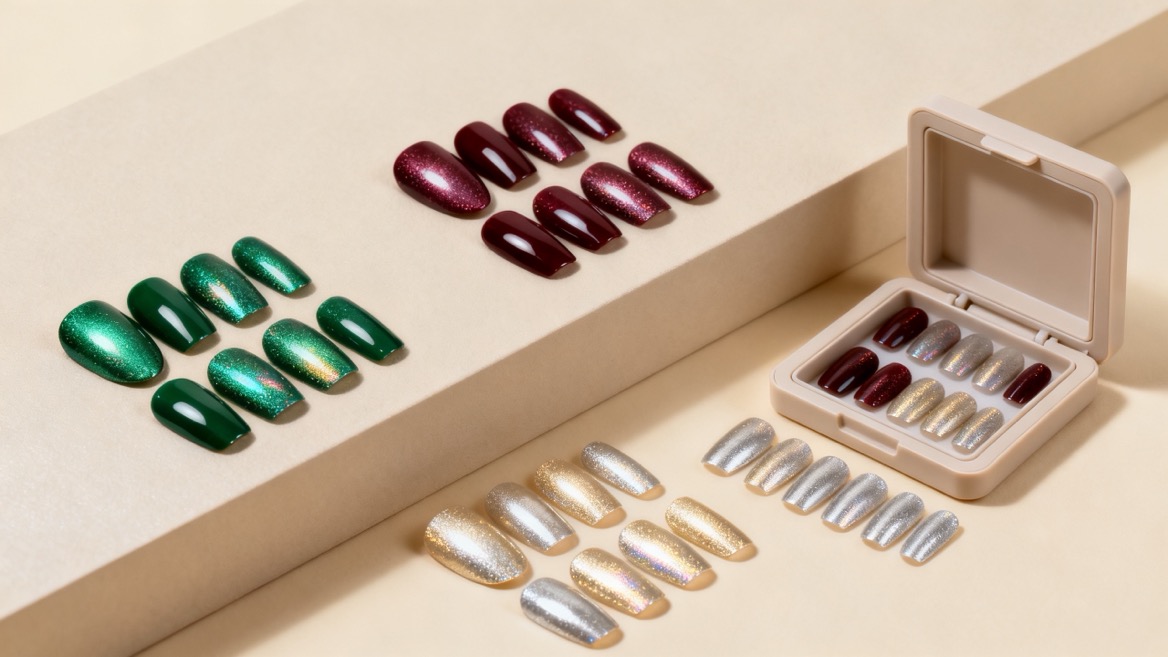
The suppliers reviewed here illustrate the breadth of China's nail-product supply chain. YoungMei describes capabilities spanning materials, molds, shapes, designs, and packaging. Gisele reports in-house mold development and two production bases. Xianxing describes facilities covering molding, injection molding, printing, processing, and packaging. These integrated operations can simplify coordination when buyers need several components developed together.
However, geographic location alone does not establish manufacturing quality. A Guangdong factory and a Jiangsu handmade workshop may both produce commercially attractive products while using very different staffing, finishing, and production-control systems.
The practical advantage is supplier choice. Buyers can match their order size and product positioning to an appropriate manufacturing model rather than expecting one factory to suit every program.
A press-on nail market report published in July 2026 by Grand View Research states that the global market was valued at USD 738.0 million in 2024 and projects USD 1,075.0 million by 2030, with a 6.5% compound annual growth rate for 2025–2030. These figures cover press-on nails generally, not cat eye designs specifically. They should not be presented as a measured cat eye market size.
For broader export context, China's General Administration of Customs reported 2025 merchandise exports of 26.99 trillion yuan, up 6.1% year on year. This supports the country's overall export scale, but it is not nail-product export data and does not establish any individual supplier's market share.
For procurement teams, the more useful implication is straightforward: develop products with repeatable specifications and replenishment capability, rather than relying only on fashionable launch samples.
The shortlist uses six screening dimensions. These are purchasing criteria, not a claim that every company has passed a factory audit.
| Selection dimension | Evidence buyers should request | Why it matters |
|---|---|---|
| Manufacturing identity | Business license, factory address, production walkthrough, subcontracting disclosure | Distinguishes actual production capability from sales representation |
| Cat eye product capability | Physical samples, moving-light video, production-method explanation | Separates magnetic effects from printed or glitter-based approximations |
| Development capability | Mold options, material specifications, packaging samples, development workflow | Determines the depth of OEM/ODM support |
| Quality management | Inspection records, material traceability, defect handling, current certificates | Supports repeat-order consistency |
| Delivery reliability | Available finishing capacity, order schedule, recent delivery records | Tests whether advertised capacity applies to the requested product |
| Commercial suitability | MOQ by design, packaging minimums, tooling charges, reorder terms | Identifies the actual financial commitment |
The central purchasing principle is repeatability. A supplier should be able to explain how an approved design becomes a controlled production specification—not simply promise that bulk goods will "look like the sample."
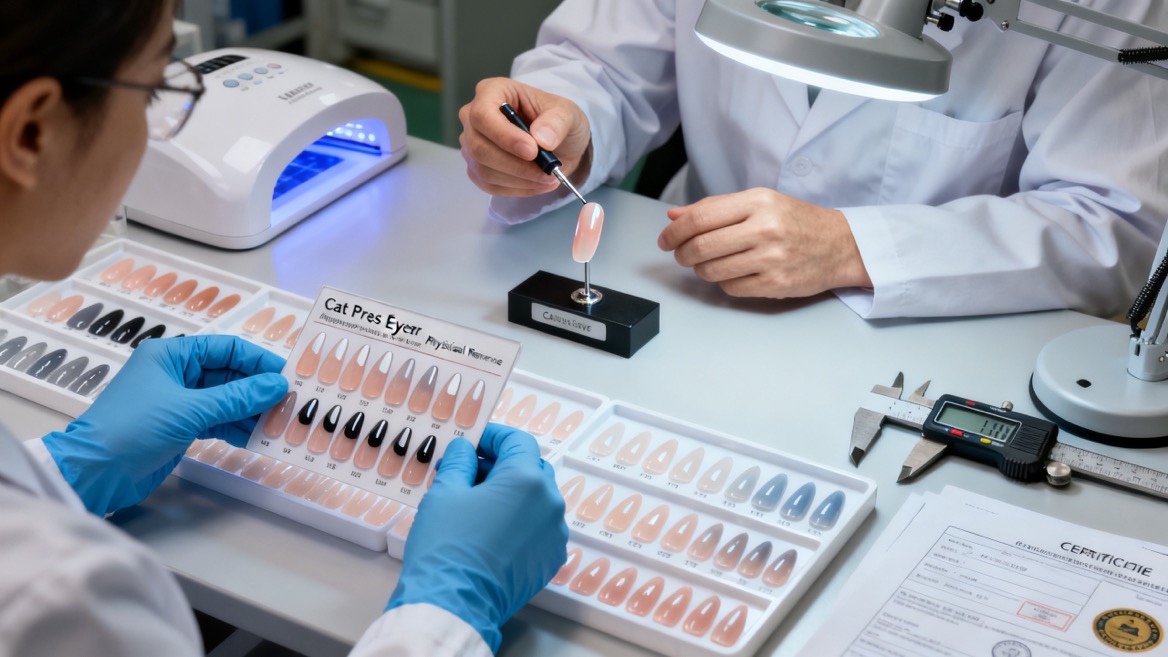
Published figures are not independently verified. "Not disclosed" means that a dependable, comparable figure was not available in the reviewed material.
Capacity units also differ. Individual nail pieces, complete retail sets, production lines, and floor area should never be treated as interchangeable.
| Manufacturer | Published capacity or scale | Published MOQ | Certification or documentation position |
|---|---|---|---|
| Dongguan YoungMei Technology Co., Ltd. | Claims 26 automated lines and up to 1 million individual pieces daily; other timeline figures use different units | Not disclosed in reviewed company page | Lists ISO-related claims and several safety/documentation categories; current scope and validity require verification |
| Ennio | Reports more than 10,000 m² and over 300 employees | Cat eye page lists 3,000 for customized designs; packaging MOQ of 5,000 sets | Claims ISO 9001:2015; product-specific applicability requires review |
| Gisele | Reports 10,000 m², two production bases, and 150 technicians | Obtain a design-specific quotation | General certification claims; inspect current certificates and test reports |
| Senboma | Reports 45+ lines and 40,000 m²; capacity figures vary across pages | General MOQ of 3,000 sets/style; cat eye page lists additional custom-design and order minimums | Publishes compliance and audit claims; independently verify their meaning and scope |
| Xianxing Beauty | Reports 20,000 m²; one page states 300,000 individual pieces/day | Small-scale customization advertised; exact MOQ not disclosed | Request current, product-linked documentation |
| HM Technology | Reports 5,000 m² and 20,000 sets/day | Low MOQ advertised; exact figure not disclosed | Claims ISO 9001 and BSCI; verify certificate and audit records separately |
| OEMnail | Reports a 1,000 m² facility; output not disclosed | Advertises custom orders from 50 sets, subject to project details | Certificate details not established in reviewed text |
| Nailystal | Handmade and UV-printed production; comparable output not disclosed | Discusses serving orders from 20 handmade sets; custom minimums require confirmation | Request material, coating, and product-specific documentation |
| HUIZI | Reports a 15,000 m² production and purification facility | Obtain a quotation for the exact product format | Confirm documentation for rigid press-ons versus gel strips |
| Dalian Nailway Arts | Reports a factory exceeding 3,000 m²; output not disclosed | Low MOQ advertised; exact figure not disclosed | Lists MSDS, CPSR, and other reports; applicability requires review |
Sources: supplier company pages and product listings. Senboma's inconsistent capacity figures and YoungMei's differing piece/set figures are deliberately not converted into a single comparable output estimate.
YoungMei is a relevant starting point for buyers seeking coordinated product development, private-label packaging, and a wider nail-product sourcing program.
Its company history traces mold-related operations to 2005, entry into bulk press-on nail production to 2008, and establishment of an internal research and development team to 2012. These milestones describe the business's published operating history; buyers should confirm the incorporation date of the precise legal entity used in contracts.
YoungMei reports a 30,000 m² production plant, 26 automated production lines, and more than 200 skilled manicurists. Its published customization scope includes materials, shapes, molds, designs, and packaging. The company identifies Europe, the United States, and Russia among its served markets and states that products reach more than 90 countries and regions.
For small and medium-sized brands, its useful positioning is flexible planning and coordinated OEM/ODM support rather than a promise of the lowest price. Its page advertises production planning of 3–30 days, online support, and urgent-issue response arrangements. Those are service claims to test during sampling and commercial discussions.
Procurement checkpoint: Request a cat eye-specific development plan covering materials, magnetic finish, packaging, MOQ, and bulk lead time. The same page also advertises certain orders shipping within 48 hours; do not assume that timing applies to newly developed molds, packaging, or handmade collections.
Ennio is a candidate for buyers seeking established OEM/ODM support and a published cat eye product program.
Its website places its origins in 2000 and reports a Foshan manufacturing base exceeding 10,000 m², with more than 300 employees. It identifies exports to over 30 countries, including the United States, Japan, South Korea, European markets, Russia, and South Africa.
Its cat eye product page provides useful initial commercial information: 3,000 for customized designs and a separate packaging minimum of 5,000 sets. The unit basis and minimums should be confirmed in the quotation.
OEM/ODM scope includes translating brand layouts into finished collections, with attention to shaping, color, and surface finishing. Ennio also claims ISO 9001:2015 certification.
Procurement checkpoint: Confirm whether the packaging minimum creates leftover packaging inventory and how that inventory will be stored, owned, and used on reorders.
Gisele is worth evaluating for PMMA-based press-ons, shape development, and retail-ready private-label programs.
Its current company page reports 17 years of industry experience, a 10,000 m² workshop area, two production bases, and 150 technicians. A separate industry supplier overview states a 2009 founding year; verify that date against the business license before including it in contractual supplier records.
Gisele identifies North America, Europe, Australia, Latin America, and the Middle East as markets, with the United States as its primary wholesale market. Its customization scope covers materials, molding, production, packaging, and logistics. It also publishes a specific cat eye press-on product collection.
Procurement checkpoint: Compare the flexibility, curvature, and cuticle-edge profile of the exact material offered. A PMMA description alone does not establish that a product will fit your target customer population.
Senboma is a candidate for larger assortments and wholesale programs that can accommodate higher order commitments.
Its website reports a Zhongshan manufacturing operation with 45+ automated lines and a 40,000 m² facility. Its company information identifies the United States, United Kingdom, Canada, Europe, Australia, and Korea within its sales network. The reviewed material describes more than 15 years of experience but does not establish a dependable legal founding year.
Its cat eye product page lists 3,000 sets for existing patterns, 5,000 for customized designs, a 10,000-set order minimum, and production timing of 20–45 days. These are page-specific terms, not universal commitments.
Procurement checkpoint: Published output figures differ materially across Senboma's pages. Ask for available monthly output for your approved cat eye construction, including the finishing and packing stages, rather than relying on headline factory capacity.
Xianxing Beauty is a sourcing candidate for coordinated molding, decoration, packaging, and customized press-on collections.
Its published information describes a Guangzhou facility exceeding 20,000 m², with molding, injection molding, printing, processing, and packaging operations. A supplier article states that it was founded in 2012 and produces 300,000 individual pieces daily.
There is a history discrepancy worth resolving: another company-branded website describes nail-industry operations beginning in 2005. Buyers should distinguish the business's operating history, brand history, and legal incorporation date.
Its public offering includes cat eye styles and customization of materials, sizes, designs, shapes, and packaging. Global wholesale and brand customers are described, but a reliable geographic sales breakdown was not established in the reviewed material.
Procurement checkpoint: Confirm the legal relationship between the websites, quotation issuer, factory operator, and bank beneficiary.
HM Technology offers a documented press-on nail range alongside nail tools and related products.
The company states that it was established in Dongguan in 2013. It reports a 5,000 m² facility, more than 40 automated equipment units, and daily production capacity of 20,000 sets. Its catalog specifically includes gel cat eye press-on nails.
Its OEM/ODM offering covers custom press-ons and nail supplies. The website advertises small, mixed-model orders and shorter delivery for available products. Although it describes serving more than 1,000 branded clients, the reviewed page does not provide a dependable country-by-country market breakdown.
Procurement checkpoint: Separate stock-product delivery promises from bespoke production schedules. Also verify ISO certification independently and request the actual social-audit report behind the BSCI claim.
OEMnail is positioned toward startups, online sellers, salons, and growing private-label brands.
Its website states that it was established in 2020 and operates a 1,000 m² production facility. It identifies the United States, Europe, and Southeast Asia as served markets and lists cat eye press-ons among its collections.
The company advertises custom orders from 50 sets and samples within 7–10 working days. Its service scope includes designs, shapes, packaging, logo branding, barcodes, accessories, and complete retail kits. Actual minimums depend on customization details.
Procurement checkpoint: Ask what the 50-set entry point includes. Existing blanks and standard packaging are commercially different from exclusive tooling, custom magnetic colors, or bespoke printed boxes.
Nailystal is a candidate for handmade gel collections, boutique assortments, and lower-volume design testing.
Its company information places its origins in Donghai County, Jiangsu, and distinguishes handmade gel products from UV-printed products. It specifically mentions cat eye among the styles developed through its workshops. An exact founding year is not disclosed in the reviewed material.
Its stated customers include salons, boutiques, online resellers, distributors, influencer brands, and startups. It describes worldwide service, but no verified geographic market split is provided. OEM/ODM services include handmade and printed collections, with low-volume wholesale options.
Procurement checkpoint: Require the production method to be named on the purchase order. Handmade magnetic gel and printed shimmer should not be substituted merely because they look similar in a catalog photograph.
HUIZI is relevant to buyers combining press-on extensions with nail wraps, gel strips, and other decorative nail formats.
Its website reports more than 16 years of manufacturing experience and a 15,000 m² production and purification facility. The reviewed information does not establish an exact legal founding year. It identifies the United States, Europe, and Asia among its markets.
HUIZI publishes a cat eye collection and offers wholesale, custom design, and private-label services. However, its range includes cat eye gel strips as well as broader nail-extension products.
Procurement checkpoint: Verify the product format before comparing prices. A flexible nail strip is not a rigid, preformed press-on nail, even when both are marketed with a cat eye appearance.
Nailway is a broader artificial-nail sourcing candidate rather than a fully verified cat eye specialist in this review.
Its website describes an owned factory exceeding 3,000 m², 15 years of production and export experience, and internal development, production, design, purchasing, and sales teams. It does not provide an exact founding year.
Nailway offers OEM/ODM artificial nails, press-ons, accessories, and one-stop purchasing. It discusses European and United States documentation requirements and participation in international beauty exhibitions, although a quantified market distribution is not provided.
Procurement checkpoint: Before advancing this supplier for a cat eye project, request current magnetic-finish samples and confirm whether that finishing process is performed internally or subcontracted. Its broader press-on manufacturing credentials do not independently prove cat eye production capability.
A purchasing specification should separate:
1. Nail-tip substrate and material grade.
2. Base color or printed layer.
3. Magnetic or decorative effect layer.
4. Protective topcoat.
5. Adhesive tabs or liquid glue.
6. Packaging and instructions.
Suppliers in this shortlist advertise different constructions, including ABS, PMMA, handmade gel, and UV-printed products. These descriptions are not interchangeable, and a material name alone is not proof of environmental performance or finished-product safety.
Request the exact resin or substrate specification, coating information, permitted material changes, and test-report linkage to the finished SKU.
Magnetic cat eye gel involves positioning magnetic particles before curing. This means the finished appearance depends on application and magnet manipulation, not simply the color name.
For a purchasing specification, define:
- Base shade and acceptable color variation.
- Highlight placement and visual direction.
- Narrow-line, diffuse shimmer, or other intended effect.
- Appearance under agreed lighting.
- Consistency across nail sizes.
- Surface smoothness and edge coverage.
Use physical samples and short videos under moving light. A static image is a weak acceptance standard for an effect whose appearance changes with viewing conditions.
The European Commission states that CE marking applies only to products covered by legislation requiring it; products outside that scope must not carry the mark. RoHS primarily concerns electrical and electronic equipment. Neither should automatically be demanded as a general certification for ordinary, non-electronic press-on nail tips.
A nail kit containing an electrical accessory may introduce separate requirements. Buyers should assess each component and destination market rather than accept a collection of compliance logos as proof.
Similarly, an SDS provides chemical safety information; it does not independently demonstrate that every finished-product requirement has been met. Where suppliers list ISO, social audits, safety reports, or cosmetic documentation together, ask what each document actually covers.
Before paying a development fee or deposit, obtain:
- The registered company name and business license.
- Factory and office addresses.
- The quotation issuer and bank beneficiary.
- A live walkthrough of relevant production stages.
- Disclosure of outsourced finishing or packaging.
- Current certificates and product test reports.
Resolve differences between English trading names and registered legal names in writing.
Use three approval stages:
1. Appearance sample: evaluate shape, fit, color, and effect.
2. Pre-production sample: confirm actual materials, production method, accessories, and packaging.
3. Bulk inspection sample: compare randomly selected goods against the retained approved set.
Keep matching reference samples with the buyer and supplier. Record specifications alongside them, because a sample alone cannot explain an invisible resin or coating change.

Agree on defect categories before production. These may include incorrect sizes, visible effect mismatch, rough edges, surface defects, missing accessories, incorrect labels, and damaged packaging.
Set a written rule that material, coating, adhesive, subcontractor, and packaging changes require approval. Ask the supplier to explain how it will identify affected batches and resolve repeat defects.
A complete quotation should identify:
- Product and packaging quantities.
- Tooling and development fees.
- Inspection costs.
- Shipping term and named destination.
- Import-clearance responsibilities.
- Carton dimensions and weights.
- Separate handling requirements for included chemicals or accessories.
Nailway, for example, distinguishes stock delivery from custom production of approximately 30–45 days. YoungMei and Senboma also publish product-dependent schedules. Treat lead time as a project-specific commitment starting from agreed approval conditions, not from the initial inquiry date.
One practical risk deserves special attention: approving a visually attractive sample without documenting how bulk production will reproduce it.
This is particularly important when a supplier offers both handmade gel and machine-printed collections, as Nailystal explicitly does. The two methods may serve different price points and production volumes.
A purchasing safeguard is to ask:
- Was the sample made by the proposed bulk-production method?
- Will the same substrate, coating, and finishing team be used?
- Which steps are outsourced?
- How will consistency be checked across all sizes?
- What process changes require renewed approval?
Do not describe this as a proven industry-wide practice of deception. It is a procurement control against a plausible mismatch between sample development and commercial production.
A second trap is misleading capacity comparison. YoungMei publishes individual-piece figures, HM publishes set output, and Senboma lists varying capacity numbers. Those figures cannot support a reliable ranking without a common definition and verification.
The suppliers in this guide represent different sourcing models: integrated development operations, larger automated manufacturers, flexible private-label providers, and handmade specialists. Their suitability depends on the buyer's product construction, order volume, documentation needs, and replenishment plan.
YoungMei is a relevant first candidate for brands seeking coordinated customization across nail materials, shapes, molds, designs, and packaging. Its published flexible production planning and broader product-development offering warrant a structured sampling discussion—not an assumption that every project will have the same MOQ or delivery schedule.
To start a project with Dongguan YoungMei Technology Co., Ltd., submit your target market, design references, preferred shapes, estimated quantity per design, packaging requirements, and required launch date. Request a written proposal covering sampling, material specifications, cat eye finishing, quality checks, documentation, and bulk-production timing.
Request the full certificate, including number, registered company, site address, standard, scope, issuer, and validity dates.
Search the company or certificate number in IAF CertSearch. Review its status, scope, certification body, and accreditation details. If the record is absent or inconsistent, contact the issuing certification body directly rather than treating the supplier's PDF as conclusive evidence.
Also confirm that the certified scope covers relevant manufacturing activities—not only sales or an unrelated facility.
Put the material requirement into the specification and purchase order. Request material identification, batch traceability, and approval before substitutions.
For higher-risk or larger projects, discuss independent material-identification testing with a qualified laboratory. Ask it to explain what the proposed method can and cannot establish; do not assume one test can prove every claim about recycled content, coatings, or long-term performance.
Supplier descriptions show why this matters: different products are offered in ABS, PMMA, and other constructions.
Ask for separate minimums for the nails, each design, each shape, printed packaging, accessories, and the overall order.
OEMnail advertises entry-level custom orders from 50 sets, while Ennio publishes a higher packaging minimum than its customized-design minimum. Senboma's cat eye listing includes an overall order minimum. These examples show why one advertised MOQ does not describe the full purchasing commitment.
Request finished, packed sets per week for your exact construction and pack configuration.
Confirm whether the figure represents molding output, decorated nails, or shipment-ready goods. Ask how many orders already occupy the relevant production stage.
Do not automatically divide total piece output by pack size and treat the result as available capacity. The supplier figures in this guide use materially different bases.
Build a component-by-component document checklist with your importer or compliance adviser.
Ask which requirement applies to the nail tips, coatings, glue, packaging, and any electrical accessory. Verify the exact tested product and report issuer.
CE marking is not permitted simply because a buyer prefers it, and RoHS is not a blanket requirement for ordinary non-electronic nails. Request documentation that matches the actual product and market rather than the longest list of logos.
- YoungMei company background, production claims, development scope, and service information: [youngmeinails]
- Ennio company background and cat eye product terms: [ennionails]
- Gisele company profile and cat eye product collection: [giselenails]
- Senboma factory information and cat eye order terms: [senboma]
- Xianxing manufacturing information and published history: [xianxingbeauty]
- HM Technology company profile and cat eye product range: [hmtechnails]
- OEMnail company profile, private-label services, and sampling terms: [oemnail]
- Nailystal handmade and printed manufacturing information: [nailystal]
- HUIZI manufacturing information and cat eye collection: [huizi]
- Dalian Nailway factory profile and OEM/ODM services: [nailway]
- Grand View Research, press-on nails market report published in July 2026; market figures concern the broader press-on category: [grandviewresearch]
- Chinese government publication reporting General Administration of Customs' full-year 2025 trade data; figures concern total merchandise trade: [english.www.gov]
- European Commission guidance on when CE marking is required or prohibited: [europa]
- European Commission explanation of the RoHS Directive's electrical and electronic equipment scope: [environment.ec.europa]
- IAF CertSearch certificate-verification database and verification procedure: [iafcertsearch]