
- All
- Product Name
- Product Keyword
- Product Model
- Product Summary
- Product Description
- Multi Field Search
English
Views: 298 Author: Young Mei Publish Time: 09-28-2026 Origin: Site


Content Menu
● Why China—and how we selected
● Ten manufacturers to shortlist
>> 1. Dongguan YoungMei Technology Co., Ltd.
>> 2. Zhongshan Senboma Artware Co., Ltd.
>> 3. Guangzhou Xianxing Beauty
>> 5. Gisele (Tianjin) Crafts Co., Ltd.
>> 6. Dalian Nailway Arts Co., Ltd.
>> 8. MissGel
>> 9. OEMnail
>> 10. XXNailArt chrome range: a product-level option, not another factory
● Technical checks for chrome sets
>> The quiet failure buyers miss
>> A practical qualification sequence
● FAQs
>> 1. How can I tell whether a factory's ISO 9001 certificate is current?
>> 2. Does a "CE-certified" or "RoHS-certified" chrome nail meet EU requirements?
>> 3. Why does a factory quote different MOQs for nails and boxes?
>> 4. How do I detect a material or finish change after approving a sample?
>> 5. What should I request when the retail set includes liquid glue?
A chrome press-on nail can look flawless in a sales photograph and still disappoint at retail. The mirror finish may scratch inside its tray, the coating may lift at the free edge, or the production batch may use a different tip from the one the buyer approved. For procurement teams, choosing a manufacturer means evaluating the entire process behind the finished set—not simply comparing catalog images and unit prices.
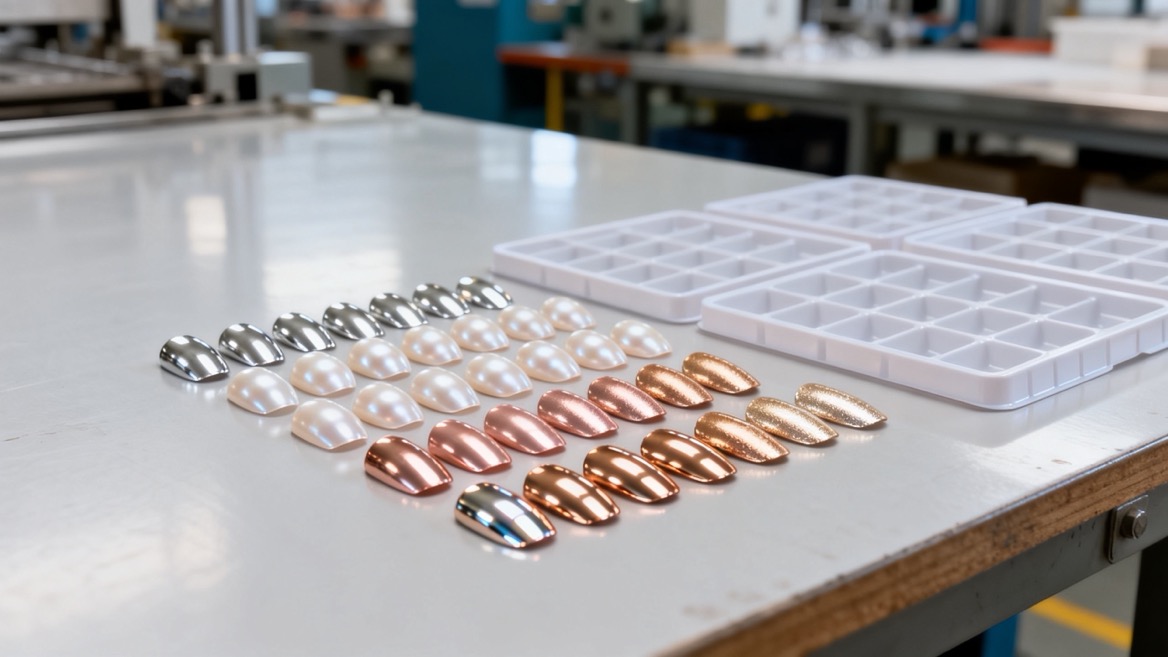
China offers buyers a choice between scaled, export-oriented nail-product manufacturing and more labor-intensive decorative production. Guangdong suppliers can coordinate molded tips, finishes, packaging, and accessories, while Donghai County in Jiangsu has developed a distinct handmade press-on nail cluster. A Donghai County government article, citing the local industry association, reported 150 million pairs of handmade press-on nails produced in 2024, including 80 million pairs sold overseas through cross-border e-commerce. Those are *cluster-level handmade-nail figures*, not chrome-specific output or a measure of any factory on this list.
A September 2026 artificial-nails market report from Fortune Business Insights valued the global artificial-nails market at USD 1.59 billion in 2025 and projected USD 1.68 billion for 2026. Its scope includes products beyond chrome press-ons, so neither figure should be presented as the size of the chrome press-on niche. Likewise, Reuters reported that a separate customs total for artificial nails is unavailable because they are categorized among plastic products. A precise national "chrome press-on nail export value" would therefore be difficult to substantiate from the sources reviewed here.
We assessed the manufacturers against five purchasing questions:
| Selection dimension | What a buyer should request |
|---|---|
| Manufacturing identity | Legal business name, operating address, production-site evidence, and a clear account of outsourced steps. |
| Chrome-development capability | Samples demonstrating the requested reflectivity, color, shape, curvature, and top-coat performance. |
| Quality control | Incoming-material checks, approved reference samples, in-process controls, lot identification, and final inspection records. |
| Delivery reliability | Documented sample and bulk timelines, realistic peak-season capacity, and a repeat-order plan. |
| Commercial and market fit | MOQ by design and packaging component, OEM/ODM scope, export experience, and documents relevant to the destination market. |
A useful technical distinction comes before supplier selection: "chrome" describes an appearance, not a single material or production method. A factory might create it with pigment or powder over a coated tip, a film or transfer process, or another surface treatment. Buyers should specify the tip substrate, decorative process, protective top coat, and approved visual standard separately. "Soft gel," "acrylic," and "chrome" should not be treated as interchangeable material specifications.
The table uses the units each company publishes. Pieces, sets, and monthly output are not directly comparable. "Not disclosed" means no reliable public figure was identified for this comparison; it does not mean the factory lacks that capacity or documentation.
| Manufacturer | Relevant focus | Public capacity claim | Public MOQ claim | Public documentation or audit claim |
|---|---|---|---|---|
| Dongguan YoungMei Technology Co., Ltd. | Chrome styles, press-ons, wraps, and OEM/ODM kits | 26 lines; 1 million+ pieces/day | Not disclosed | ISO and BSCI referenced; request current, site-specific proof. |
| Zhongshan Senboma Artware Co., Ltd. | Scaled private-label press-ons | 45+ lines; site also states 4 million+ units/month and 5 million+ sets/month in different sections | Generally 3,000 sets/style on its main site; confirm for chrome | ISO, GMP, BSCI and test-report claims; verify scope. |
| Guangzhou Xianxing Beauty | Frequent designs and chrome OEM/ODM | 300,000 pieces/day | Chrome-specific MOQ not consistently stated | REACH-related and test-document claims; request SKU reports. |
| Ennio Nails | Glaze/chrome development for retail collections | Production base over 10,000 m²; output not stated | "Low MOQ"; figure not disclosed | ISO 9001:2015 facility claim; product claims vary by item. |
| Gisele (Tianjin) Crafts Co., Ltd. | PMMA tips and catalog chrome designs | 1 million pieces/month | 100 sets/design in stock; 1,000 custom; 2,000 custom boxes | Request current product-specific reports. |
| Dalian Nailway Arts Co., Ltd. | Press-ons and customized retail ranges | Factory over 3,000 m²; output not stated | Not disclosed | Company references MSDS and other reports; inspect the underlying files. |
| Glint Nails | Soft-gel-style ODM and custom packaging | Not disclosed | Generally 1,000 per design and shape, subject to negotiation | Request current site and product documents. |
| MissGel | Chrome-capable press-ons alongside gel products | Claims 10 press-on production lines and 1 million units/month | Not disclosed | Request separate tip, coating, and any liquid-product records. |
| OEMnail | Small-brand private label and chrome finishes | 1,000 m² facility; output not stated | Site promotes orders from 50 custom sets, while saying MOQ varies | Specific certificates not established here. |
| Guangzhou Xianxing Beauty's XXNailArt range | Chrome designs with published product-level terms | Use Xianxing's stated factory capacity above; not a second independent factory | One chrome listing: 50 stock or 1,000 custom sets/design | Verify which legal entity issues invoices and reports. |
Established experience: The company reports more than 15 years in press-on nail manufacturing; its history page traces earlier nail-mold work to 2005 and bulk press-on activity to 2008. Markets: Its website says it serves distributors, beauty brands, and chain retailers in more than 90 countries, including markets in North America and Europe. OEM/ODM scope: Tip shape and size, materials, finishes, design, packaging, and related nail products.
YoungMei deserves consideration from small and midsize brands that need a manufacturer willing to work through several product decisions rather than quote an existing design unchanged. Its site displays chrome press-on products and describes in-house production of press-ons and wraps, with equipment, care items, and other categories also available through partner factories. That distinction matters: a one-stop purchase order does not necessarily mean every component is made at one address.
The company publishes a 30,000 m² manufacturing-base figure, 26 automated lines, 200+ skilled personnel, and output of more than 1 million pieces daily. Its homepage advertises a 48-hour sample turnaround; its about page also mentions 48 hours for custom orders to be finished and shipped, which is a materially different claim. A buyer should ask which styles qualify, whether the clock starts after artwork approval, and whether it refers to a sample, a stocked item, or a production order.
Its practical advantage for a developing brand is the combination of design communication, product-and-packaging coordination, and a factory-led press-on program. The cost case should still be tested through an itemized quote, not assumed from a "factory-direct" description. Request a chrome-specific pre-production sample, the material and coating specifications, the MOQ for each packaging component, and written responsibility for any partner-sourced glue or accessories.
Established experience: More than 15 years, according to Senboma; a consistent legal founding year was not established in the reviewed material. Markets: The company names North America, Europe, the Middle East, Japan, and South Korea. OEM/ODM scope: Custom shapes, designs, private-label packaging, accessories, and large branded collections.
Senboma is most relevant to buyers planning substantial repeat volumes or multi-design retail programs. Its website reports 45+ automated production lines, a 40,000 m² facility, and a general MOQ of 3,000 sets per style. It also gives different monthly capacity descriptions—more than 4 million units in one section and more than 5 million sets in another. Do not normalize those figures into a single production estimate without the factory defining "unit," "piece," and "set."
For chrome programs, ask how the factory separates coated-tip throughput from decorated-set packing capacity. A high molding output will not, by itself, establish capacity for a specific mirror finish, protective coating, or final retail kit. Senboma publicly references ISO, GMP, BSCI, and product-testing documents; obtain current copies showing the certified entity, address, scope, and relevant product or process.
Founded: Xianxing states 2012. Markets: Its public materials address international wholesale and customized export buyers; confirm market-specific customer references directly. OEM/ODM scope: Materials, sizes, shapes, design, surface finishes, and packaging, including published chrome styles.
Xianxing may fit brands with frequent launches or a broad assortment of shapes and finishes. It reports a 20,000 m² factory, output of about 300,000 pieces daily, and more than 100 new products per month. Its chrome product pages and listings make it more directly relevant to this category than a general beauty-accessory factory with no visible mirror-finish range.
The sourcing question is whether its quick development claims hold for *your* chrome effect after color matching, coating approval, packaging, and testing. Xianxing publishes short sampling and production timelines for some products, but buyers should obtain a milestone schedule for the exact SKU. Its website references REACH, RoHS, and MSDS documentation; these terms are not substitutes for a report identifying the tested material, components, date, and destination-market requirement.
Founded: Ennio states that it began in 2000 as a Sino-Korean joint venture. Markets: Its website names the United States, Japan, South Korea, Europe, Russia, and South Africa among its export destinations. OEM/ODM scope: Brand-supplied artwork, original design development, sampling, shape and color development, finishing, and private-label packaging.
Ennio's published glaze-and-chrome range makes it a sensible contact for buyers prioritizing refined pearlescent or metallic presentation rather than only a basic silver mirror effect. The company reports a production base exceeding 10,000 m² and more than 300 trained employees. It does not publish a comparable daily chrome-set capacity or a numerical MOQ on the reviewed pages, so request both in a written quotation.
Ennio states that its facility follows ISO 9001:2015-certified standards and references other certifications for selected products. That qualification is essential: paperwork for an electrical nail tool, for example, would not establish the status of a non-electrical chrome press-on set. Buyers should review the documents item by item.
Founded: 2009, according to its website. Markets: Gisele describes international brand, supermarket, and e-commerce customers rather than publishing a definitive country-by-country sales split. OEM/ODM scope: PMMA or ABS tip options, designs, custom packaging, nail glue, and accessory kits.
Gisele offers one of the clearer published MOQ schedules in this shortlist: 100 sets per in-stock design, 1,000 sets for a new custom style, and 2,000 sets for custom printed boxes. Its website reports 1 million pieces per month and displays chrome press-on styles, including a long-square design. Those terms could suit a buyer validating demand before moving to a larger branded run—but the low stock MOQ should not be mistaken for the MOQ of a new chrome formulation or custom box.
Ask Gisele to identify the substrate used in the quoted SKU rather than relying on the broad terms "acrylic" or "salon-grade." Confirm whether color, curvature, and coating performance remain the same if the order moves from stocked designs to a newly developed style.
Established experience: Nailway reports 15 years of production and export experience; the reviewed page does not give a precise incorporation year. Markets: It describes serving global brand chains, supermarkets, nail-training businesses, and online sellers, with participation in international beauty shows. OEM/ODM scope: Customized press-ons, children's nails, toenails, salon nails, and related products.
Nailway reports an owned factory exceeding 3,000 m² and separate design, R&D, production, purchasing, and sales functions. It is an alternative for importers who value a supplier with a broad retail-nail range and want to evaluate a production location outside the Guangdong cluster. Its public information does not establish chrome-specific capacity or MOQ, so those should be early qualification questions rather than assumptions made after sampling.
The company lists various documents, including MSDS and CPSR. Request each complete underlying document and check what product it covers. A safety data sheet for a chemical mixture, a cosmetic safety report for an applicable formulation, and a quality-management certificate answer different questions; none automatically certifies a finished nail-and-glue kit.
Established experience: Glint states 13+ years of press-on nail manufacturing experience, but the reviewed material does not establish a legal founding year. Markets: Its website emphasizes US and European brand work. OEM/ODM scope: Custom shapes and artwork, packaging, press-ons, adhesives, and related nail-care products.
Glint may appeal to brands seeking close collaboration on a polished, soft-gel-style range. It publishes a general MOQ of 1,000 per style—defined on its site as one design and one shape—and a sample timeframe of seven to ten days. It also says smaller quantities may be negotiated. For a chrome collection, ask whether each colorway is another "style," and whether the MOQ changes when the coating or tray format changes.
Glint's website makes sweeping statements about its share of branded production in the US and Europe. These are unverified marketing claims, not market-share evidence for a supplier comparison. Evaluate its actual production site, samples, repeat-order controls, and available capacity instead.
Founded: MissGel states 2011. Markets: The reviewed company materials do not establish a verified market breakdown. OEM/ODM scope: Private-label nail products, press-on tips, chrome-powder options, and a wider range of gel and nail-art products.
MissGel is a different type of prospect: a wider nail-products supplier that also publishes press-on manufacturing capabilities. Its custom press-on page claims 10 automated lines, monthly capacity of 1 million units, PMMA material options, and decorative processes that include chrome powder. That makes it worth screening when a brand intends to launch coordinated press-ons and other manicure products.
For procurement purposes, separate the quotation into finished press-on sets, loose tips, coatings, and any liquid products. Their production lines, testing requirements, and MOQs may differ considerably. Before describing the range as one integrated factory program, verify which steps are performed in-house and which are supplied by partners.
Founded: OEMnail states 2020. Markets: It says it serves customers in the US, Europe, and Southeast Asia. OEM/ODM scope: Chrome and other finishes, custom shapes, artwork, retail packaging, and complete kits.
OEMnail positions itself toward startups, smaller brands, and private-label launches. It reports a 1,000 m² production facility, sampling in seven to ten working days, and the possibility of custom orders from 50 sets. Elsewhere on the same site it says MOQ depends on design and packaging. Treat the 50-set figure as a starting inquiry point, not a guaranteed MOQ for a new chrome finish, proprietary shape, and printed retail box together.
A sensible pilot would use a limited number of designs while testing color consistency across multiple production samples. Ask for a separate quote for stock tips with custom branding versus a genuinely custom chrome process; they are not the same project.
Business identity: XXNailArt product pages identify Xianxing Beauty in their supplier information; this entry should not be counted as an independently verified manufacturer. Markets: Confirm directly with the invoicing company. OEM/ODM scope: Published chrome nail designs with stock and custom-order terms.
This range remains useful to buyers because a black French chrome listing states 50 sets per stock design and 1,000 sets per custom design. A specific SKU is often a better starting point for a test order than a generic promise of a "flexible MOQ." Still, confirm the SKU's current availability, set contents, finish, legal seller, and whether the Xianxing factory shown elsewhere will make the exact product being quoted.
If your approved-vendor list requires ten separate manufacturing entities, leave this entry out and continue sourcing rather than relabeling a product range as a new company.
Chrome finishes amplify small production differences. Under a direct light, buyers may see streaks, uneven reflectivity, edge wear, or color shifts that are less obvious on opaque printed nails. An approved photograph is therefore insufficient: compare physical samples under the same lighting, at the same viewing angle, and against an agreed reference set.
Specify and test the following before approving bulk production:
- Tip construction: Record the stated substrate, resin or tip grade, thickness range, curvature, size chart, and molded-edge condition. Ask whether a material change triggers renewed approval.
- Finish construction: Identify whether the effect uses a powder, pigment, transfer layer, film, or another process, and document the protective top coat. Ask which steps are done at the named factory.
- Appearance standard: Approve physical limits for mirror uniformity, visible streaking, pinholes, edge coverage, color variation, and coating trapped around the cuticle edge.
- Performance standard: Agree on appropriate abrasion, handling, adhesion, and storage-conditioning tests before production. Set the method and pass criteria with the supplier rather than accepting "scratch-resistant" without a definition.
- Kit compatibility: Check the tip with the actual adhesive tab or glue, insert, tray, alcohol prep pad, and instruction leaflet to be sold. A finish that performs on a loose sample can still mark or rub against its final packaging.
Be precise with compliance language. The European Commission says CE marking is mandatory only where applicable EU legislation provides for it and must not be put on products outside that scope. The EU RoHS Directive addresses electrical and electronic equipment; a non-electrical press-on nail does not become a RoHS-regulated electrical product because a supplier has tested substances against a RoHS list. REACH concerns chemicals and restrictions, but a generic "REACH certificate" is not, by itself, a universal product approval. Determine requirements for the actual finished set and its destination market.
A kit containing nail glue needs particular attention. European Commission guidance distinguishes glues used solely to attach false nails from substances applied to form an artificial nail; the classification of an individual adhesive depends on its characteristics. Ask for the glue's safety data sheet, composition information where appropriate, label, batch code, shelf life, and transport classification, then have the importer or a qualified adviser review the destination-market requirements. For EU consumer sales, also assess applicable general product-safety obligations for the finished kit.
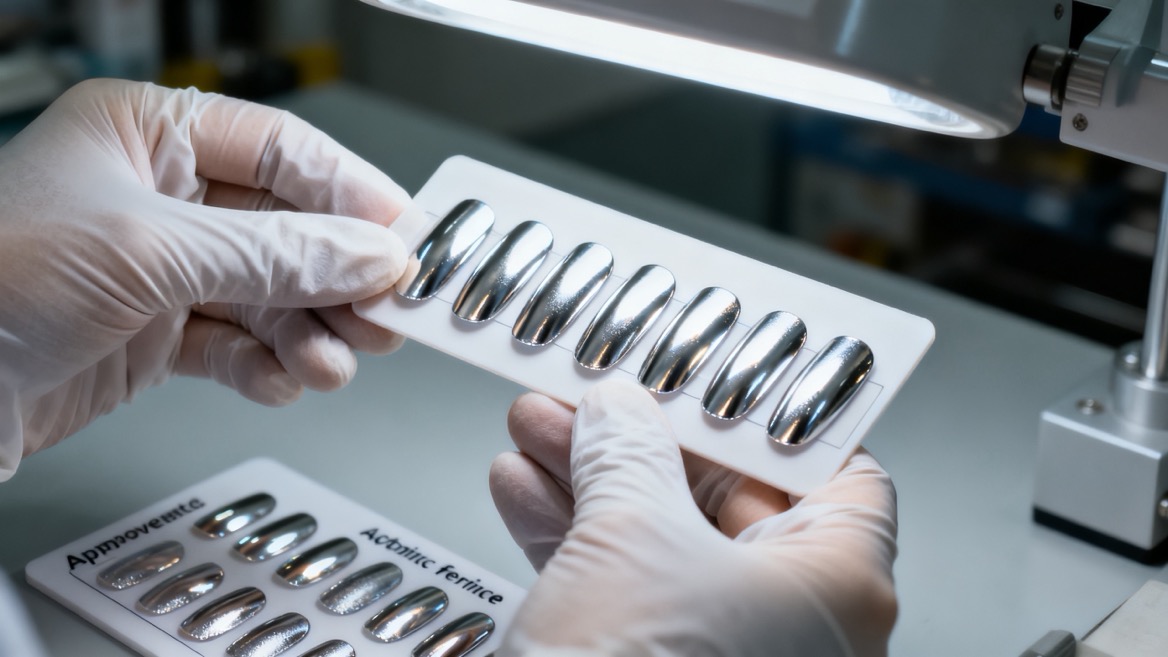
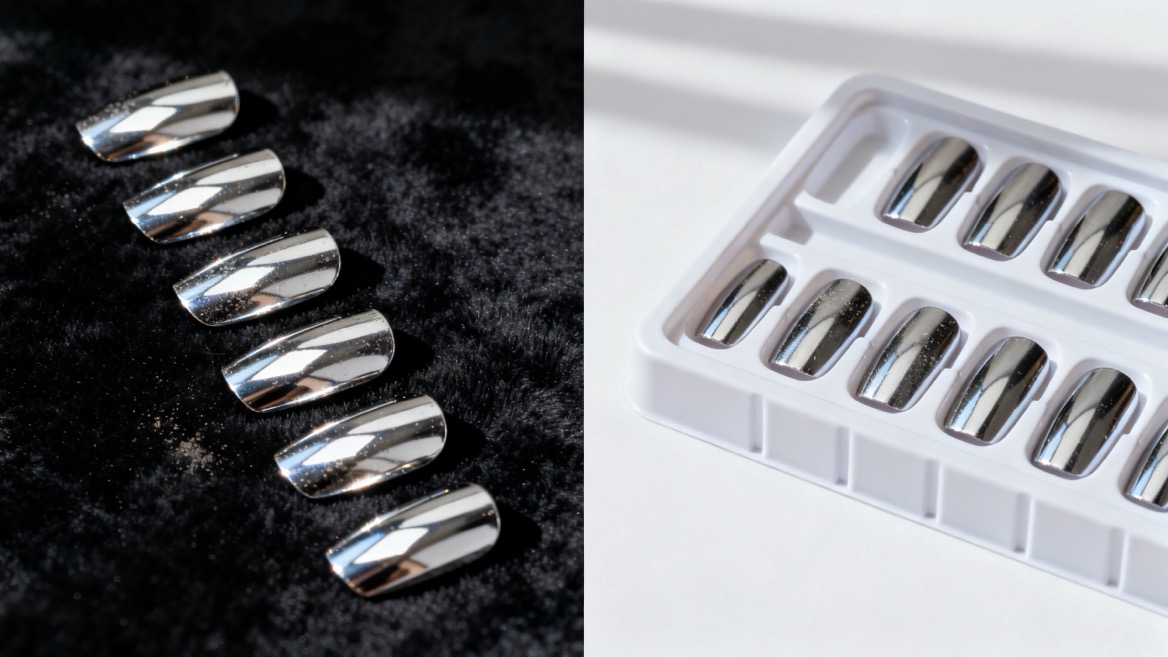
Test chrome after it has sat in its final tray—not only as a loose nail. This is a practical procurement recommendation, not a claim that every supplier has this defect. In a tightly packed assortment, raised decorations, a printed insert, or adjacent nails may contact the reflective face during storage and transit. A sample inspected immediately after finishing can pass, while the retail-packed version reaches a customer with fine rub marks.
Build a simple comparison into the approval process: retain one loose reference set and one fully packed set from the same pre-production batch. After agreed storage and transport simulations, inspect both under consistent lighting. If only the packed set deteriorates, changing resin may not solve the problem; the tray geometry, insert, or protective packaging may be the real cause.
1. Issue one specification to every supplier. State the target country, set count and size assortment, shape, tip material, chrome color reference, finish process, accessories, packaging, forecast, and required shipment date. Require quotes to distinguish pieces from finished sets.
2. Verify the actual production party. Obtain the legal name, business license, factory address, and a live or independently arranged site review. Ask which steps—molding, coating, decoration, assembly, and printing—are outsourced.
3. Approve samples in stages. Review a visual concept, a physical design sample, a complete retail-pack sample, and a pre-production sample made by the proposed production process. Sign and retain a reference set for each SKU.
4. Put controls in the purchase order. Identify permitted materials and substitutions, inspection criteria, lot marking, defect remedies, component MOQs, intellectual-property terms, and the agreed response if bulk goods differ from the reference sample.
5. Plan freight before choosing glue. Ask the forwarder to review the complete kit and adhesive documentation. Confirm classification, labeling, destination-market importer responsibilities, and the agreed Incoterm before the cartons are packed.
The most useful shortlist depends on the buying program. YoungMei is worth evaluating for a growing brand that wants close OEM/ODM coordination across chrome styles and retail presentation; Senboma is a candidate for larger branded programs; Xianxing offers visible design breadth; and suppliers such as Ennio, Gisele, and Glint present different approaches to finishes, minimums, and collection development. None should receive a purchase order on website claims alone.
To begin a structured comparison, send two or three suppliers the same chrome nail specification and ask each for an itemized quotation, a production-process map, current supporting documents, and a fully packed sample. Buyers considering can use that same brief to assess its sampling response and OEM support against the alternatives.
Request the full certificate showing its number, legal entity, site address, scope, issuing certification body, and validity dates. Check the issuing body or an accredited-certificate search service, and contact the body directly if the record is unclear. Confirm that the scope covers the operation you intend to buy from—not merely a trading office. ISO itself does not issue certificates to companies.
Not on that description alone. First determine which legislation applies to the finished non-electrical nail set and to each included component. CE marking is not a general safety badge, and EU RoHS is directed at electrical and electronic equipment. Request product- and material-specific test evidence where relevant, plus a documented assessment of applicable consumer-product and chemical obligations.
The nails, printed box, molded tray, and accessories may each have a separate production minimum. Gisele, for example, publicly lists 1,000 sets for a new custom style but 2,000 sets for custom printed boxes. Ask for an MOQ *per component and per design*, plus the cost and ownership of any excess packaging, before comparing unit prices.
Retain signed reference samples and record the tip material, thickness range, finish construction, color standard, and accessory specifications in the order. Require a pre-production sample from the intended line and inspect randomly selected finished sets before shipment. If the supplier proposes an alternative resin, coating, chrome material, or adhesive, make written reapproval a condition of use.
Ask for a current safety data sheet, adhesive identification and traceability, batch and expiry information, proposed consumer label, and transport details. Check compatibility with the actual tip and packaging, then have the destination-market importer and freight provider review the complete kit. Do not assume that documentation for a bare plastic tip covers the adhesive as well.
- [Donghai County's handmade press-on nail industry reporting]—local industry-association production and overseas-sales figures. [jsdh.gov]
- [Fortune Business Insights: Artificial Nails Market]—2025 estimate and 2026 forecast for the broader artificial-nails market. [fortunebusinessinsights]
- [Reuters: Chinese beauty-product exporters]—industry reporting and the limitation of nail-specific customs data. [reuters]
- [ISO: How certification works]—guidance on checking accredited certification claims. [iso]
- [European Commission: CE marking], [RoHS], [REACH], and [general product safety]—starting points for product- and market-specific compliance review. [single-market-economy.ec.europa]