
- All
- Product Name
- Product Keyword
- Product Model
- Product Summary
- Product Description
- Multi Field Search
English
Views: 298 Author: Young Mei Publish Time: 11-19-2026 Origin: Site


Content Menu
● What Is the Difference Between 3D Press-On Nails and Flat Nail Art?
● Which Design Stands Out More on a Physical Retail Shelf?
>> When 3D press-on nails make the stronger first impression
>> When flat nail art makes a stronger shelf statement
● Which Style Works Better Online and on Mobile?
>> Make the thumbnail communicate one clear difference
>> Use detail images to show what the thumbnail cannot
● How to Test Visual Impact Before Placing a Bulk Order
>> 1. Run a matched-sample shelf test
>> 2. Separate attention from purchase performance
>> 3. Approve the retail pack, not just the decoration
● How to Build a Press-On Nail Assortment With Both Styles
● Request Matched Samples for Your Next Retail Launch
>> Are 3D press-on nails better for impulse purchases?
>> Can flat nail art look premium without gems or charms?
>> Does flat nail art mean nail stickers?
>> What is the best packaging for 3D press-on nails?
>> Which style should a retailer launch first?
3D press-on nails usually make the stronger first impression when shoppers can see their raised details. Flat nail art can have more impact when shoppers need to recognize a design quickly, especially through a reflective package window or in a small online thumbnail. The retail decision is not simply which set looks better in a sample tray. It is which design communicates its appeal under the conditions in which customers actually shop.
From a manufacturer's perspective, I would use 3D designs to draw attention to an occasion-led collection and flat designs to give customers clear, easy-to-compare options. But I would not approve either style from a close-up alone. The finished pack, shelf position, and first product image can change which design stands out.

In this comparison, both styles use the same product format: a predesigned press-on nail. The difference is the decoration. A 3D design has details that project above the nail surface, such as molded bows, sculpted flowers, raised gel lines, or attached gems. Flat nail art uses surface-level decoration, such as printed graphics, painted patterns, gradients, or French tips. "Flat" describes the artwork, not the natural curve of the nail tip. It does not mean matte, plain, or limited to stickers.
That distinction matters when briefing a supplier. A printed pearl can suggest depth in a front-facing image, but it has no raised profile. Conversely, a tiny sculpted pearl has real depth but may disappear behind window glare. Ask whether the shopper should see the motif, perceive the texture, or do both. The answer should guide the artwork, pack, and photography.
| Retail factor | 3D press-on nails | Flat nail art |
|---|---|---|
| First visual cue | Raised detail, highlights, shadows, and profile | Color contrast, recognizable motifs, and clean lines |
| Strongest presentation | A clear window or angled image that reveals relief | A frontal view that shows the overall design accurately |
| Common visibility problem | Glare or a tray lip hides the focal accent | Fine lines or low-contrast artwork disappear at small sizes |
| Sampling priority | Accent placement, attachment, and pack clearance | Print alignment, edge definition, and color consistency |
| Best starting role | Featured launch, seasonal display, or occasion collection | Everyday assortment, coordinated color range, or graphic-led collection |
Choose 3D when texture is central to the design and the display lets shoppers see it. A raised bow or sculpted flower can give a collection a recognizable focal point. It can also separate a featured design from adjacent sets that use similar colors. That makes it a good candidate for a bridal edit, a festive promotion, or a limited release where the shopper is actively looking for something distinctive.
The accent must remain visible in the actual pack. If the tallest decoration sits behind a tray lip or a bright reflection crosses the window, the detail that justified the design may be the first thing shoppers miss. Try one or two focal nails against quieter companion nails. This gives the eye a clear place to land and lets you test whether extra embellishment adds anything to the presentation.
Choose flat art when the design must communicate through color, pattern, or silhouette at a glance. A graphic French tip or bold checkerboard can be easier to recognize from the aisle than a small raised detail. Flat art is also a useful starting point for a coordinated range: shoppers can compare colors and patterns without having to interpret a different type of embellishment on each pack.
Do not mistake a better shelf position for a better design. Eye-tracking research on supermarket shelves found that the number of facings—the number of packs presented front-on—and their position affected attention. More attention did not always translate into better evaluation. That research did not test nail products. Its practical lesson for nail buyers is to match placement and facings before crediting the artwork for a result.
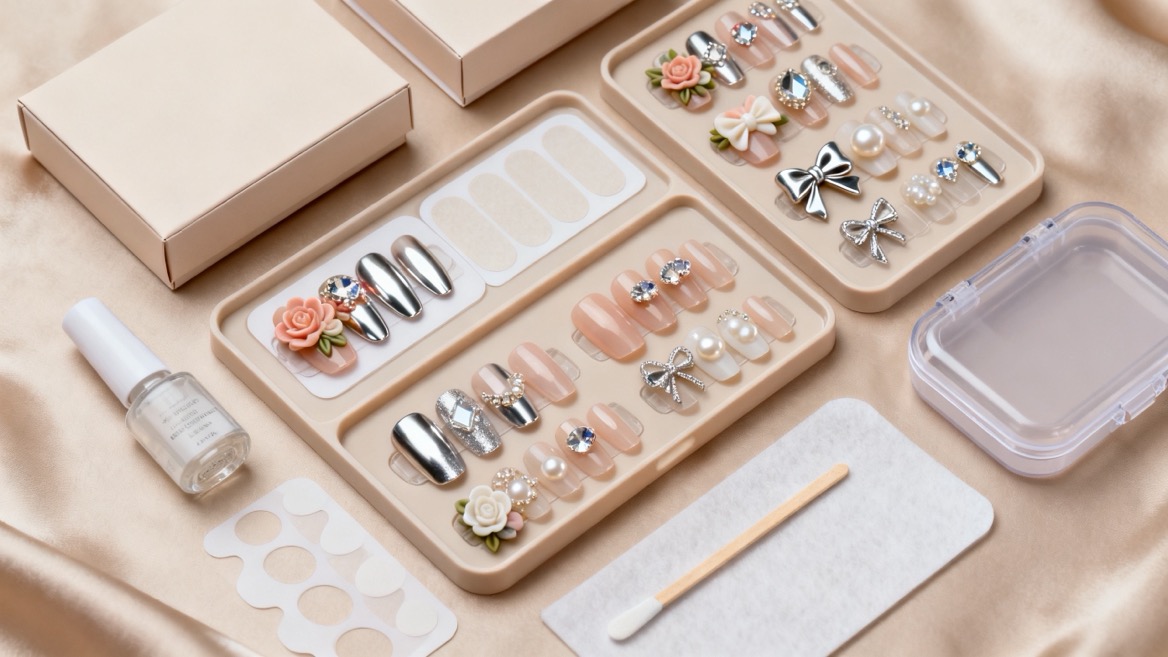
Judge both designs first at the size shoppers will see on a mobile category page. Can they distinguish the set from its neighbors without opening the listing? A consistent crop, background, and scale make the comparison easier. Flat art can lead with a front-facing image when a graphic or color contrast is the selling point. For 3D, try a slight angle that makes the relief visible without hiding the overall design. If the charm still reads like a printed dot, change the angle, lighting, or composition rather than relying on the product title to explain it.
Give a 3D set an angled close-up or side view so customers can judge how far the accent projects. Show the set on a hand to communicate nail length and the scale of the embellishments. For flat art, add a detail view that shows line definition, pattern placement, or the finish. If a listing offers multiple designs, make sure the image changes with the selected variant. A photograph of a neighboring style is not a substitute for showing what the customer will receive.
To isolate the effect of dimensional decoration, request two samples with the same nail shape, length, palette, and motif. For example, compare a printed bow with a raised bow on the same base color. Use equivalent front-of-pack artwork and window size, with enough clearance for the raised sample. If the tray must differ, record that difference. You are testing what the shopper can see through a working pack, not comparing loose tips under ideal lighting.
Place both packs at equal height with the same number of facings. View them from the aisle and again at arm's length. Swap their positions and repeat. Ask reviewers which pack they noticed first and what detail they could identify without picking it up. Record those answers separately. A set can catch the eye with a flash of light yet fail to communicate whether the design features a bow, a flower, or a gem.
For a store pilot, compare units sold per in-stock store-week and record differences in price, promotional support, and placement. If you can observe pack pickups consistently, track those separately from purchases. Online, compare listing click-through with product-page add-to-cart rate. Keep the price, traffic source, and promotional treatment comparable where possible. With limited traffic, treat the result as directional rather than conclusive.
Suppose the 3D set earns more clicks, but the flat set converts more visits into carts. That does not prove the raised style is less desirable. The thumbnail may attract shoppers who then find the accent larger than expected, or the page may not show enough detail to confirm what they are buying. Review the images and pricing before drawing a conclusion. Then compare contribution after packaging, decoration, and returns as well as units sold.
For 3D production, agree on a physical reference sample for accent height, placement, and finish. Check the tallest decorated nail inside the closed pack. Review whether the insert restrains movement without pressing on the accent, and agree with your supplier on how to check attachment and inspect samples after handling and transit. For flat art, focus on color, pattern alignment across tip sizes, edge definition, and the finish under normal display lighting. A motif that looks balanced on a larger tip may be cropped too tightly on a narrower one.
For an established range, start with the role each style needs to play. A brand introducing a seasonal collection might feature a raised floral set in its campaign and pair it with coordinating printed or painted designs. A wholesaler serving stores with different fixtures might start with graphic flat designs whose main motifs remain legible without a bespoke display. A chain retailer can test a small 3D assortment in matched stores before assigning it space across the network.
An accent-led hybrid is worth sampling if the choice is not clear. Keep most nails flat and place sculpted details on one or two focal nails. This lets you assess how much texture you need to make a design recognizable. Before committing, request an itemized quote for decoration, tooling if required, assembly, tray changes, and inspection. Do not assume every 3D design costs more than every flat design: a simple raised accent and an intricate multi-step flat finish are different production jobs.
Send Dongguan YoungMei Technology Co., Ltd. your target market, price tier, nail shape, artwork direction, estimated order volume, and pack dimensions. Request an OEM/ODM comparison with one raised design and one flat design presented in retail-ready sample packs. With its own factory and an established supply chain, YoungMei supports brands, wholesalers, and retail chains with rapid sampling, custom development, and one-stop sourcing. Approve the design that shows its value on your actual shelf or product page—not just in the sample tray.

They may draw a first look when the raised feature is visible and the design suits the occasion. That does not establish a higher purchase rate. In a pilot, compare pickups or product-page clicks with actual sales before expanding the assortment.
Yes. Precise linework, a consistent finish, and an intentional palette can create a premium look without relying on embellishment. Check the approved sample under ordinary retail lighting. Fine artwork that looks crisp in a studio close-up can be difficult to read behind a reflective window.
No. This comparison covers surface-level artwork on press-on nail tips. Nail stickers are a separate format. Both can feature similar artwork, but the product construction, application instructions, and packaging brief are different.
Start with a pack that shows the most distinctive accent clearly and has enough internal clearance to keep the decoration from contacting the window. Check the final pack from the shopper's viewing angle and inspect the product again after handling and transit trials.
Start with flat art for a broad everyday range where shoppers need to recognize and compare options quickly. Start with a 3D design when the launch needs one standout product and the display can show its depth. If you want a fair read on demand, test both in the same palette and price tier.
- Pierre Chandon, J. Wesley Hutchinson, Eric T. Bradlow, and Scott H. Young (2009). ["Does In-Store Marketing Work? Effects of the Number and Position of Shelf Facings on Brand Attention and Evaluation at the Point of Purchase."] *Journal of Marketing*, 73(6), 1–17. Supermarket eye-tracking research used to distinguish visual attention from brand evaluation and to explain why shelf position and facings should be controlled in a pilot. [psycnet.apa]
- Nielsen Norman Group (2019). ["UX Guidelines for Ecommerce Product Pages."] Usability research supporting the recommendations on enlarged images, alternate angles, and photos that show a product in use. [nngroup]
- Nielsen Norman Group (2022). ["6 Tips for Product Photos on Listing Pages."] Research informing the recommendations on consistent image scale, visible product details, contextual views, and images that match product options. [nngroup]
- KISS and Dashing Diva. [KISS Nails Collection] and [Dashing Diva Magic Press Collection]. Commercial examples of jeweled, 3D, French, and patterned press-on styles. These listings illustrate assortment choices; they do not provide comparative sales data. [kissusa]