
- All
- Product Name
- Product Keyword
- Product Model
- Product Summary
- Product Description
- Multi Field Search
English
Views: 224 Author: Young Mei Publish Time: 10-03-2026 Origin: Site


Content Menu
● Waterslide Decals vs Nail Stickers
>> What are waterslide nail decals?
>> What are self-adhesive nail stickers?
>> Which produces a better-looking manicure?
>> Which is faster and longer-lasting?
>> How to apply waterslide nail decals
>> How to apply self-adhesive nail stickers
>> Troubleshooting lifting and wrinkles
● Choosing Products for Your Brand
>> Match the format to the customer
>> Build a meaningful sample test
>> Specify custom artwork and packaging
>> Develop your collection with YoungMei
>> Are waterslide decals better than nail stickers?
>> Can beginners use waterslide nail decals?
>> Can nail stickers go over gel polish?
>> Can waterslide decals go over regular polish?
>> Why do my nail stickers keep lifting?
>> Which format is better for custom branding?
Waterslide decals vs nail stickers: both make detailed nail art accessible without hand-painting every design, but they differ in application, handling, and product development. Waterslide decals release from their backing with water, while nail stickers use an adhesive backing for peel-and-place application.
For nail enthusiasts, the choice comes down to finish, convenience, and technique. For brands, wholesalers, and retailers, it also involves customer expectations, packaging, compatibility, and repeatable quality.
At Dongguan YoungMei Technology Co., Ltd., our perspective starts with the complete product experience—not simply an attractive printed sheet. With more than 15 years of experience in nail-product manufacturing, our company focuses on press-on nails, nail stickers, and related products, supported by an in-house factory and established supply chain.
This guide compares both options and explains what to evaluate before choosing a manicure accessory or developing a custom collection.
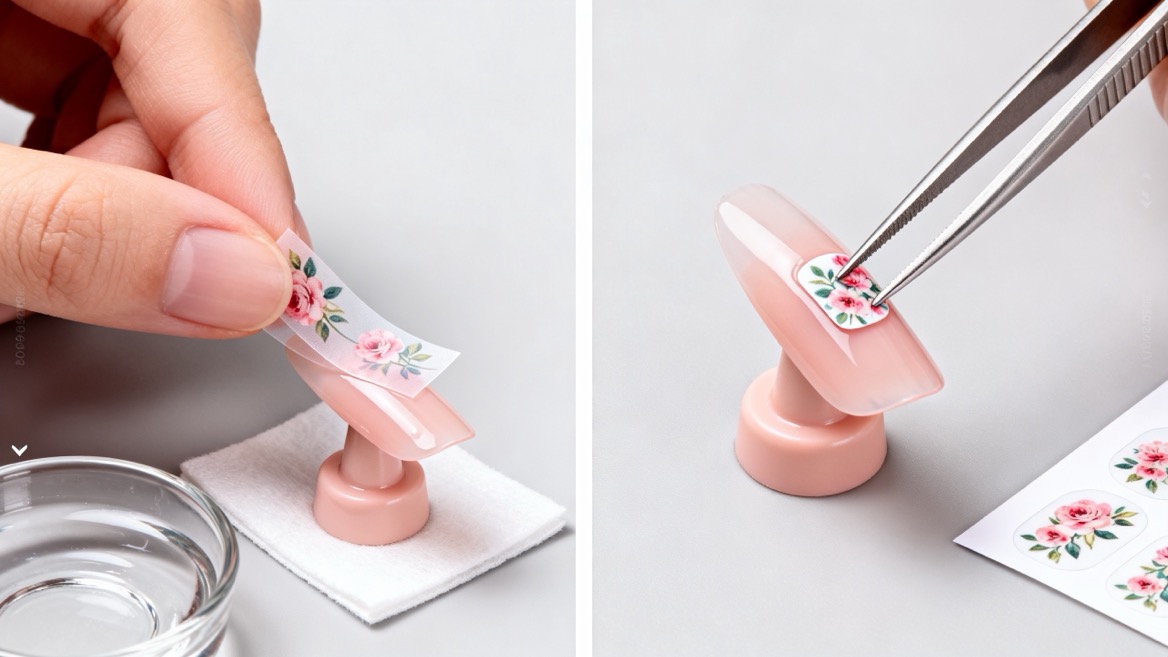
Waterslide nail decals are printed designs carried on a thin film supported by paper backing. Water loosens the connection between the film and backing, allowing the design to slide onto the nail.
The application usually involves cutting out a motif, wetting the backing, positioning the film, removing excess moisture, and sealing the design.
Their appeal is the ability to create detailed artwork with a relatively unobtrusive finish. However, "thin" does not automatically mean invisible: film borders, wrinkles, and trapped moisture can still affect the result.
Stickers have an adhesive backing and are lifted from a release sheet before being pressed onto the nail.
This category includes different constructions. Some stickers are thin printed motifs; others incorporate raised textures, metallic effects, or decorative elements.
For a fair comparison, this article primarily discusses individual nail-art stickers—not full-cover polish strips or semi-cured gel wraps. Those products have different application and removal requirements.
| Comparison point | Waterslide decals | Self-adhesive nail stickers |
|---|---|---|
| Application mechanism | Water releases the film from its backing | Adhesive attaches the design to the prepared surface |
| Preparation | Usually requires trimming and wetting | Usually requires peeling and positioning |
| Placement adjustment | Can allow adjustment while still wet | Repositioning depends on adhesive and construction |
| Handling challenge | Film may fold, tear, or wrinkle | Adhesive may become contaminated during handling |
| Finished appearance | Can create a low-profile, painted-on effect | Ranges from low-profile to intentionally dimensional |
| Main tools | Scissors, water, tweezers, absorbent pad | Tweezers and a soft pressing tool |
| Common application problem | Trapped moisture or excess film | Poor adhesion or lifted edges |
| Sealing | Requires a compatible finishing system | Sealing depends on the product and intended wear |
| Customer learning curve | Includes water-release and transfer technique | Fewer preparation steps, but careful placement still matters |
Neither format is automatically better.
For delicate floral illustrations or detailed accent artwork, waterslide decals can be an appealing choice. Thin self-adhesive stickers can also deliver refined results, while dimensional stickers suit designs where texture is intentional.
My recommendation is to evaluate the finished nail rather than the unused sheet. Apply the same artwork in both formats over the same base color, then compare border visibility, smoothness, and clarity.
Transparent artwork may appear different over light and dark backgrounds. Ask whether the design includes an opaque backing or white underprint before approving a collection intended for multiple nail colors.
Stickers eliminate the cutting-and-soaking workflow, but total application time depends on preparation and handling. A delicate sticker can take time to lift and position; a practiced technician may transfer a water decal efficiently.
Durability depends on the complete system: nail preparation, film or adhesive performance, finishing products, edge placement, and daily exposure.
There is no reliable universal wear-time advantage for either category. Avoid promising a fixed number of days without testing the specific product under defined conditions.
Prepare scissors, tweezers, a small water container or moistened pad, a lint-free absorbent material, and compatible finishing products.
1. Prepare the nail and apply the chosen base or color system according to its instructions.
2. Cut out the motif, keeping unnecessary surrounding film to a minimum.
3. Wet the backing using the decal supplier's recommended method.
4. Test whether the film slides freely; do not pull it away before release.
5. Position the backing near the nail and gently slide the design into place.
6. Smooth the film carefully, working out wrinkles and trapped water.
7. Blot excess moisture and allow the decal to dry appropriately.
8. Seal with a compatible finishing system, following its application and curing instructions.
Some nail-decal instructions suggest approximately 15–30 seconds of soaking, but release time varies. The slip test is more useful than treating one timing range as a universal rule.
A decal that resists movement needs further preparation—not additional pulling force.
Prepare fine-point tweezers and a soft silicone tool. Avoid handling the adhesive side unnecessarily.
1. Prepare the base surface according to the sticker and coating instructions.
2. Remove surface residue or a gel inhibition layer when the specified method requires it.
3. Lift the sticker carefully from its release sheet.
4. Position it without overlapping surrounding skin.
5. Press the center, then smooth toward the edges.
6. Inspect for lifted corners, bubbles, or incomplete contact.
7. Apply the recommended compatible finishing products.
8. Complete any required curing using the coating manufacturer's instructions.
Paola Ponce's gel-based method uses a non-tacky prepared surface for stickers. That is a useful technique, but it should not replace the instructions for every adhesive formulation.
Do not automatically buff the natural nail simply because one enhancement-based tutorial includes buffing.
For the gel application system described in the comparison tutorial, both formats are sealed with two thin gel layers.
However, that does not establish a universal requirement for every decal, sticker, polish, or gel combination. Compatibility matters more than applying an arbitrary number of coats.
A finishing product must protect the design without causing distortion, lifting, or excessive bulk. Follow the relevant product instructions and test unfamiliar combinations first.
If gel is involved, the lamp and curing procedure must match the coating system. Do not borrow a curing time from an unrelated product.
| Problem | Possible cause | Practical response |
|---|---|---|
| Water decal folds during transfer | Film released without enough support | Keep it supported on the backing during positioning |
| Decal wrinkles | Excess film or difficult nail curvature | Use a smaller motif and smooth gently |
| Sticker lifts at the corners | Incomplete contact or unsuitable surface | Recheck preparation and press the edges carefully |
| Design develops visible borders | Film perimeter remains noticeable | Trim appropriately and evaluate the finishing system |
| Artwork changes after sealing | Coating and printed design are incompatible | Test the combination before full application |
| Finish becomes unnecessarily bulky | Thick decoration or excessive coating | Choose a thinner design or revise the layer system |
Removal should follow the coating system, not just the decorative format.
A decal sealed beneath gel becomes part of that manicure's removal process. A sticker under conventional polish should be removed according to the compatible polish and sticker instructions.
Do not pick or forcibly peel off a finished gel manicure. Dermatology guidance also recommends protecting surrounding skin during acetone removal and moisturizing afterward.
If application or removal causes pain, stop rather than forcing the product away.
For a beginner-focused retail collection, I would prioritize understandable instructions, easy handling, and forgiving placement. A sticker range may suit that positioning, provided customers can lift and apply the designs successfully.
For a professional nail-art collection, waterslide decals may offer an attractive workflow for detailed motifs. Sample trials should establish whether the format fits the technician's existing coating system.
For press-on nail development, evaluate both formats on the actual tip material and curvature. A design that works on a flat display sample may behave differently near a curved sidewall.
These are selection criteria, not claims that one format suits every customer.
Comparing only the price per sheet can produce misleading purchasing decisions.
A more useful framework is:
Usable cost = landed batch cost ÷ successfully usable designs.
For illustration, suppose one batch costs $100 and yields 1,000 usable motifs. Its material cost is $0.10 per usable motif. Another costs $90 but yields only 750 usable motifs, bringing that figure to $0.12.
This hypothetical example excludes labor, packaging, returns, and shipping differences. It demonstrates why handling losses and inconsistent quality deserve attention alongside purchase price.
For salon products, also measure application time. For retail products, consider instruction clarity and the frequency of avoidable customer errors.
Instead of approving samples by appearance alone, test a small matrix of realistic conditions:
- Light and dark base colors.
- Different nail curvatures.
- Small motifs and larger coverage areas.
- Each finishing system intended for the product.
- Experienced and first-time users.
- Normal handling and relevant wear conditions.
Record observations rather than relying on memory. Useful measures include successful transfer rate, placement difficulty, visible edges, print changes after sealing, and lifting during the evaluation period.
Set acceptance criteria before testing. Otherwise, an attractive sample can overshadow a recurring functional problem.
This framework is a proposed purchasing method, not a report of completed laboratory testing or customer results.
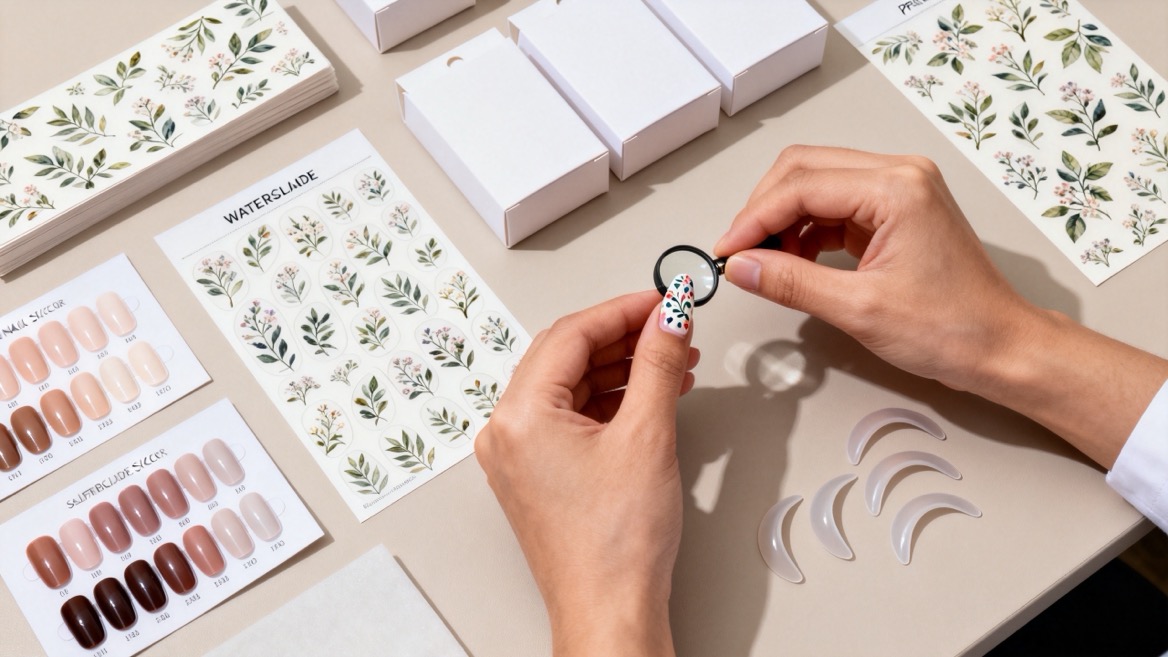
For OEM/ODM development, a strong brief connects visual requirements with practical performance.
Ask prospective suppliers to clarify:
- Design dimensions and intended placement.
- Film construction or sticker thickness.
- Print opacity and background-color requirements.
- Cutting accuracy and release behavior.
- Compatible application and finishing methods.
- Packaging protection and storage instructions.
- Applicable documentation for the target market.
- Sampling, approval, and production lead times.
Avoid treating broad labels such as "premium," "non-toxic," or "long-lasting" as substitutes for evidence. Any such claim needs appropriate support for the actual product and intended market.
Clear instructions should distinguish waterslide decals from peel-and-stick products. Include transfer or release guidance, preparation requirements, sealing advice, and removal information.
A short illustrated sequence can be more helpful than attractive packaging that leaves customers guessing.
At Dongguan YoungMei Technology Co., Ltd., we support global brands, wholesalers, and chain retailers with OEM/ODM customization, rapid sampling, consistent-quality objectives, and one-stop sourcing for nail products.
Our approach is to begin with your customer, design direction, and application requirements, then build a sampling brief around them.
Contact YoungMei with your target market, preferred artwork, packaging concept, estimated order quantity, and intended nail or coating system. Ask our team to confirm suitable product options and sample requirements before finalizing your collection.
Not universally. Waterslide decals suit users comfortable with wet transfer, while stickers eliminate the soaking step. Compare the finished appearance, handling, and compatibility of the actual products.
Yes, but practicing on a sample tip is sensible. Wait until the film slides freely, keep it supported during transfer, and remove excess moisture before sealing.
They can be used in compatible gel systems. Follow the specified surface-preparation method, press the sticker flat, and use the recommended finishing and curing procedure.
Some can, provided the decal and finishing products are compatible. Follow the supplier's instructions and test the combination instead of assuming a gel-based technique transfers unchanged.
Possible causes include surface residue, incomplete contact, unsuitable curvature, or incompatible finishing products. Inspect preparation and edge contact before simply adding more top coat.
Choose through sampling. Compare artwork reproduction, handling success, coating compatibility, packaging requirements, and usable cost. The best option is the one that performs reliably for your intended customer.
- [Paola Ponce Nails — "How To Waterslide Decals vs Nail Stickers."] Practitioner guidance on the two application mechanisms, surface preparation, transfer techniques, and sealing within the author's gel system. [paolaponcenails]
- [NashlyNails — Waterslide Nail Decals Application Guide.] Supplier guidance on cutting, wetting, releasing, and applying water decals, including an indicative soaking range. [nashlynails]
- [Daily Charme — Nail Art Water Slide Decals.] Commercial product-category context for waterslide nail-art decals. [dailycharme]
- [American Academy of Dermatology — "Gel manicures: Tips for healthy nails."] Dermatologist guidance on gel-manicure precautions, avoiding picking, and limiting surrounding-skin exposure during acetone removal. [aad]
- [American Academy of Dermatology — "Manicure and pedicure safety."] General nail-care guidance, including moisturizing after polish removal. [aad]
- Company background: YoungMei's experience, factory, supply chain, product focus, and service capabilities are based on information supplied for this article, not an independent factory audit.
- Editorial analysis: The purchasing framework, sample-test matrix, and hypothetical cost example are original recommendations, not published market statistics or verified case studies.