
- All
- Product Name
- Product Keyword
- Product Model
- Product Summary
- Product Description
- Multi Field Search
English
Views: 222 Author: Jenny Publish Time: 08-26-2026 Origin: Site


Content Menu
● Press-On Nails vs Dip Powder Nails at a Glance
● Cost: Which Option Delivers Better Value?
>> Cost Verdict
● Durability: How Long Do They Really Last?
● Removal: The Most Important Difference
>> How to Remove Press-On Nails Safely
>> How to Remove Dip Powder Nails Safely
● Hygiene and Nail-Health Considerations
● How Beauty Brands Should Position Each Product
● Which Is Better: Press-On Nails or Dip Powder Nails?
● Build Your Private-Label Press-On Nail Collection
● FAQs
>> Are press-on nails cheaper than dip powder nails?
>> How long do glue-on press-on nails last?
>> Are dip powder nails more durable than press-on nails?
>> Do press-on nails damage natural nails?
>> Is acetone necessary to remove dip powder nails?
>> Can dip powder nails be reused?
>> What should brands include in a press-on nail kit?
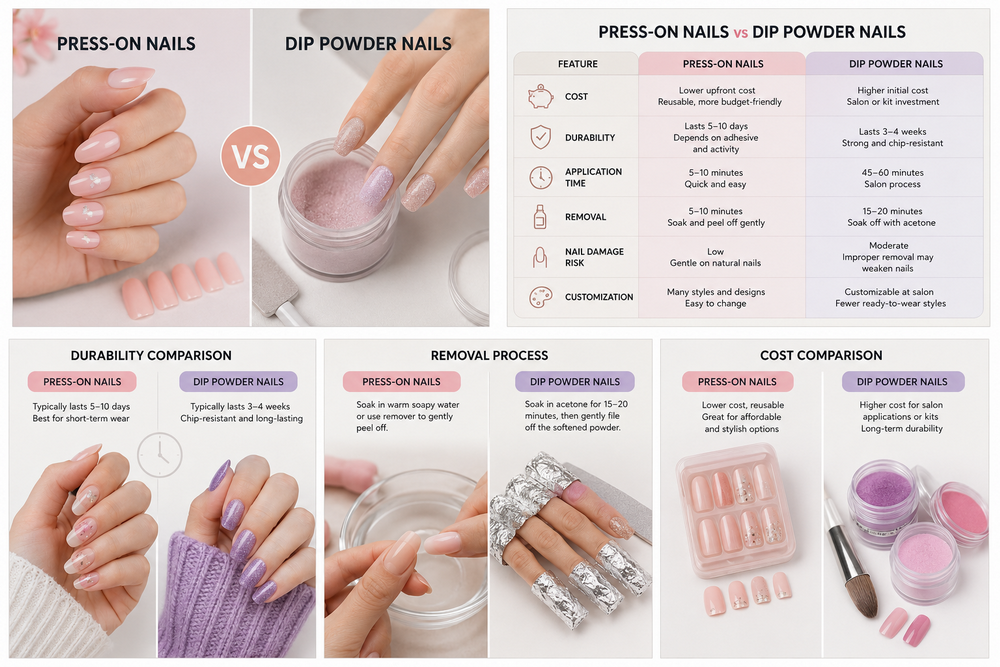
Press-on nails vs dip powder nails is no longer just a salon-choice question. For consumers, it is about budget, time, nail comfort, and style flexibility. For beauty brands, wholesalers, and nail-product retailers, it is also a product-positioning decision: should the range focus on fast, reusable, at-home press-on nail kits, or longer-wear dip powder manicure systems?
Both options can create a polished, salon-inspired result. However, they work very differently. Press-on nails are pre-shaped artificial nail tips attached with adhesive tabs or nail glue. Dip powder nails use a resin-like adhesive and colored acrylic powder applied directly over the natural nail. The better choice depends on how long the customer wants to wear the manicure, how much maintenance they accept, and how gently they want to remove it.
> Quick answer: Choose press-on nails for speed, design variety, low commitment, and at-home convenience. Choose dip powder nails for longer wear and a more durable natural-nail overlay.
Suggested featured image placement: Directly below the introduction.
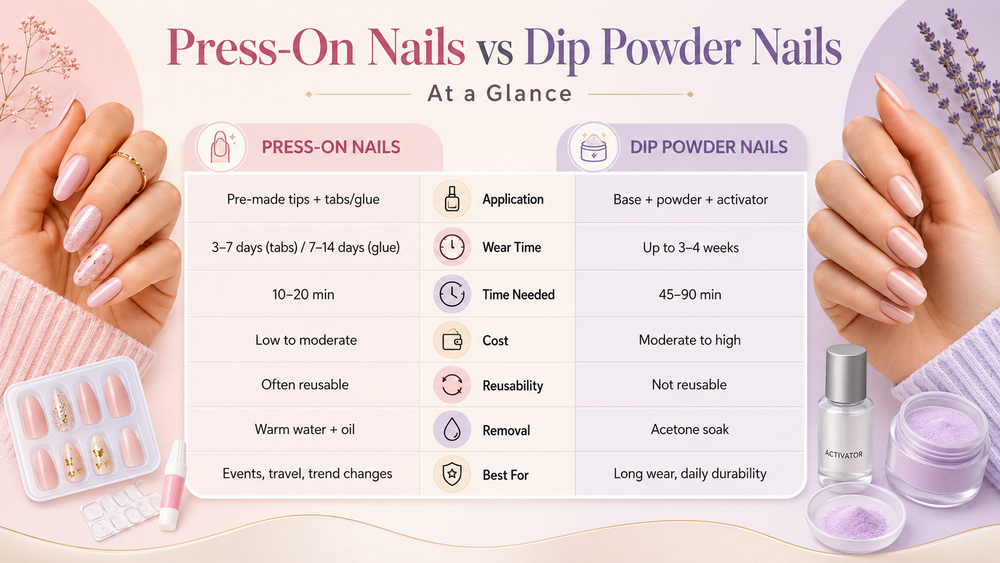
| Feature | Press-On Nails | Dip Powder Nails |
|---|---|---|
| Application method | Pre-made tips attached with glue or adhesive tabs | Adhesive base, colored powder, activator, and top coat |
| Typical wear time | Around 3–7 days with tabs; often 7–14 days with glue | Up to 3–4 weeks with proper application |
| Application time | Usually 10–20 minutes at home | Often 45–90 minutes in a salon or during a detailed DIY process |
| Initial cost | Low to moderate | Moderate to high |
| Reusability | Often reusable if removed carefully | Not reusable |
| Design flexibility | Very high; easy to change shape, color, and art | More limited once applied |
| Removal | Warm soapy water, oil, or adhesive remover; never force off | Usually requires acetone soaking and gentle removal |
| Best for | Events, trend-driven looks, travel, and fast beauty routines | Long wear, low-maintenance weeks, and stronger daily durability |
Dip powder manicures can remain chip-free for up to four weeks, according to the American Academy of Dermatology (AAD). However, removal generally requires 100% acetone, and repeated aggressive removal can dry or thin the nail plate.
Press-on nails are ready-made artificial nails, commonly manufactured from ABS plastic, acrylic-based materials, or gel-like materials. Consumers choose a size for each natural nail, then attach each tip using double-sided adhesive tabs or liquid nail glue.
Modern press-on nails are far more sophisticated than earlier drugstore versions. Premium sets may include:
- Multiple nail sizes for a better fit
- Pre-designed nail art, chrome finishes, French tips, or 3D embellishments
- Different lengths and shapes, such as almond, coffin, square, oval, and stiletto
- Adhesive tabs for temporary wear
- Nail glue for longer hold
- Prep pads, files, cuticle sticks, and storage packaging
For a consumer, the key benefit is immediate transformation. A person can switch from bare nails to a detailed, coordinated manicure in less than 20 minutes without booking a salon appointment.
For a brand, press-on nails offer a strong opportunity for seasonal collections, limited editions, creator collaborations, and repeat purchases. The global press-on nails market was estimated at USD 753.53 million in 2025 and is projected to reach about USD 1.09 billion by 2031, with convenience, lower cost than salon services, and rapid at-home application cited as key drivers.
Dip powder nails are a long-wear manicure system. The nail is prepared, coated with an adhesive base, then dipped into or sprinkled with colored powder. An activator hardens the layers, followed by shaping and a protective top coat.
Unlike gel polish, dip powder does not typically require UV or LED curing. The finished manicure creates a hard, durable layer over the natural nail.
A typical dip powder service involves:
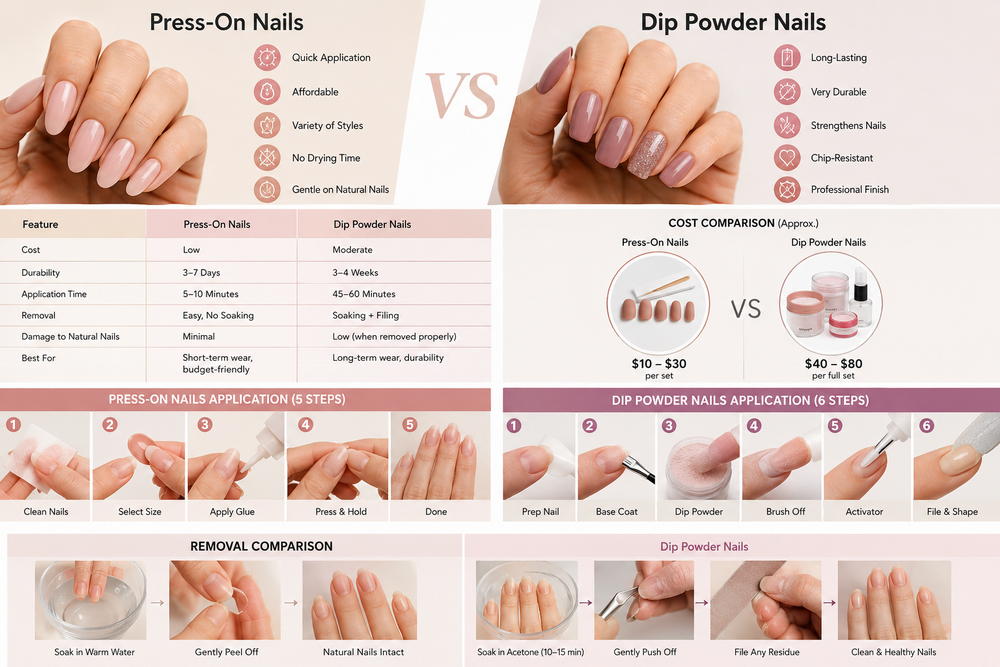
1. Cleaning and preparing the natural nail
2. Lightly buffing the nail surface
3. Applying a base adhesive
4. Dipping or sprinkling colored powder
5. Repeating layers for coverage and strength
6. Applying activator
7. Filing and shaping
8. Applying a top coat
Dip powder can be appealing for people who work with their hands, want a manicure for a holiday, or do not want to think about nail maintenance for several weeks. Cleveland Clinic notes that dip powder is known for durability and may last up to four weeks, but extensive buffing and filing can weaken the natural nail over time.
The cost comparison depends on whether the buyer chooses DIY products or professional services.
A basic press-on nail kit may cost only a few dollars at retail. Premium, handmade, salon-style, or branded press-on sets can cost considerably more, especially when they include custom art, higher-quality finishes, reusable construction, or a complete application kit.
The value proposition is strong because one press-on nail set can provide:
- A complete manicure without a salon visit
- Multiple looks through different collections
- Potential reuse when removed carefully
- Lower labor and time costs for the consumer
For retailers, the category also supports bundle selling. A brand can pair press-on nails with glue, adhesive tabs, remover, prep pads, nail files, cuticle oil, and travel cases.
Dip powder costs are usually higher because they may involve a professional salon service, trained labor, product use, and removal. DIY dip powder kits reduce the service cost, but they require time, practice, and careful hygiene.
A dip powder manicure may appear economical when calculated per week of wear. If it lasts three to four weeks, the customer receives a long-lasting finish. But the full cost should include removal, possible salon visits, and nail-care recovery products.
Press-on nails usually win for upfront affordability and variety. They are especially attractive for shoppers who want several looks per month.
Dip powder nails can offer better cost-per-day value for customers who want one durable manicure to last for weeks.
Durability does not only depend on the product type. It also depends on nail preparation, fit, adhesive quality, water exposure, handwashing frequency, typing habits, cleaning tasks, and removal technique.
With adhesive tabs, press-on nails usually work best for short-term wear. They are ideal for an evening event, a weekend, a photo shoot, a wedding, or a holiday. With nail glue and proper preparation, many users can achieve approximately one to two weeks of wear.
To improve press-on nail retention:
- Select the correct nail size; an oversized tip can lift at the sides
- Clean the natural nail with an alcohol prep pad
- Remove surface oils before application
- Avoid applying immediately after hand cream or showering
- Use a thin, even layer of glue rather than excess glue
- Press firmly according to the adhesive instructions
- Wear gloves for cleaning, dishes, and prolonged water exposure
A high-quality press-on nail should balance strength, flexibility, and fit. A tip that is too rigid may feel uncomfortable or pop off under pressure. A tip that is too thin may bend or crack. For OEM brands, consistent thickness control, secure packaging, accurate sizing, and tested adhesive compatibility are essential to reduce returns and improve repeat purchases.
Dip powder generally provides the longer-lasting option. Its hardened overlay is highly resistant to chipping and can hold up better against daily tasks than many glue-on nails.
However, durability is not always an advantage. As the natural nail grows, a visible gap develops near the cuticle. The wearer must eventually remove the dip powder or schedule a new service. If the manicure starts lifting, water and debris may become trapped underneath, so lifting should not be ignored.
Choose press-on nails when the goal is flexible, temporary beauty. Choose dip powder nails when the goal is a more fixed, durable manicure for three to four weeks.
Suggested infographic placement: After this section.
 Removal: The Most Important Difference
Removal is where many comparison articles fail consumers. The true nail-health experience is not determined only by wear time. It is often determined by what happens when the product comes off.
Never pull, rip, or pry off press-on nails. Forced removal can take layers from the natural nail plate and cause soreness or splitting.
Use this safer process:
1. Soak hands in warm, soapy water for several minutes.
2. Add cuticle oil or a gentle oil around the edges of the press-on nail.
3. Use a wooden cuticle stick to gently loosen the edge.
4. Re-soak if resistance remains.
5. Lift slowly only when the adhesive has softened.
6. Remove adhesive residue gently and moisturize nails and cuticles.
For reusable press-on nails, careful removal matters. Rough removal can warp the tip, damage nail art, or leave glue residue that makes future applications less secure.
Dip powder removal usually requires acetone. The AAD states that 100% acetone can remove more than color; it can also peel layers of the nail and irritate surrounding skin. The organization advises allowing nails time to recover between dip powder manicures.
A safer dip powder removal process includes:
1. File only the shiny top layer to help acetone penetrate.
2. Protect surrounding skin with petroleum jelly or cuticle oil.
3. Apply acetone-soaked cotton to each nail.
4. Wrap each fingertip with foil.
5. Wait until the product softens.
6. Gently slide softened product away; do not scrape aggressively.
7. Re-soak stubborn areas instead of forcing them.
8. Apply cuticle oil and hand cream after removal.
If the nails become painful, unusually thin, discolored, lifted, swollen, or itchy, stop reapplying products and consult a qualified medical professional. The AAD specifically recommends monitoring bare nails between manicures and seeking a board-certified dermatologist if problems persist.
Both press-on and dip powder systems can be used responsibly, but they have different hygiene risks.
For press-on brands, the main concerns are product fit, adhesive tolerance, clean application, and correct removal. A customer should not apply press-ons over irritated, infected, damaged, or lifting nails.
Brands can improve customer safety and confidence by providing:
- Clear preparation and removal instructions
- Ingredient information for nail glue
- Patch-test guidance for adhesive-sensitive users
- Single-use prep pads
- Strong but easy-to-understand warnings against forceful removal
- Storage boxes that protect reusable press-on sets
The major salon hygiene issue is "double dipping." If multiple customers put fingers into the same powder container, contamination can spread. The AAD recommends either dispensing powder into a disposable container and discarding unused powder or sprinkling powder directly from the original container onto the nail.
This is a meaningful education opportunity for nail brands and salons. A clear "no double dip" policy can strengthen professional credibility and reassure hygiene-conscious customers.
For B2B buyers, the decision is not necessarily press-ons or dip powder. A well-designed product portfolio can address both consumer needs.
| Customer Need | Recommended Product Focus | Positioning Message |
|---|---|---|
| Fast trend updates | Press-on nails | “Salon-inspired nails in minutes.” |
| Events and travel | Adhesive-tab press-on nails | “Temporary glamour with easy removal.” |
| Longer home wear | Glue-on press-on nails | “Secure, stylish wear without a salon appointment.” |
| Nail-art collections | Premium press-on nails | “Detailed designs without the time or technical skill.” |
| Long-lasting manicure | Dip powder system | “A durable, chip-resistant manicure for weeks.” |
| Hygiene-focused salon customers | Professional dip powder supplies | “Controlled application and no-double-dip practices.” |
For an OEM or private-label press-on nail supplier, product development should focus on more than fashionable artwork. Fit accuracy, adhesive options, flexible-but-durable material, size range, packaging quality, and clear removal instructions all affect customer reviews and brand retention.
There is no single winner.
Choose press-on nails if you want:
- A manicure in minutes
- Lower upfront cost
- Frequent design changes
- A salon-free option
- Potential reusability
- An event-ready or trend-led beauty accessory
Choose dip powder nails if you want:
- Longer wear
- A sturdy, chip-resistant finish
- Less frequent manicure changes
- A more permanent-looking natural-nail overlay
- No UV or LED curing step during application
For many consumers, the smartest routine is to alternate. Press-on nails can serve as the fast, fashion-forward option for weekends, promotions, seasonal launches, and special events. Dip powder can serve consumers who prioritize extended wear.
Looking to launch or expand a nail brand? Dongguan YoungMei Technology Co., Ltd. supports international brands, wholesalers, and beauty businesses with OEM and manufacturing solutions for press-on nails, glue-on nails, kids' nails, and related nail accessories.
Create a collection that matches your market with customized shapes, lengths, colors, finishes, nail-art styles, packaging, and accessory combinations. Contact our team to discuss your private-label press-on nail project, sample requirements, and wholesale manufacturing needs.
Suggested CTA image placement: Before the CTA or beside the contact form.
AI image prompt: *Premium B2B beauty product flat lay, assorted press-on nail sets in elegant retail boxes, nail glue, adhesive tabs, mini nail file, alcohol prep pads, neutral blush background, high-end cosmetic packaging photography, space for brand logo, no readable text, 16:9.*
Usually, yes. Press-on nails generally have a lower upfront cost because consumers can apply them at home. Dip powder may offer longer wear, but salon services, removal, and maintenance can make the total cost higher.
With good nail preparation, correct sizing, and quality nail glue, glue-on press-on nails often last around 7–14 days. Adhesive-tab press-ons are more suitable for shorter wear, commonly several days.
Yes. Dip powder is typically more durable because it forms a hardened coating over the natural nail and may last up to four weeks.
Press-on nails can damage natural nails if they are pulled off, pried off, or applied over already damaged nails. Correct removal using warm water, oil, and patience helps reduce the risk.
Acetone is commonly used because dip powder is designed to create a durable bond. The AAD notes that dip powder removal uses 100% acetone, which can dry and thin nails if used repeatedly or aggressively.
No. Dip powder is applied directly to the natural nail and removed through soaking and gentle filing. Unlike reusable press-on nails, it cannot be saved and worn again.
A complete press-on nail kit can include assorted nail sizes, nail glue, adhesive tabs, a mini file, cuticle stick, alcohol prep pad, application instructions, removal guidance, and protective storage packaging.
1. American Academy of Dermatology Association. "[Dip powder manicure: 5 tips to keep your nails healthy]." Guidance on wear duration, acetone removal, allergy awareness, hygiene, and nail recovery. [aad]
2. Cleveland Clinic Health Essentials. "[Understanding the Pros and Cons of Dip Powder, Gel and Acrylic Nails]." Dermatologist-reviewed overview of dip powder application, durability, hygiene concerns, ingredients, and nail-health considerations. [health.clevelandclinic]
3. Research and Markets. "[Press-on Nails Market – Global Industry Size, Share, Trends]." Market estimate and forecast, plus press-on nail category drivers and product-development trends. [researchandmarkets]
