
- All
- Product Name
- Product Keyword
- Product Model
- Product Summary
- Product Description
- Multi Field Search
English
Views: 294 Author: Young Mei Publish Time: 11-07-2026 Origin: Site


Content Menu
● Custom Press-On Nails vs. 3D Press-On Nails: The Key Differences
● What Are Custom Press-On Nails?
>> Custom Design Does Not Necessarily Mean Custom Fit
>> Why Low-Profile Designs Still Make a Statement
>> Not All 3D Designs Have the Same Construction
>> Where 3D Nail Art Adds Value
● Which Option Is Better for Statement Nail Collections?
>> Match the Design to the Wearing Occasion
● Compare Fit, Wear, and Reusability Separately
>> Fit Comes Before Decoration
>> Separate Adhesive Performance From Decoration Security
● Compare Manufacturing Cost and Commercial Value
>> Request Comparable Quotations
>> Evaluate Contribution, Not Just Purchase Price
● Market Context: Growth Is Not Proof That 3D Will Win
● A Practical Sampling Protocol for Custom and 3D Press-On Nails
>> Step 1: Create a Complete Design Brief
>> Step 2: Approve the Base Nail
>> Step 3: Establish an Approved Reference Sample
>> Step 4: Test Relevant Failure Modes
>> Step 5: Review the Packed Product
● A Collection Strategy: Core Designs Plus Dimensional Accents
● Safety, Labeling, and Responsible Product Claims
● Develop Your Statement Collection With YoungMei
>> Are custom press-on nails and 3D press-on nails mutually exclusive?
>> Are 3D press-on nails always more expensive?
>> Which option is better for everyday use?
>> Do 3D press-on nails last longer?
>> Can 3D press-on nails be reused?
>> What should buyers approve before placing a bulk order?
Custom press-on nails and 3D press-on nails can both anchor a statement nail collection, but they solve different design problems. Customization gives brands control over their product identity. Three-dimensional nail art adds raised details that create texture and visual impact. The strongest choice depends on your customers, price position, and production requirements—not simply which design looks more dramatic.
At Dongguan YoungMei Technology Co., Ltd., our perspective comes from more than 15 years of experience in nail product development and manufacturing. For brands, wholesalers, and retail chains, we recommend starting with one important distinction: customization describes how a product is specified, while 3D nail art describes its appearance.
These categories overlap. A custom collection can include flat artwork, sculptural accents, or both. Understanding that relationship makes sourcing decisions clearer and helps prevent expensive mismatches between a creative concept and the finished product.
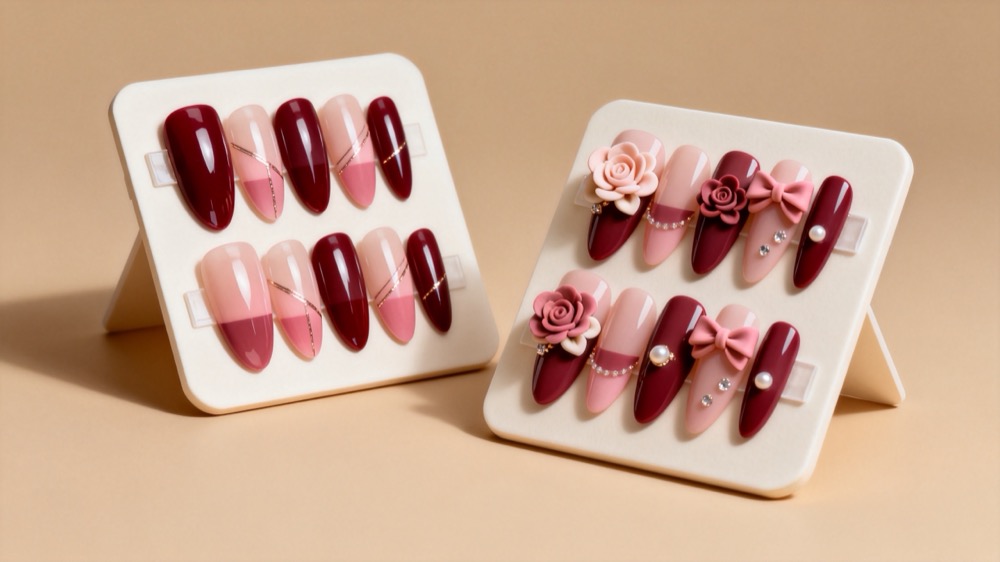
For this comparison, "custom press-on nails" means brand-specified sets with predominantly flat or low-profile decoration. "3D press-on nails" means sets featuring raised decorative elements, whether customized or sold as standard designs.
| Comparison factor | Custom, low-profile press-on nails | 3D press-on nails |
|---|---|---|
| Main advantage | Flexible brand expression | Dimensional visual impact |
| Design options | Colors, prints, gradients, finishes, shapes | Sculpted flowers, bows, pearls, crystals, raised patterns |
| Everyday practicality | Fewer protruding elements to manage | Depends on decoration height and placement |
| Production complexity | Varies with artwork and finishing processes | Adds placement, attachment, or sculpting requirements |
| Quality-control priorities | Fit, color, print alignment, surface finish | All standard checks plus decoration security |
| Packaging requirements | Protect shape and surface finish | Also prevent pressure on raised details |
| Best collection role | Core range, coordinated themes, repeatable designs | Hero products, occasion sets, premium capsules |
Neither category automatically guarantees better quality, longer wear, or stronger margins. Those outcomes depend on the complete product specification.
Custom press-on nails are manufactured or decorated according to a buyer's requirements. Customization can involve the nail itself, the assortment, accessories, and retail packaging.
For a private-label brand, that might include:
- Exclusive artwork and coordinated color palettes.
- Selected shapes, lengths, and finishes.
- A defined assortment of nail sizes.
- Branded instructions, inserts, and packaging.
- Application accessories appropriate to the intended product.
A common sourcing misunderstanding is treating "custom" as synonymous with individually measured nails.
A custom-branded retail set may use standard size assortments. A made-to-measure set follows an individual customer's measurements. These are different operating models, with different fulfillment and customer-service requirements.
Buyers should state whether they need customized artwork, a revised size assortment, or genuinely individualized sizing.
Statement nails do not require bulky decorations. Contrasting colors, graphic patterns, metallic effects, or an unusual combination of shape and artwork can create a distinctive collection.
From a product-development perspective, low-profile designs are worth considering when customers want expressive nails without prominent surface embellishments.
3D press-on nails feature decoration that rises above the nail surface. Examples include sculpted flowers, raised bows, pearls, crystals, and textured patterns.
The term describes dimensional appearance. It does not automatically mean the product was made with a 3D printer.
A small raised detail and a heavily embellished sculptural set should not share the same production assumptions.
Buyers need to clarify:
- Whether details are molded, sculpted, or separately attached.
- Which materials and attachment methods are proposed.
- How far decorations extend above or beyond the nail.
- Whether placement changes across nail sizes.
- How the finished set will be protected during shipment.
These questions turn "make it look luxurious" into an actionable manufacturing brief.
Dimensional details can give a collection a recognizable focal point. They are particularly relevant when the product concept centers on occasion dressing, collectible designs, or elaborate nail styling.
However, visual complexity is not proof of customer demand. A striking sample still needs an appropriate price, comfortable fit, and credible product presentation.
Choose predominantly low-profile custom nails when the priority is broad usability, coordinated branding, or a repeatable core assortment.
Choose 3D press-on nails when raised decoration is central to the collection's identity and your target customers accept the associated handling requirements.
Choose custom 3D nails when you need both exclusive branding and dimensional artwork.
Start with the customer's activities rather than a reference image.
A customer choosing nails for a special event may accept prominent embellishments. Someone seeking an everyday manicure may prefer smaller accents or an entirely smooth surface.
During sampling, ask testers to perform relevant activities, such as:
- Typing and using a phone.
- Handling clothing fasteners.
- Putting on knitwear.
- Opening the product package.
- Applying and removing the nails according to instructions.
Treat feedback as evidence for that tested design—not a universal conclusion about all 3D nails.
Decoration style alone does not determine how long a press-on set stays attached.
Fit, preparation, adhesive selection, application, user activity, and removal all affect the experience. Avoid promising an identical wear period across different users without suitable supporting evidence.
Assess sidewall coverage, curvature, length, and the available size range before approving decorative details.
A beautiful nail that fits poorly is not a successful sample. A sizing guide should also explain how customers can select an appropriate size without forcing an unsuitable nail onto the natural nail.
For a 3D set, there are at least two distinct performance questions:
1. Does the press-on remain attached under the intended conditions?
2. Do its decorations remain secure and intact?
A satisfactory answer to one does not establish the other.
Likewise, describe reusability cautiously. Removal methods, adhesive residue, surface damage, and decoration condition can affect whether a set remains suitable for another application. Do not promise a fixed number of reuses without testing the complete system.
Custom press-on nails are not automatically inexpensive, and 3D press-on nails are not automatically profitable.
A detailed printed design with multiple finishing stages may require substantial processing. A restrained 3D accent may involve less work than a fully embellished set.
Give suppliers the same specification when comparing offers:
- Nail count and size assortment.
- Shape, length, and base construction.
- Artwork, finishes, and embellishments.
- Accessories and adhesive configuration.
- Packaging and labeling.
- Order quantity and inspection requirements.
Otherwise, the lowest quotation may simply describe a different product.
A useful planning calculation is:
Contribution per set = selling price − landed product cost − channel fees − fulfillment cost − expected returns and replacements.
This is a decision framework, not an industry benchmark. Use your own verified costs.
For dimensional products, include any additional protective packaging and realistic replacement allowances. A higher retail price does not necessarily compensate for greater fulfillment costs or return rates.
Grand View Research estimates the global press-on nails market at $831.8 million in 2026 and projects it to reach $1,322.6 million by 2033, representing a 6.8% compound annual growth rate.
These are research estimates and forecasts, not guaranteed outcomes.
More importantly, the headline figures describe the overall press-on nails market. They do not establish that 3D styles outperform low-profile custom designs.
The practical implication is to validate your specific assortment. Category growth cannot replace evidence about your customers' preferred designs, acceptable prices, fit requirements, or reasons for returning products.
A structured approval process can reveal problems that photographs cannot.
The following is a proposed buyer checklist, not a claim that every manufacturer uses identical procedures.
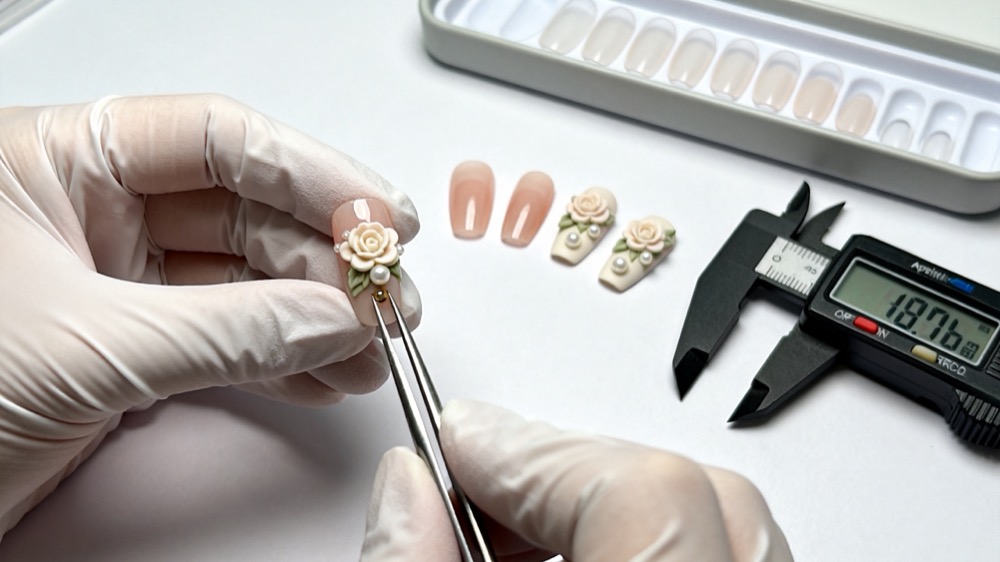
Specify the intended customer, wearing occasion, target retail positioning, shape, length, size assortment, colors, and decoration placement.
For raised artwork, include side-view references and proposed height limits—not just top-view images.
Review fit, curvature, consistency, and edge finishing before approving elaborate decoration.
This reduces the risk of investing in artwork on an unsuitable base.
Record acceptable color, artwork placement, finish, and decoration position. Identify which variations are acceptable and which count as defects.
For handmade details, agree on tolerances rather than expecting every piece to be visually identical.
For low-profile sets, inspect print alignment, surface defects, and finish consistency.
For 3D sets, add checks for loose decorations, sharp edges, snagging, and interference with adjacent fingers. Agree on testing methods and acceptance criteria before production.
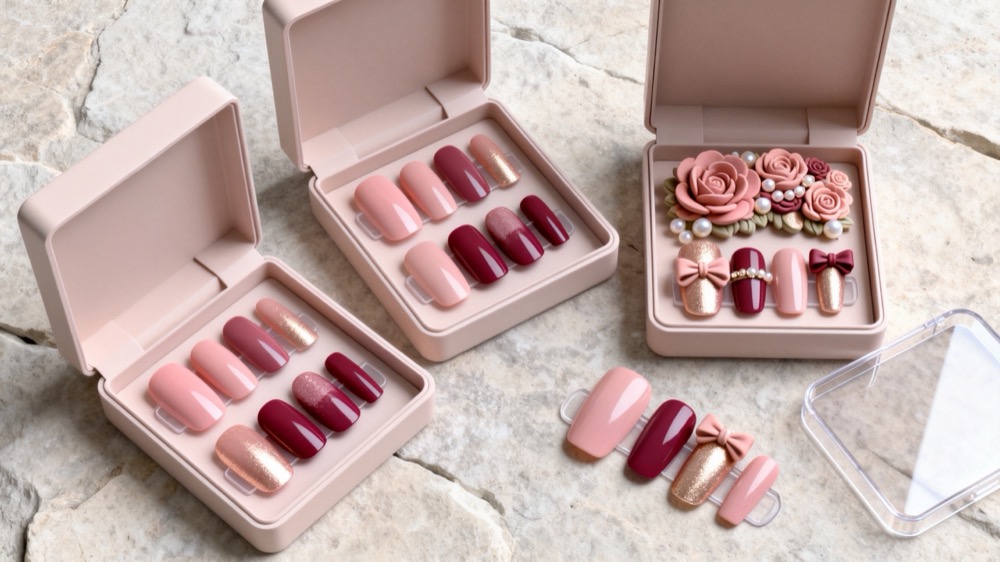
Check whether the packaging touches or compresses decorations, whether nails move during handling, and whether customers can remove them without damaging the design.
Approve the retail-ready product, not merely loose samples.
Rather than treating this comparison as an either-or decision, consider assigning different jobs to different designs.
A proposed assortment could include:
- A low-profile core range for the brand's recurring visual identity.
- Accent sets combining smooth nails with selected raised details.
- Fully dimensional hero sets for a focused occasion or creative theme.
This is a planning model, not a documented sales case.
Its value is that it lets buyers compare different levels of decoration without committing the entire collection to one construction style.
Track sell-through, contribution, fit-related complaints, decoration damage, and return reasons separately. Strong initial sales are useful, but they do not reveal whether the product creates repeat demand.
Neither "custom" nor "3D" establishes that a nail product is safer.
The American Academy of Dermatology notes that artificial nail products and application practices can contribute to irritation and nail damage. Its guidance covers artificial nails broadly; it should not be presented as a direct comparison of these two press-on categories.
Provide clear product-specific application and removal instructions. Avoid unsupported claims such as "damage-free," "allergy-free," or universally suitable for sensitive users.
Request documentation relevant to the actual nail materials, coatings, decorations, and supplied adhesive. Confirm destination-market requirements with qualified support rather than assuming one document covers every component and country.
Dongguan YoungMei Technology Co., Ltd. develops and manufactures press-on nails, nail stickers, and related nail products. With more than 15 years of experience, an owned factory, and an established supply chain, we support OEM/ODM customization, rapid sampling, consistent-quality production, and one-stop sourcing.
For your next collection, send our team your target market, design references, preferred shapes, packaging requirements, estimated quantities, and launch schedule.
Request a side-by-side sample proposal covering a low-profile custom design and a dimensional alternative. Comparing both against the same commercial brief is a practical way to decide which direction deserves production investment.
No. Customization describes buyer-defined specifications, while 3D describes raised decoration. A brand can commission custom 3D press-on nails with exclusive artwork and packaging.
No. Cost depends on materials, processing steps, decoration complexity, quantities, and packaging. Compare quotations against an identical specification before drawing conclusions.
Low-profile designs are a practical starting point when customers want fewer protruding details. However, actual suitability depends on fit, length, decoration placement, and the wearer's activities.
Not necessarily. Raised decoration does not establish adhesive performance. Evaluate nail attachment and decoration security separately under the intended use conditions.
Potentially, but reusability depends on the materials, adhesive, removal process, and condition after wear. Verify any specific reuse claim through testing rather than assuming it applies universally.
Approve the base nail, size assortment, artwork, decoration placement, packaging, instructions, and defect criteria. Confirm commercial terms and delivery expectations alongside the physical sample.
- Grand View Research. "Press-on Nails Market Size, Share & Trends Analysis Report, 2026–2033." Source for the market estimates and forecast; not evidence of a performance advantage for 3D products. [View report]. [grandviewresearch]
- American Academy of Dermatology Association. "Artificial Nails: Dermatologists' Tips for Reducing Nail Damage." Source for general artificial-nail irritation and damage considerations. Its guidance is not a comparative clinical study of custom and 3D press-ons. [Read guidance]. [aad]
- Dazznails. "3D Nails." Commercial product examples illustrating raised flowers, bows, charms, and other dimensional decorations; not independent evidence of durability or market performance. [View examples]. [dazznails]
- OEMnail. "Private Label Press-On Nail Manufacturer | OEM & ODM Solutions." Commercial reference illustrating customization categories such as shapes, colors, finishes, artwork, and packaging; not independent verification of YoungMei's capabilities. [View manufacturing overview]. [oemnail]