
- All
- Product Name
- Product Keyword
- Product Model
- Product Summary
- Product Description
- Multi Field Search
English
Views: 220 Author: Young Mei Publish Time: 09-15-2026 Origin: Site


Content Menu
● What Is HEMA-Free Gel Polish?
● HEMA-Free Gel Polish vs. Regular Gel Polish at a Glance
● Why HEMA Matters in Gel Nail Products
● Is HEMA-Free Gel Polish Better for Sensitive Customers?
>> A More Responsible Product Message
● Performance: Does HEMA-Free Gel Polish Last as Long?
>> Key Performance Factors to Test
● The Hidden Variable: Lamp Compatibility
● Application Safety: The Most Important Habit
>> Professional Application Steps
● Regulatory and Labeling Considerations
>> Documents Serious Buyers Should Request
● How Brands Should Choose Between the Two
● OEM/ODM Insight: How to Develop a Stronger HEMA-Free Range
● Build a More Responsible Nail Collection
>> Is HEMA-free gel polish completely free from acrylates?
>> Does HEMA-free gel polish cure under a normal LED lamp?
>> Does regular gel polish always contain HEMA?
>> Can customers with previous gel allergies use HEMA-free gel polish?
>> Does HEMA-free gel polish have weaker adhesion?
>> What should a private-label buyer test before ordering?
HEMA-free gel polish and regular gel polish can both deliver glossy, durable, salon-quality manicures—but they differ most in formulation strategy, sensitisation considerations, regulatory fit, and how brands should communicate safe application. For nail brands, wholesalers, salon chains, and private-label buyers, the right choice is not simply "safer versus stronger." It is about building a product system that matches your target market, customer skill level, lamp compatibility, performance expectations, and ingredient-positioning strategy.
At Dongguan YoungMei Technology Co., Ltd., we have spent more than 15 years working with nail-product buyers and brands across different markets. In practical product development, we see one clear trend: buyers increasingly ask not only, "How long does this gel polish last?" but also, "What is in it, who is it for, and how can we reduce avoidable skin exposure during use?" That is why a clear comparison between HEMA-free gel polish and regular gel polish matters for both product selection and responsible brand development.

HEMA-free gel polish is UV/LED-cured gel nail colour formulated without HEMA, short for 2-hydroxyethyl methacrylate. HEMA is a methacrylate monomer used in some nail systems to support adhesion, coating formation, and curing performance.
A HEMA-free formula does not mean it contains no acrylates, no methacrylates, or no potential allergens. Instead, it means the formula is designed without the specific ingredient HEMA. Manufacturers may use alternative monomers, oligomers, resins, adhesion promoters, photoinitiators, pigments, and film-forming materials to create the finished gel system.
For many brands, "HEMA-free" is a meaningful formulation and positioning choice. It can help meet the needs of customers who actively avoid HEMA, salons that want a more selective product range, and retailers seeking clearer ingredient-based product segmentation.
However, the claim must be used accurately. HEMA-free is not the same as allergy-proof, irritation-proof, or universally suitable for every user. A responsible brand should pair the claim with complete ingredient disclosure, proper directions, compatible-lamp guidance, and clear warnings about preventing uncured gel from touching the skin.
Regular gel polish is a broad category describing colour coatings that cure under a compatible UV or LED lamp. It is sometimes called UV gel polish, soak-off gel polish, gel nail colour, or LED gel polish.
A conventional gel polish usually contains a combination of:
- Film-forming oligomers and resins
- Reactive monomers that help create a cured coating
- Photoinitiators that activate under lamp light
- Pigments, glitters, or effect powders
- Rheology modifiers for brush control and self-leveling
- Adhesion-supporting ingredients
- Additives for gloss, flexibility, stability, and wear
Some regular gel polishes contain HEMA, while others do not. Therefore, "regular gel polish" is not the opposite of "HEMA-free gel polish" in a strict technical sense. HEMA-free gel polish is still regular gel polish in terms of product format and application method. The real distinction is whether HEMA appears in the formula.
For buyers, this point is important. When sourcing an OEM or ODM product, asking only for "gel polish" is not enough. You should specify whether you require:
- HEMA-free formulation
- A formula without HEMA and Di-HEMA TMHDC
- A formula suited to professional-only distribution
- A consumer-oriented formula for at-home application
- A formula compatible with a particular lamp wavelength and output
- A product with specific label and market-compliance requirements
| Comparison Area | HEMA-Free Gel Polish | Regular Gel Polish |
|---|---|---|
| HEMA content | Formulated without HEMA | May contain HEMA or may be HEMA-free |
| Product purpose | Designed for brands seeking HEMA-free positioning | Broad gel-colour category for professional or consumer use |
| Curing requirement | Requires a compatible UV/LED lamp | Requires a compatible UV/LED lamp |
| Wear performance | Can provide strong gloss, colour, and durability when formulated correctly | Can provide strong gloss, colour, and durability when formulated correctly |
| Ingredient communication | Requires careful, accurate “HEMA-free” claim management | Requires full ingredient and intended-use communication |
| Sensitisation strategy | Removes one known sensitising ingredient from the formula | Depends on the complete formula and exposure controls |
| Best fit | Ingredient-conscious brands, selected salon programs, retailers, private labels | Broad product lines, performance-led collections, professional systems |
| Key sourcing question | Which alternative chemistry supports adhesion and curing? | Does the formula contain HEMA, and for which market is it intended? |
The most important takeaway is simple: the quality of a gel polish depends on the whole formulation and the full application system—not one ingredient alone.
HEMA is a low-molecular-weight methacrylate used in certain UV-cured nail products. It can contribute to flow, adhesion, and polymer-network formation. These properties can be useful in a coating system, but the ingredient also requires careful handling because methacrylates can sensitise the skin when uncured product repeatedly contacts the surrounding skin.
The European Commission's Scientific Committee on Consumer Safety concluded that HEMA and Di-HEMA trimethylhexyl dicarbamate can present a sensitisation risk when products are misused, applied incorrectly, or allowed to contact adjacent skin. The same opinion stated that appropriate use on the nail plate, with skin contact avoided, is central to reducing the risk.
This is why the discussion should never stop at the ingredient list. The real-world risk profile also depends on:
- Whether uncured gel touches the cuticle, sidewalls, or fingertips
- Whether the lamp fully cures the formula
- Whether the user applies coats too thickly
- Whether brushes and bottle necks are kept clean
- Whether product is used on broken, inflamed, or damaged skin
- Whether the user has a history of acrylate or methacrylate sensitivity
- Whether the product is intended for trained professionals or at-home users
In other words, formulation and application discipline work together.
HEMA-free gel polish may be a sensible option for consumers or professionals who specifically want to avoid HEMA. It can also be useful for brands building a more ingredient-conscious collection.
But it should not be marketed as a medical solution or a guaranteed option for people with existing gel-product allergies. Someone who has experienced redness, itching, swelling, blistering, peeling skin around the nails, or nail lifting after using gel products should stop using the suspected product and seek advice from a qualified healthcare professional or dermatologist.
This is especially important because a person sensitised to one acrylate or methacrylate may react to other related substances. Removing HEMA can reduce one source of exposure, but it does not automatically eliminate every possible trigger in a UV-cured nail system.
Instead of saying:
> "Safe for everyone with allergies."
A more responsible product statement would be:
> "Formulated without HEMA. Avoid skin contact with uncured product. Use only with a compatible lamp and follow the application instructions."
That language is clearer, more credible, and more useful to end users.
A well-developed HEMA-free gel polish can achieve excellent wear, gloss retention, pigment dispersion, brushability, and soak-off removal. Modern formulation options allow manufacturers to build HEMA-free systems that perform strongly across cream colours, shimmer shades, magnetic gels, jelly gels, cat-eye effects, and selected builder-gel categories.
Still, performance is not automatic. Removing HEMA changes the formulation balance, so the development team must carefully adjust the system.
For a HEMA-free gel polish collection, a manufacturer should evaluate:
1. Adhesion
The coating should bond reliably to a properly prepared nail surface without premature lifting.
2. Cure response
The formula must cure thoroughly under the intended lamp, not simply form a hard-feeling top surface.
3. Viscosity and leveling
The gel should be easy to control, resist flooding into the cuticle, and level evenly after application.
4. Colour payoff
High-pigment shades should remain smooth and cure consistently in thin layers.
5. Flexibility
A cured coating that is too brittle may crack. One that is too soft may scratch or wear prematurely.
6. Gloss retention
The finished manicure should maintain shine through normal wear and cleansing.
7. Removal behaviour
A soak-off system should soften predictably with the brand's recommended removal process.
For private-label buyers, it is wise to ask for performance samples rather than choosing solely from a colour chart. Wear tests, lamp tests, and application trials reveal more than a bottle appearance can.
One of the most overlooked reasons for gel-polish complaints is poor curing compatibility. A gel polish formula, its photoinitiator package, pigment load, coat thickness, and lamp output must work together.
A lamp may turn on and emit light, yet still be unsuitable for a particular formula. The result can be incomplete polymerisation, soft layers beneath the surface, poor wear, wrinkling, colour shrinkage, or unnecessary contact with residual uncured material.
Before launching a HEMA-free or regular gel polish line, test the product with the exact lamp system recommended to customers.
- Use the intended lamp wavelength and output.
- Apply thin, even coats.
- Follow the specified cure time for each colour and product type.
- Test highly pigmented shades separately, especially black, white, neon, glitter, and magnetic gels.
- Confirm whether the product requires a base coat and top coat from the same system.
- Do not mix cure instructions from unrelated brands without validation.
- Include lamp guidance in packaging, product pages, and salon training materials.
For a brand owner, this is not a minor operational detail. Cure compatibility is part of product safety, customer satisfaction, and repeat-purchase performance.
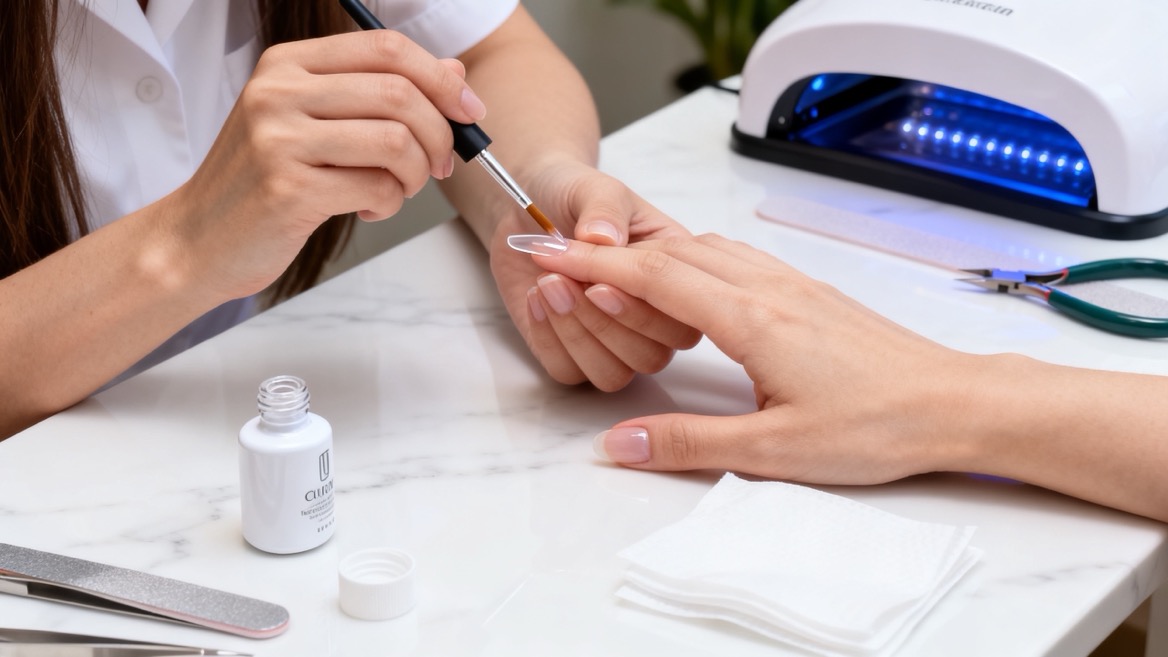
Whether a gel polish contains HEMA or is HEMA-free, avoiding contact between uncured gel and skin is one of the most important good-practice rules.
From a manufacturing and product-development perspective, the best formula can still create problems when it is applied carelessly. That is why quality brands should teach proper application as part of the product experience.
1. Clean and prepare the natural nail according to the product system.
2. Avoid applying gel over irritated, damaged, or broken skin.
3. Use a controlled amount of product on the brush.
4. Keep a small margin between the gel and the cuticle or sidewalls.
5. Clean any skin contact immediately before curing.
6. Apply thin coats rather than one thick coat.
7. Cure for the full recommended time using a compatible lamp.
8. Do not pick, peel, or force off the cured coating.
9. Remove gel using the recommended soak-off or professional removal method.
10. Stop use if irritation, itching, swelling, or blistering occurs.
This guidance is valuable for salons, educators, distributors, and direct-to-consumer nail brands. It also helps reduce avoidable complaints caused by incorrect use rather than an inherent defect in the product.
Regulatory requirements differ by market, so brands should not assume that one formula, label, or warning statement can be used everywhere without review.
In the European Union, HEMA and Di-HEMA trimethylhexyl dicarbamate are subject to restrictions for use in professional nail products, together with specified warning requirements. This means importers, distributors, and private-label brands selling into the EU need to verify formula status, product classification, labeling, responsible-person requirements, safety documentation, and local language obligations before launch.
Research published in 2024 found HEMA in nearly 60% of 394 cosmetic nail products examined and reported gaps in warnings and ingredient labeling among products containing HEMA. For buyers, this is a reminder that sourcing decisions should include documentation checks—not just colour selection and unit price.
When developing a nail-gel collection, request appropriate documents and product information from your supplier, which may include:
- Full ingredient list using INCI naming
- Safety Data Sheet where applicable
- Certificate of Analysis for relevant materials or batches
- Product specifications
- Microbiological or stability information where relevant
- Compatibility guidance for lamps and use conditions
- Packaging artwork review support
- Restricted-substance or market-specific compliance declarations
- Batch traceability information
- Sample-test and quality-control records
The exact documents needed depend on the destination market and product category. Brands should also work with local regulatory professionals where required.
The better choice depends on your business model, customer profile, and launch goals.
| Your Priority | Better Starting Direction |
|---|---|
| Building an ingredient-conscious retail collection | HEMA-free gel polish with clear application education |
| Supplying trained salon professionals | A validated professional system with strict use instructions |
| Launching in multiple international markets | Start with market-by-market formula and label review |
| Creating a high-pigment fashion collection | Focus on cure testing for every shade, regardless of HEMA status |
| Serving customers with HEMA-avoidance preferences | HEMA-free options plus transparent INCI disclosure |
| Competing on long wear and salon finish | Prioritise adhesion, lamp compatibility, coating flexibility, and testing |
The strongest commercial strategy is often not choosing only one category. Many established brands build a well-organised portfolio that includes a HEMA-free range, professional-use products where permitted, and transparent product education for every collection.
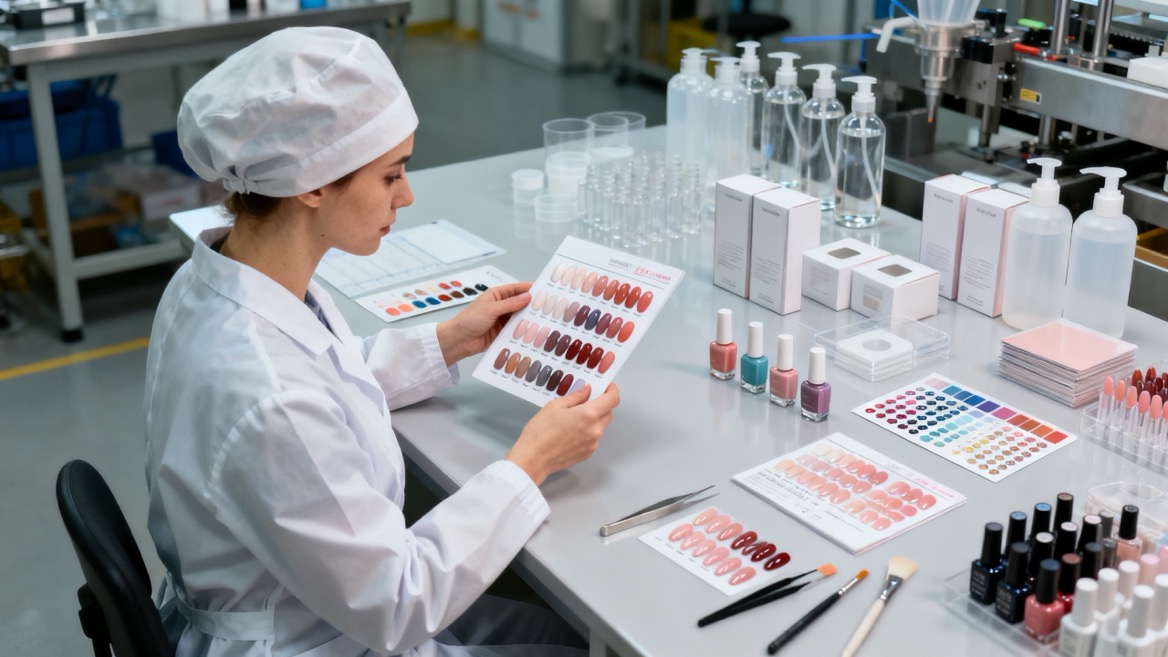
For OEM/ODM buyers, the most effective HEMA-free project begins with a clear product brief. "Please make a HEMA-free gel polish" is only the first step. A workable development brief should define the performance target, end market, packaging format, shade direction, curing system, intended user, price position, and compliance expectations.
At Dongguan YoungMei Technology Co., Ltd., we recommend structuring a custom project around the following questions:
- Which countries will the product be sold in?
- Is the target customer a salon professional, retailer, distributor, or home user?
- Do you require HEMA-free only, or exclusion of additional ingredients?
- Which lamp will customers use?
- What bottle size, brush type, cap finish, and outer packaging are required?
- Which colour categories are essential for launch?
- Do you need matching base coats, top coats, builders, nail stickers, or press-on nails?
- What testing, sampling, and artwork-approval stages are required before mass production?
A clear brief saves development time and reduces expensive revisions. It also makes it easier to create a consistent product story across gel polish, press-on nails, nail stickers, and other nail accessories.
HEMA-free gel polish and regular gel polish are not competing in a simple "good versus bad" comparison. They are formulation and market-positioning options that need to be evaluated through performance, ingredient transparency, safe-use instructions, target-market requirements, and reliable manufacturing control.
For brands that want to develop a HEMA-free gel polish collection, professional gel system, press-on nail range, nail-sticker line, or complete nail-accessory program, Dongguan YoungMei Technology Co., Ltd. can support OEM/ODM development from formula selection and rapid sampling to packaging coordination, quality control, and one-stop sourcing.
Contact our team to discuss your target market, product requirements, preferred packaging, and custom nail-product project.
No. HEMA-free only means that HEMA is not included in the formula. The product may still contain other acrylates, methacrylates, resins, or related ingredients used in UV/LED-cured nail systems. Always review the full ingredient list.
It can, but only when the formula is compatible with that lamp's wavelength, output, and recommended cure time. Brands should provide lamp-specific curing instructions rather than assuming every LED lamp performs the same way.
No. Regular gel polish is a product category, not a fixed ingredient list. Some conventional gel polishes contain HEMA, while others are formulated without it.
They should not assume it is suitable simply because it is HEMA-free. A previous reaction may involve HEMA or other ingredients. The person should stop using the triggering product and seek advice from a qualified medical professional before trying another UV-cured nail product.
Not necessarily. Adhesion depends on the complete formula, nail preparation, coat thickness, lamp compatibility, and application technique. A properly developed HEMA-free system can provide reliable wear.
Test the formula with the intended lamp, packaging, brush, base coat, top coat, and removal method. Review colour coverage, cure quality, gloss, viscosity, wear, and label claims before confirming bulk production.
1. European Commission, Scientific Committee on Consumer Safety. [The Safety of Cosmetic Ingredients HEMA and Di-HEMA Trimethylhexyl Dicarbamate].
2. Steunebrink IM, et al. [Presence of 2-hydroxyethyl methacrylate (HEMA) and di-HEMA trimethylhexyl dicarbamate in cosmetic nail products and associated labelling].
3. European Commission. [Opinion on the Safety of Cosmetic Ingredients HEMA and Di-HEMA Trimethylhexyl Dicarbamate].
4. Javaid K, et al. [Dermatologic Conditions Associated With Various Types of Nail Cosmetics: A Review].
5. Biorius. [HEMA in UV Nail Polishes: Regulatory and Safety Background].
6. American Contact Dermatitis Society-related clinical discussion. [Trends in Nail Services May Cause Dermatitis].