
- All
- Product Name
- Product Keyword
- Product Model
- Product Summary
- Product Description
- Multi Field Search
English
Views: 222 Author: Jenny Publish Time: 08-04-2026 Origin: Site


Content Menu
● Why Superficial Comparisons Fail
● Technical Principle and Material System
>> What this means in practice
>> Pro Tip
>> Simulated field-use comparison
● Compliance and Certification
>> Supply-chain terms worth using naturally
>> Pro Tip
● Hidden Costs: Maintenance, Installation, and Failure Risk
>> Simulated cost logic for decision-making
● Why Press-Ons Are Sometimes Better Than the "Upgraded" Option
● Recommended Comparison Table Fields
● Scenario-Based Recommendations
● A Common Industry Misconception
● FAQ
>> Are press-on nails only for one-day wear?
>> Do acrylic nails always damage natural nails?
>> Which option is more cost-effective in the long run?
For most buyers, press-on nails are the better choice when flexibility, lower commitment, and easier removal matter most, while acrylic nails make more sense when long-wear strength and salon-level structure are the priority. The real decision is not which option is universally better, but which one fits the user's wear cycle, maintenance tolerance, and budget model more accurately.

If the goal is fast application, lower upkeep, and easy style rotation, press-on nails usually win; if the goal is maximum structural durability over a longer wear window, acrylic nails usually perform better. That is why the best choice depends less on trend appeal and more on how the nails will actually be worn, maintained, removed, and repurchased over time.
This article is written for beginner buyers, including first-time beauty shoppers, small e-commerce buyers, private-label sourcing teams, and content marketers comparing product options for commercial or editorial use. These readers typically need a framework that goes beyond price and appearance, especially when comparing wear time, compliance expectations, maintenance burden, and total ownership cost. A more technical article for formulation specialists or product engineers would focus much more heavily on polymer chemistry, monomer ratios, curing behavior, and failure analysis, but that is not the most useful lens for a decision-first audience.
Many online articles reduce the comparison to "press-ons are cheaper" and "acrylics last longer," but that framing leaves out the deeper factors that actually drive satisfaction and repurchase behavior. Buyers do not just purchase a nail style; they purchase an application system, a maintenance schedule, a removal process, and a certain level of risk to the natural nail. Once those four layers are examined together, the differences between press-on and acrylic nails become much clearer.
Press-on nails are pre-formed artificial nail tips that are attached to the natural nail using adhesive tabs, liquid nail glue, or other pre-applied adhesive systems. Their main advantage is standardization: shape, size, finish, and visual design are already manufactured in advance, so the application process is mainly about surface preparation and secure attachment. In supply chain terms, press-ons behave more like a finished consumer good with packaging, sizing, adhesive compatibility, and batch consistency as key quality variables.
Acrylic nails work differently. They are created by combining a liquid monomer with a powder polymer to form a moldable material that hardens into a reinforced overlay or extension on the natural nail. This makes acrylic nails much more dependent on technician skill, product handling, shaping technique, curing behavior, and correct maintenance intervals. In practical terms, press-ons are a prefabricated product system, while acrylics are closer to an on-site service system built through application expertise.
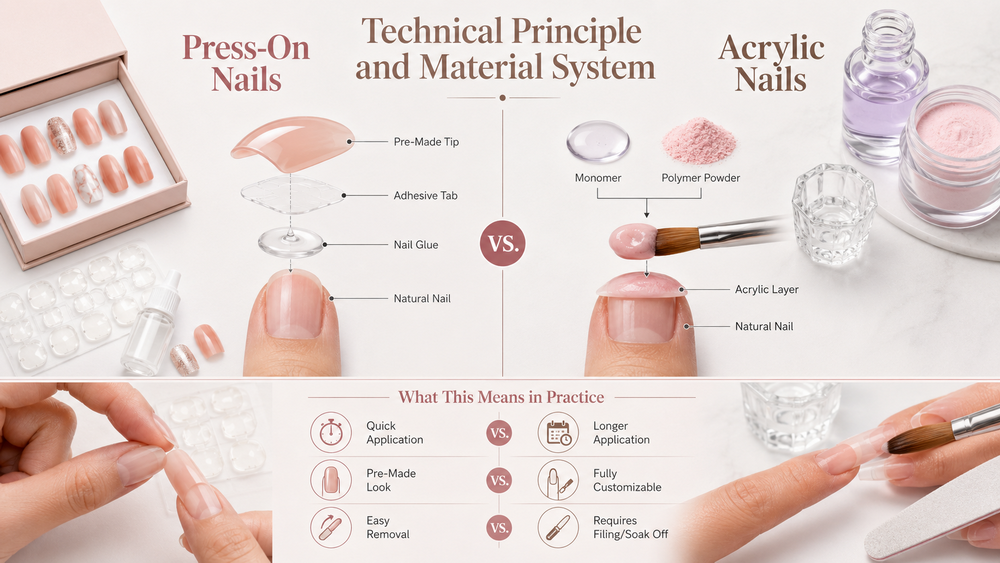
The material difference affects almost every downstream outcome. Press-ons are easier to scale, easier to swap, and easier for non-professional users to understand, while acrylics offer stronger structural reinforcement but demand more skill and more careful upkeep. For a buyer, the key question is whether convenience and repeatability matter more than long-wear structural performance.
A common mistake is to assume that the "more professional" material is automatically the better purchase. In reality, the better option is often the one with the lower failure cost after application, and press-ons can outperform acrylics in exactly that area because they are faster to replace and usually easier to remove correctly.
Durability is where acrylic nails usually earn their reputation. Typical press-on wear time varies sharply by adhesive method: adhesive tabs often last about 1 to 3 days, while glue-applied press-ons commonly last around 7 to 14 days under good prep and normal daily use. By contrast, acrylic nails are usually worn for longer cycles and often require a fill-in every 2 to 3 weeks as the natural nail grows out. That longer service interval is the main reason acrylics are seen as the more durable option.
However, lifecycle analysis tells a more nuanced story. Press-ons follow a short-cycle model: apply, wear, remove, and replace. Acrylics follow a maintenance-loop model: apply, grow out, fill, rebalance, and eventually remove. One system favors easy turnover; the other favors sustained wear with recurring upkeep.
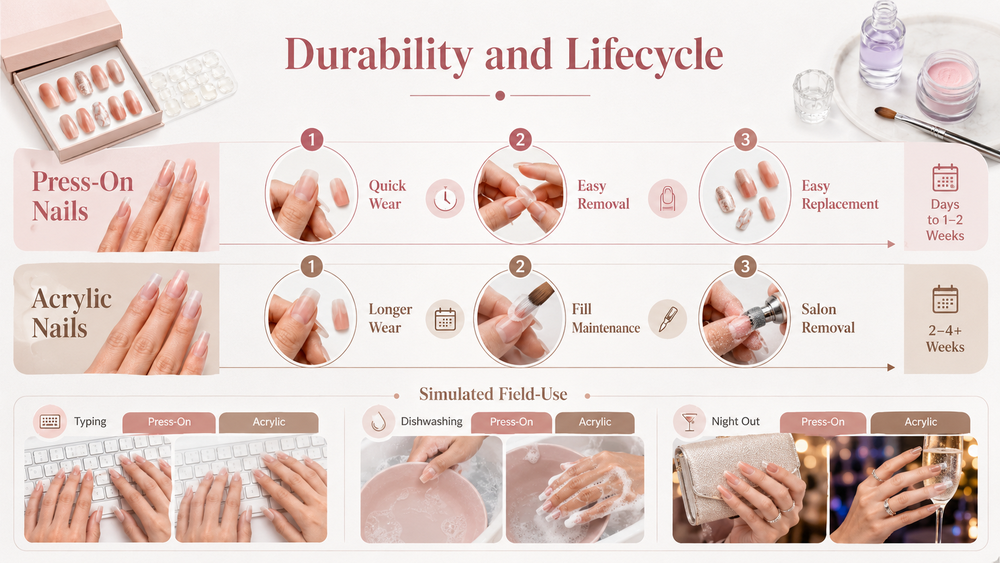
In a practical comparison model for beginner users, glue-based press-ons typically maintain acceptable cosmetic appearance for about 7 to 10 days under office work, light housework, and normal handwashing, while acrylic nails often maintain acceptable structure for 14 to 21 days before visible grow-out and fill demand become major issues. Under heavier use, such as frequent water exposure, packaging work, or repetitive tapping, press-ons are more likely to fail through edge lifting or full pop-off, while acrylics are more likely to show lifting near the cuticle area or stress at the apex if maintenance is delayed.
These numbers should not be treated as lab-certified universal values, but they reflect the wear ranges most frequently reported across current guidance and maintenance references. For an article aiming to sound expert without overstating certainty, that distinction matters: durability is influenced not only by product type, but also by prep, user habits, water exposure, application quality, and removal behavior.
Many buyers overvalue headline wear time and undervalue maintenance compliance. Acrylics can absolutely outlast press-ons, but the advantage shrinks fast when users skip fill-ins, delay repairs, or remove them aggressively at home. In those cases, the theoretical lifecycle benefit of acrylic nails can be undermined by higher repair and recovery costs.
Compliance is one of the most neglected parts of nail product comparison, especially in consumer-facing content. For press-on nails, the compliance conversation often includes cosmetic manufacturing controls, labeling accuracy, ingredient disclosure, safety documentation, and market-specific chemical restrictions. Sources discussing press-on manufacturing repeatedly reference frameworks such as ISO 22716 for cosmetic GMP, REACH-related expectations for EU market access, and SDS or MSDS documentation to support ingredient and handling transparency.
Acrylic systems involve compliance from two angles: the product chemistry itself and the professional service context in which the product is applied and removed. The chemistry side overlaps with general cosmetic and chemical safety expectations, while the service side brings in hygiene standards, professional handling practices, ventilation awareness, and skill-dependent application quality. For buyers evaluating suppliers, this means that "compliance" is not just a packaging claim; it is a documentation chain.

To improve authority in the article, these terms fit naturally into the comparison: batch traceability, SDS, private label, ingredient disclosure, GMP, REACH alignment, adhesive compatibility, fill-in cycle, salon protocol, and removal safety. These terms signal that the comparison is grounded not only in beauty trends but also in sourcing and risk control.
A supplier saying a product is "export-ready" is not the same as having a complete compliance file. For practical sourcing decisions, buyers should verify whether the supplier can provide batch-level traceability, safety documentation, and labeling support, especially for cross-border sales.
At first glance, press-on nails usually look cheaper. In many cases, they are cheaper on an upfront basis because the buyer is paying for a finished set rather than a salon service cycle. But hidden cost is where the comparison becomes more revealing.
For press-ons, hidden costs include repeated repurchase, sizing mismatch, replacement of lost nails, adhesive quality differences, prep time, and reduced wear when the user applies them poorly. For acrylic nails, hidden costs usually include salon appointments, recurring fill-ins, professional removal, aftercare, and the possibility of nail recovery treatments if the natural nail becomes thin or damaged after improper removal. So while press-ons often involve smaller and more frequent spending, acrylics can create a larger long-term maintenance burden.
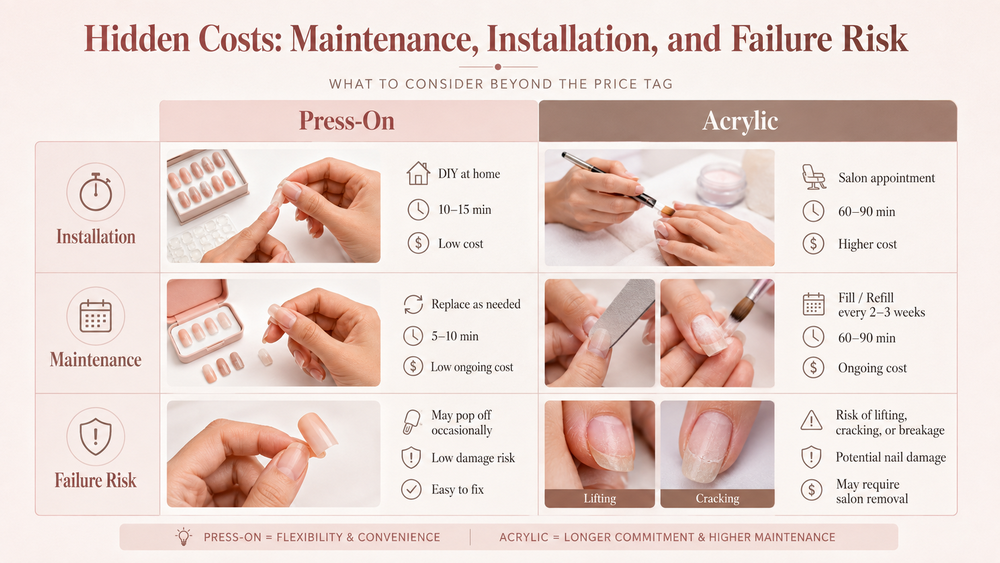
A simple decision model helps here. If a buyer uses press-ons for occasional events, travel, content shoots, or quick style changes, total annual cost can remain relatively controlled because maintenance is low and wear cycles are selective. If a buyer uses acrylics continuously all year, the cost structure often shifts from one-time purchase thinking to service subscription behavior, because fill-ins and upkeep become part of the routine.
This is where many consumers get trapped. Acrylic nails can look more cost-efficient on a cost-per-day basis over one wear cycle, but not always on a cost-per-year basis once recurring service, repair, and removal are fully counted. That distinction gives the article stronger real-world credibility because it mirrors how actual spending behaves.
One of the biggest "buyer traps" is focusing only on installation price. The smarter comparison is total ownership cost: application, maintenance, removal, replacement, and natural nail recovery if something goes wrong.
Most comparison articles lean toward acrylic nails because they are longer-lasting and are associated with salon professionalism. That is not always the best recommendation. Press-on nails can be the smarter choice when flexibility matters more than permanence, when the user likes frequent design changes, when travel or events drive short-term use, or when the buyer wants to reduce removal-related stress on the natural nail.
This is the most important counterintuitive point in the article: the lower-tier substitute can win because the use case is different, not because the premium option failed. In buyer psychology, the best-performing product is often the one that creates the fewest downstream problems. For style rotation, short commitment, and simpler replacement, press-ons often do exactly that.
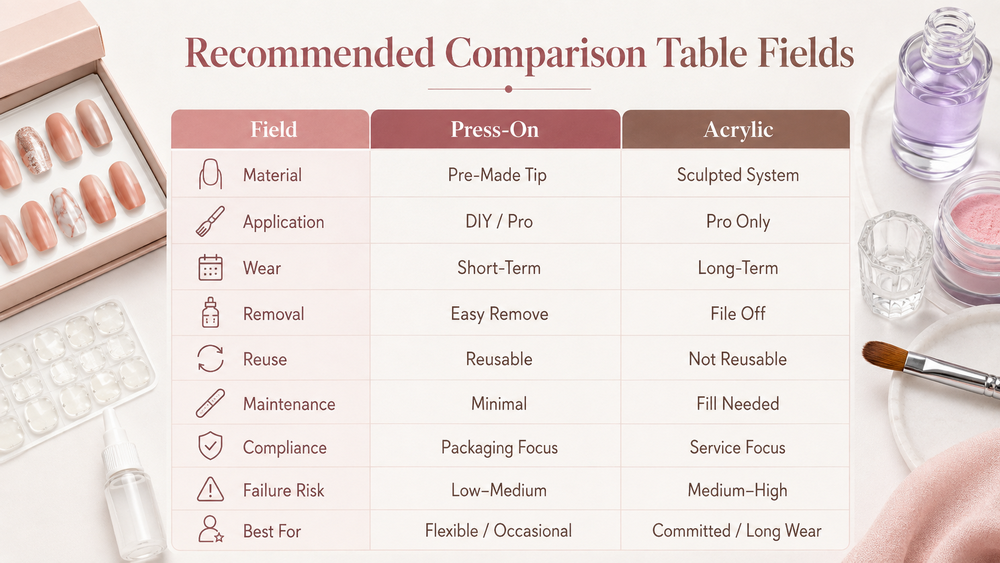
A visual comparison table should include the fields below so readers can understand the decision in seconds rather than paragraphs.
| Field | Why it matters |
|---|---|
| Product type | Clarifies whether the system is pre-made or salon-built |
| Core material / application system | Explains the technical difference between adhesive attachment and monomer-powder build |
| Typical wear time | Sets realistic performance expectations |
| Maintenance interval | Shows whether the user must plan for fill-ins or replacements |
| Removal method | Highlights convenience and risk to the natural nail |
| Main failure mode | Helps users anticipate lifting, pop-off, or grow-out problems |
| Compliance documents to request | Useful for private-label, retail, and cross-border buying |
| Hidden cost level | Adds the overlooked maintenance burden |
| Best-fit scenario | Turns comparison into decision support |
If the buyer is budget-conscious, tests new styles frequently, or only needs nails for short-term wear such as weekends, weddings, campaigns, or travel, press-on nails are usually the stronger choice because they are easier to apply, easier to remove, and less demanding in long-cycle maintenance. They also fit business models that prioritize variety, speed to market, and easier SKU expansion.
If the buyer wants a longer-wear beauty routine, prefers salon shaping, or values structural strength over quick replacement, acrylic nails make more sense because they hold up better over longer service windows and support a more durable finished look when maintained properly. They are especially suitable when the user accepts recurring fill-ins as part of the routine rather than seeing them as a drawback.
If the buyer is sourcing for professional channels or premium service experiences, acrylic systems can be positioned as the higher-commitment solution with stronger retention and salon credibility, while press-ons can be positioned as the low-friction, scalable solution for trend-led retail and beginner-friendly use. That type of framing is more objective than simply declaring one option superior.
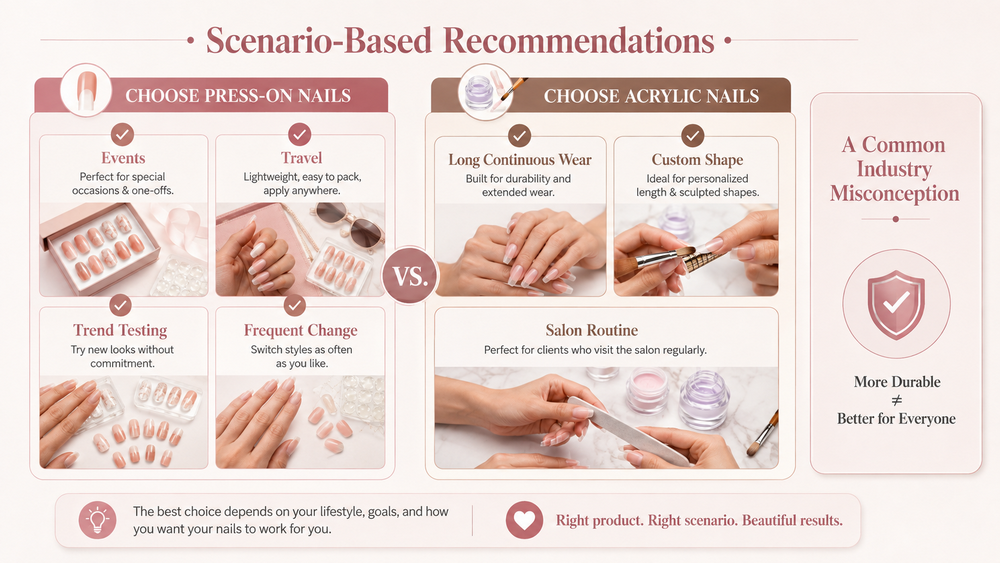
One of the most common misconceptions is that press-on nails are automatically low quality and acrylic nails are automatically the "serious" option. Current wear guidance and removal discussions do not support such a simple view. Press-ons may be less durable over long continuous wear, but they often offer a better balance of convenience, style flexibility, and lower removal burden for the average non-professional user.
No. Wear time depends heavily on the adhesive method. Adhesive-tab sets often suit very short wear, while glue-applied press-ons commonly last around 1 to 2 weeks when prep is done correctly.
Not always, but damage risk increases when application is too aggressive, when nails are over-filed, or when removal is rushed or forced. The product type matters, but the application and removal process matter just as much.
That depends on use frequency. For occasional wear and frequent style changes, press-ons are often more cost-effective because upkeep is lighter. For continuous long-wear use, acrylics may deliver better short-term durability, but the long-run cost can rise once fills, removal, and repair are included.
The best comparison is not "press-on nails versus acrylic nails" in the abstract. The real comparison is flexible, short-cycle beauty versus structured, maintenance-based wear. Once the decision is framed that way, buyers can choose based on actual lifestyle, maintenance tolerance, and business model fit instead of relying on beauty-industry assumptions.
1. Press On Nails Quality Control & Compliance Guide for EU Markets. Discusses ISO 22716, quality control expectations, and compliance topics relevant to press-on nail manufacturing. Source used from search result [1].
2. Safety Standards and Certifications for Nail Factories. Covers ISO 22716, REACH, RoHS, MSDS, testing, and factory safety topics relevant to nail product compliance. Source used from search result [2].
3. Legal & Safety Standards for Press On Nails Manufacturers. Summarizes labeling, testing, GMP, and global compliance expectations for press-on nail suppliers. Source used from search result [3].
4. Essential Certifications for Press-On Nail Manufacturers. Reviews key certifications and quality documentation used by press-on nail manufacturers. Source used from search result [4].
5. Do I Need a License to Sell Press-On Nails? (2026). Provides information on selling requirements, labeling, and regulatory expectations in the U.S. context. Source used from search result [5].
6. How Long Do Press-On Nails Last? Real Wear Time Guide. Used for reported wear-time ranges and application-related durability factors for press-on nails. Source used from search result [6].
7. How Long Do People Usually Keep Press On Nails On? Real Usage Guide. Used for common wear behavior and usage-duration context. Source used from search result [7].
8. How Long Do Press-On Nails Last? Glue vs Tabs vs Gel Adhesive. Used for comparing expected wear time by adhesive system. Source used from search result [8].
9. How Long Do Press-On Nails Last? Used for additional wear-time guidance and buyer-facing expectations. Source used from search result [9].
10. Reusing Press Ons: Here's How to Do It Right. Used for removal, reuse, and replacement logic around press-on nails. Source used from search result [10].
11. How Long Do Press-On Nails Last? Expert Guide (2026). Used for supporting context around wear variability and best-practice prep. Source used from search result [11].
12. Acrylic Fills | How to Do, Maintain & Fix Common Issues. Used for fill intervals, maintenance-cycle framing, and acrylic upkeep expectations. Source used from search result [12].
13. Are Acrylic Nails Bad for Your Nails and Skin? Used for removal risk, over-filing concerns, and natural nail damage context. Source used from search result [13].
