
- All
- Product Name
- Product Keyword
- Product Model
- Product Summary
- Product Description
- Multi Field Search
English
Views: 222 Author: Jenny Publish Time: 08-18-2026 Origin: Site


Content Menu
● What Does ABS Mean in Press-On Nails?
>> Why each ABS component matters
● Why ABS Is Commonly Used for Press-On Nail Tips
>> 1. Good strength-to-flexibility balance
>> 2. Smooth surface for nail art and decoration
>> 3. Efficient molding for OEM and private-label programs
>> 4. Commercially practical cost structure
● ABS vs. Soft Gel vs. Acrylic vs. PVC Nail Tips
● How to Assess ABS Press-On Nail Quality Before You Buy
>> Evaluate the complete application system
● Manufacturer Insight: The Production Controls That Matter
>> Mold precision and size repeatability
>> Material and color consistency
>> Decoration adhesion and wear testing
● Safety and Compliance: Make Claims Carefully
● Choosing an ABS Press-On Nail OEM Manufacturer
● Start Your Custom ABS Press-On Nail Project
● FAQ
>> 1. What is ABS in press-on nails?
>> 2. Are ABS press-on nails better than soft gel nails?
>> 3. Are ABS press-on nails safe?
>> 4. Can ABS nails be used for kids' nail products?
>> 5. How long do ABS glue-on nails last?
>> 6. Can ABS press-on nails be customized for private label?
>> 7. What should I test before ordering ABS press-on nails in bulk?
When buyers ask us, "What is ABS in press-on nails?", they usually want to know more than the material name. They want to know whether ABS nail tips are durable, comfortable, safe to market, easy to customize, and reliable for large-scale production.
ABS stands for acrylonitrile butadiene styrene. It is a thermoplastic polymer widely used to make press-on nails, glue-on nails, and children's nail products because it can balance strength, flexibility, surface smoothness, and molding efficiency. For a nail brand, the right ABS formulation and production process can make the difference between a nail set that feels natural and one that cracks, warps, lifts, or looks overly plastic.
As an OEM press-on nail manufacturer, we believe the material should never be evaluated in isolation. The real result depends on the ABS grade, tip thickness, curve design, injection-molding consistency, surface treatment, decoration method, adhesive system, and quality-control process.
> Key takeaway: ABS is not automatically "good" or "bad." A well-designed ABS press-on nail can offer a lightweight, durable, customizable option for retail, salon, promotional, and private-label nail collections.

ABS is made from three components: acrylonitrile, butadiene, and styrene. Together, they produce a material that can be molded into detailed shapes while retaining useful impact resistance and flexibility.
For press-on nail production, ABS is commonly used as the structural base of the artificial nail tip. Manufacturers heat the material, inject it into precision molds, cool it, trim it, and then decorate the finished nail through printing, painting, chrome effects, glitter application, 3D embellishment, or other finishing processes.
- Acrylonitrile contributes chemical resistance and hardness.
- Butadiene improves toughness and helps reduce brittleness.
- Styrene supports rigidity, surface finish, and moldability.
This balance is why ABS is widely selected for mass-produced artificial nails. A nail tip must be firm enough to hold its shape but flexible enough to follow the natural curve of the wearer's nail bed.
[Suggested image placement: after this section]
AI image prompt:
"Macro product cutaway of a premium ABS press-on nail tip, showing a smooth curved artificial nail structure and subtle layered material visualization, clean white background, professional cosmetics manufacturing style, realistic studio lighting, no text, high detail."
For brands and wholesalers, ABS offers practical advantages throughout the product lifecycle—from product development to shipment and consumer use.
A rigid tip can feel uncomfortable and may crack when pressed onto a curved nail bed. An overly soft tip may deform, lose its shape, or look less premium. Properly formulated ABS helps achieve a more balanced feel.
This is especially important for:
- Short square press-on nails for everyday wear
- Medium almond and coffin nail tips
- Long fashion nails with printed or 3D designs
- Kids' nail sets that need lightweight, smooth edges
- Multi-size sets designed for a broad range of nail widths
ABS can provide a stable surface for various decorative processes. This makes it useful for brands developing trend-driven collections, including:
- French tip press-on nails
- Solid-color matte nail sets
- Chrome or metallic-effect nails
- Cat-eye-inspired visual designs
- Glitter and holographic styles
- Floral, animal-print, or seasonal artwork
- 3D press-on nails with attached decorative elements
A smooth and consistent substrate supports more even color application and cleaner artwork. However, the decoration's durability still depends on paint adhesion, curing or drying conditions, topcoat performance, and abrasion testing—not solely on the ABS base.
ABS can be injection molded at scale. For OEM buyers, this makes it possible to create multiple shapes, lengths, and C-curves while maintaining repeatable production standards.
A professional manufacturer can support customization in areas such as:
| Customization area | What brands can specify |
|---|---|
| Nail shape | Square, squoval, almond, oval, coffin, stiletto, ballerina |
| Nail length | Short, medium, long, extra-long |
| C-curve | Flatter, natural, or deeper curvature |
| Thickness | Lightweight everyday tips or stronger fashion tips |
| Finish | Glossy, matte, pearl, chrome-look, glitter, translucent |
| Artwork | Printed patterns, hand-painted effects, French tips, seasonal graphics |
| Packaging | Retail box, blister pack, paper card, pouch, brand insert |
| Application accessory | Nail glue, adhesive tabs, prep pad, cuticle stick, mini file |
Compared with some more specialized nail systems, ABS press-on nails can offer a cost-efficient route to launching a wide variety of styles. This matters for private-label brands that want to test collections, refresh designs frequently, or serve several price tiers.
Cost efficiency should not mean cutting quality. A lower-priced press-on nail can still require accurate molds, controlled material sourcing, clean trimming, reliable coating adhesion, and appropriate packaging protection.
The phrase "best nail material" can be misleading because these options may refer to different product types and application systems. For example, salon acrylic extensions, UV-cured gel systems, and pre-made press-on nail tips are not direct equivalents.
For press-on nail buyers, the better question is: Which material and product design fit the intended customer, use scenario, price point, and brand promise?
| Factor | ABS press-on nail tips | Soft gel nail tips | Acrylic enhancement systems | PVC nail products |
|---|---|---|---|---|
| Typical format | Pre-made press-on or glue-on nail | Pre-made tips or salon extension systems | Liquid-and-powder salon enhancement | Often low-cost molded artificial nails |
| Feel | Balanced firmness and flexibility | Often described as more flexible or gel-like | Usually rigid once cured | Can vary, often less refined |
| Custom molding | Strong potential | Depends on formulation and production method | Not typically a pre-decorated press-on format | Possible but quality can vary |
| Decoration options | Broad: print, paint, glitter, 3D effects | Broad, depending on surface process | Usually finished through salon application | Often more basic |
| Best fit | Retail press-ons, OEM collections, wholesale sets | Premium flexible nail-tip positioning | Professional salon services | Budget or novelty products |
| Key purchasing focus | Material grade, mold, thickness, adhesion, finish | Flexibility, fit, curing/system compatibility | Technician process and product chemistry | Safety documentation and quality consistency |
Important: Avoid making unverified claims that one material is universally "non-toxic," "hypoallergenic," or "safer" than every alternative. Product safety depends on the complete finished set, including pigments, coatings, glues, removers, packaging claims, intended use, and the regulations in the destination market.
The U.S. Food and Drug Administration notes that nail products sold in the United States must be safe when used as labeled or customarily used. It also highlights that some consumers may develop allergic reactions to certain ingredients used in nail products. [fda](https://www.fda.gov/cosmetics/cosmetic-products/nail-care-products)
[Suggested image placement: after comparison table]
AI image prompt:
"Premium B2B cosmetic product comparison flat lay: ABS press-on nails, soft gel nail tips, professional acrylic nail tools, and simple PVC nail tips, arranged in four labeled visual zones without visible brand names or text, clean editorial beauty lighting, neutral background, realistic product photography."
Two ABS nail sets can look similar online but perform very differently in real use. For brands, distributors, and importers, evaluating quality before placing a large order is essential.
Ask for samples and inspect the following points:
1. Fit and C-curve: The tip should sit naturally over the nail without excessive pressure at the sidewalls.
2. Thickness consistency: Tips should not feel paper-thin at stress points or unnecessarily bulky near the cuticle.
3. Edge quality: Check for sharp flash, rough trimming, burrs, and uneven free edges.
4. Surface finish: Look for flow marks, sink marks, bubbles, scratches, or inconsistent gloss.
5. Flex test: Gently flex representative tips. The goal is controlled resilience, not extreme brittleness or permanent distortion.
6. Color and design adhesion: Rub and lightly scratch-test non-visible areas according to your internal test protocol.
7. Size assortment: Verify that the nail-width range fits the target customer group and that sizes are clearly identified.
A press-on nail is a system, not only a tip. Nail glue and adhesive tabs have different intended wear experiences.
- Liquid nail glue is generally selected for stronger, longer wear when used correctly.
- Adhesive tabs are typically better for shorter wear, easier removal, try-on occasions, and frequent style changes.
- Prep tools influence adhesion because oil, moisture, and dust can reduce bonding performance.
- Instructions and warnings help consumers apply and remove the product more responsibly.
For example, a premium ABS nail tip paired with weak adhesive tabs may receive poor consumer reviews for "falling off," even if the tip itself is well made. Conversely, a strong glue paired with unclear removal instructions can create avoidable customer dissatisfaction.
From a factory perspective, the strongest quality difference is often not visible in a product photo. It sits inside the production controls.
A good mold helps ensure each size is consistent in width, curvature, apex profile, and edge thickness. If size 5 varies across production runs, consumers may experience fit problems even when the design looks excellent.
The factory should establish controls for incoming ABS material, masterbatch or pigment use, and production settings. Inconsistent parameters can result in shade variation, uneven transparency, warping, or unstable surface appearance.
For printed, painted, chrome-look, or 3D nail collections, quality teams should verify:
- Artwork registration and placement
- Color consistency against approved samples
- Topcoat appearance and adhesion
- Resistance to normal handling and packing friction
- Embellishment attachment strength
- Defect rate before final packing
Long or embellished nails need packaging that prevents pressure damage in transit. For retail-ready sets, this may include molded trays, secure wells, protective films, inner cards, and cartons designed around the product's fragility.
> OEM tip: Approve a "golden sample" before mass production. It should document the nail shape, length, thickness, material appearance, artwork, accessory assortment, packaging, barcode location, and acceptable quality standard.
Material marketing must be accurate. It is risky to claim that all ABS press-on nails are "hypoallergenic," "eco-friendly," or "compliant with U.S. and EU standards" without product-specific substantiation.
For the U.S. market, nail products are regulated as cosmetics, and companies remain responsible for product safety and labeling. FDA materials caution that polymers are generally considered relatively safe, but residual reactive substances or other ingredients can be associated with reactions in sensitized individuals. [fda](https://www.fda.gov/cosmetics/cosmetic-products/nail-care-products)
For the EU market, cosmetic products require a responsible person and supporting product information, including safety-related documentation. EU cosmetics legislation also generally prohibits substances classified as carcinogenic, mutagenic, or toxic for reproduction, subject to limited regulatory conditions and exceptions. [health.ec.europa](https://health.ec.europa.eu/document/download/47f167ec-b5db-4ec9-9d12-3d807bf3e526_en?filename=cosmetic_1223_2009_regulation_en.pdf)
For brand owners, practical compliance preparation may include:
- Product ingredient and material documentation
- Safety data for adhesives, coatings, and relevant chemical components
- Destination-market labeling review
- Batch or lot traceability
- Age-appropriate warnings for kids' nail products
- Stability, compatibility, and packaging assessments where applicable
- Product safety and quality documentation maintained by the responsible parties
Do not position ABS itself as a guarantee of safety. Instead, communicate that the product is developed with material control, appropriate testing, responsible labeling, and market-specific compliance review.
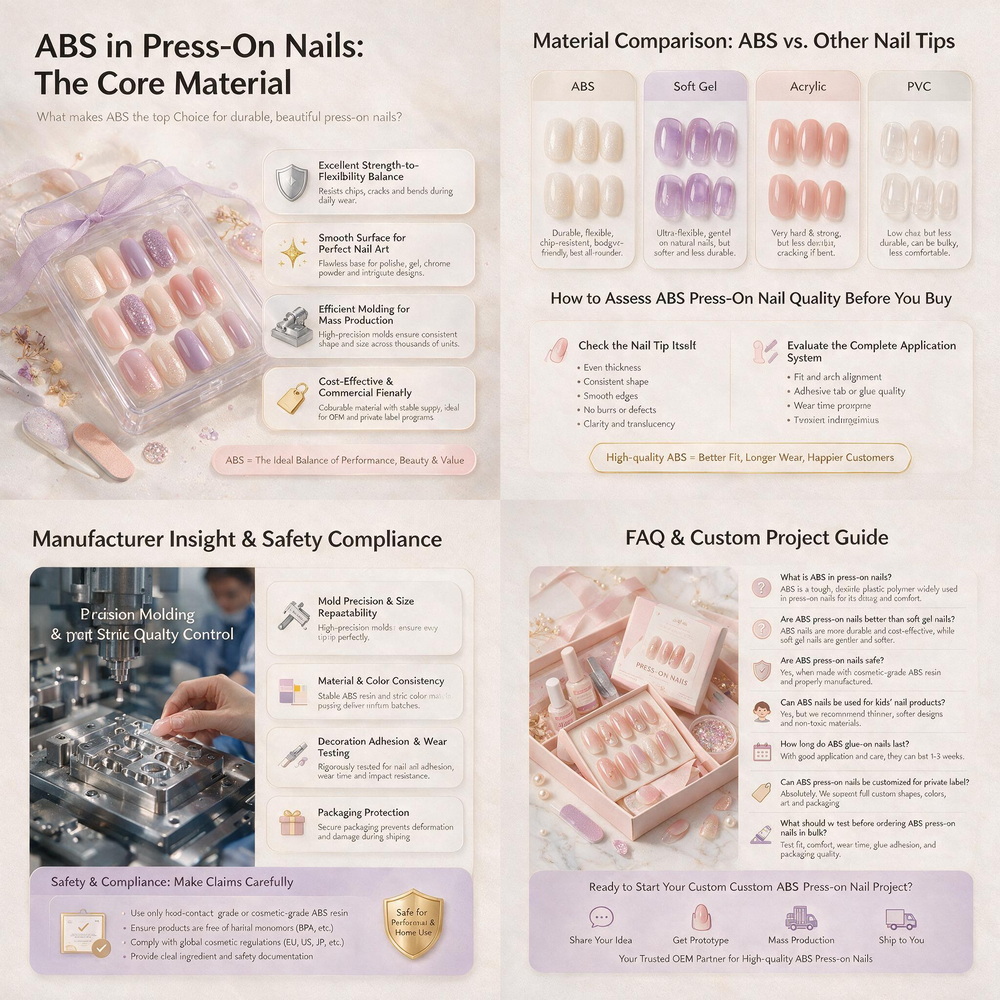
A reliable OEM partner should be able to discuss more than "we can make any design." Look for a manufacturer that can explain how it controls quality from concept to shipment.
Ask these questions before selecting a supplier:
- What ABS material options and tip thicknesses do you offer?
- Can you provide physical samples before confirming a bulk order?
- How do you control C-curve, sizing, and mold consistency?
- What inspection points apply to printing, 3D decorations, and topcoat adhesion?
- Can you support private-label packaging and required inserts?
- What are the MOQ, sampling timeline, production lead time, and quality standard?
- Can you provide relevant documentation for the target market and accessory components?
- How do you handle color approval, artwork revisions, and production defects?
At Dongguan YoungMei Technology Co., Ltd., we support overseas nail brands, wholesalers, and manufacturing partners with OEM and custom press-on nail solutions. Whether you need classic French nails, trend-focused chrome designs, reusable glue-on nail sets, or age-appropriate kids' nails, a structured development process helps turn your concept into a consistent retail product.
A successful private-label nail collection starts with the right product brief. Share your target market, nail shape, length, design direction, expected price point, packaging idea, and preferred application method.
Contact Dongguan YoungMei Technology Co., Ltd. to request ABS press-on nail samples, discuss OEM customization, and develop a collection built for your brand—not a generic catalog listing.
ABS is short for acrylonitrile butadiene styrene, a moldable thermoplastic commonly used as the base material for press-on and glue-on nail tips. It is valued for its combination of strength, flexibility, smooth surface quality, and suitability for mass production.
Neither is universally better. ABS press-on nails are often a practical choice for scalable OEM production and diverse decoration options. Soft gel nails may be positioned around a more flexible, gel-like feel. Brands should select based on target users, desired fit, design requirements, price point, and performance testing.
Safety depends on the entire finished product—not only the ABS tip. Brands should evaluate the nail tip, coatings, pigments, adhesive, instructions, labeling, and market-specific requirements. Consumers should follow the product directions and discontinue use if irritation occurs.
Yes, ABS can be used in kids' nail sets when the product is appropriately designed. Manufacturers should prioritize smooth edges, suitable sizing, lightweight construction, age-appropriate packaging, clear warnings, and a suitable temporary-wear adhesive approach.
Wear time depends primarily on nail preparation, nail fit, adhesive type, water exposure, daily activity, and correct application. Glue-on sets generally target longer wear than adhesive-tab sets, while adhesive tabs are often chosen for temporary use and easier removal.
Yes. OEM customization can include nail shape, size range, length, C-curve, thickness, colors, printed artwork, surface effects, 3D decorations, accessory kits, packaging, logo placement, and inserts.
Request samples and assess fit, tip thickness, flexibility, edge smoothness, surface defects, color accuracy, decoration adhesion, glue or adhesive-tab performance, packaging protection, and the consistency of the size assortment.
1. U.S. Food and Drug Administration. *Nail Care Products.* Discusses safety expectations for nail products sold in the United States and notes potential sensitivity concerns related to some nail-product ingredients. [FDA source](https://www.fda.gov/cosmetics/cosmetic-products/nail-care-products) [fda](https://www.fda.gov/cosmetics/cosmetic-products/nail-care-products)
2. European Commission. *Regulation (EC) No 1223/2009 on Cosmetic Products.* Covers cosmetic-product safety requirements, product information, notification obligations, and restrictions on certain substances. [European Commission PDF](https://health.ec.europa.eu/document/download/47f167ec-b5db-4ec9-9d12-3d807bf3e526_en?filename=cosmetic_1223_2009_regulation_en.pdf) [health.ec.europa](https://health.ec.europa.eu/document/download/47f167ec-b5db-4ec9-9d12-3d807bf3e526_en?filename=cosmetic_1223_2009_regulation_en.pdf)
3. European Commission. *CMR Substances in Cosmetic Products.* Explains the general prohibition framework for carcinogenic, mutagenic, and reprotoxic substances in EU cosmetic products, with limited exceptions. [European Commission guidance](https://single-market-economy.ec.europa.eu/sectors/cosmetics/cosmetic-products-specific-topics/cmr-substances_en) [single-market-economy.ec.europa](https://single-market-economy.ec.europa.eu/sectors/cosmetics/cosmetic-products-specific-topics/cmr-substances_en)
4. Original source page supplied for restructuring: *What Is ABS in Press-On Nails?: ABS Material Details.* Used as the baseline for identifying content gaps and rebuilding the article structure. [Original article](https://www.xianxingbeauty.com/what-is-abs-in-press-on-nails-abs-material-details.html) [xianxingbeauty](https://www.xianxingbeauty.com/what-is-abs-in-press-on-nails-abs-material-details.html)
