
- All
- Product Name
- Product Keyword
- Product Model
- Product Summary
- Product Description
- Multi Field Search
English
Views: 217 Author: Young Mei Publish Time: 09-12-2026 Origin: Site


Content Menu
>> Why Glossy Nails Remain a Core Retail Finish
>> Why Matte Nails Feel More Fashion-Led
● Glossy vs. Matte Top Coat: Side-by-Side Comparison
● How Top-Coat Finish Changes Nail Color
>> Best Finish by Color Family
● Durability: Is Glossy or Matte More Long-Lasting?
>> What Buyers Should Test Before Launch
● Application Guide for a Smooth Finish
>> Step 1: Prepare a Clean Nail Surface
>> Step 2: Build an Even Color Layer
>> Step 3: Apply the Top Coat in Controlled Strokes
>> Step 4: Dry or Cure Completely
>> Step 5: Protect the Final Surface
● Mixed Glossy and Matte Designs Create Higher-Value Collections
>> High-Impact Mixed-Finish Ideas
● Choosing the Right Finish for Your Customer
>> A Practical Buying Framework
● Finish Development for OEM and ODM Projects
>> Questions to Ask Your Nail Product Manufacturer
● Final Verdict: Glossy or Matte Top Coat?
● FAQs
>> 1. Can I use a matte top coat over glossy nail polish?
>> 2. Does a glossy top coat make nail color look brighter?
>> 3. Does matte top coat last as long as glossy top coat?
>> 4. Which top coat is better for press-on nails?
>> 5. Can glossy and matte finishes be used on the same press-on nail design?
>> 6. Which colors look best with a matte finish?
>> 7. Why does my matte top coat become shiny in some areas?
>> 8. Can a supplier customize the top-coat effect for private-label nail products?
A glossy top coat delivers a reflective, glass-like surface that makes color look deeper and brighter, while a matte top coat transforms the same shade into a soft, non-reflective, velvety finish. Neither is universally "better": the ideal choice depends on the nail design, target customer, wear expectations, product system, and the visual identity of the collection.
For private-label nail brands, wholesalers, salon chains, and retail buyers, this is more than a style decision. The top-coat finish affects product positioning, customer satisfaction, photography, repeat purchases, and the number of designs that can be created from a single color range. At Dongguan YoungMei Technology Co., Ltd., we have seen how a well-planned finish range helps buyers turn one press-on nail or nail sticker collection into multiple commercial stories.

A glossy top coat is a clear finishing layer designed to create a smooth, highly reflective surface over colored nail polish, gel polish, press-on nails, nail stickers, or nail art. It is commonly used to enhance color depth, level minor surface texture, protect decorative layers, and create the polished "fresh salon manicure" appearance many consumers recognize immediately.
A high-quality glossy top coat should create an even film without visible brush marks, shrinking, cloudiness, or uneven reflection. For pre-made press-on nails, a glossy finish can also make printed patterns, chrome effects, glitter, marble details, and jelly colors appear more dimensional.
Glossy nails are a commercial staple because they are familiar, versatile, and easy to photograph. Their reflective surface catches light, helping colors appear more saturated and designs look more premium in product images, videos, store displays, and social content.
Key advantages of a glossy finish include:
- High visual impact for product photography and e-commerce listings
- Brighter-looking color on reds, pinks, jellies, neons, metallics, and glitter designs
- A smooth, polished appearance that suits classic and trend-led collections
- Versatility across everyday, bridal, holiday, party, and professional nail styles
- Strong compatibility with rhinestones, foil, decals, cat-eye patterns, and printed nail art
- Easy consumer recognition, especially for first-time press-on nail buyers
For example, a translucent cherry-red press-on nail may look juicy and glass-like under a glossy top coat. The same red design with a matte finish becomes moodier, softer, and more fashion-forward. One base design can therefore support two distinct product concepts.
A matte top coat is a clear finishing layer that reduces surface reflection. Instead of creating a mirror shine, it leaves a soft, muted, suede-like, velvet-like, or frosted appearance. It can be applied over many colors and design styles to convert a shiny surface into a contemporary matte nail look.
A successful matte top coat should dry or cure evenly. It should not produce patchiness, unwanted gloss spots, drag marks, chalkiness, or a rough-feeling surface. For manufacturers and buyers, formula consistency is especially important because matte finishes make application inconsistencies more visible than glossy finishes.
Matte nail finishes often appeal to customers who want a more editorial, understated, modern, or luxury-inspired look. They reduce light reflection, which changes how a color is perceived. Dark shades can become more dramatic, nude colors can look more refined, and minimalist designs can gain visual depth.
Matte top coats are particularly effective for:
- Black, charcoal, burgundy, navy, and dark green press-on nails
- Minimalist nude and neutral nail collections
- Autumn and winter seasonal launches
- Velvet, suede, soft-touch, and quiet-luxury visual themes
- Men's grooming or gender-neutral nail concepts
- French-tip, geometric, marble, and negative-space nail art
- Mixed-finish designs with glossy details over a matte base
The finish can also help hide minor visual irregularities on the nail surface. A glossy surface reflects light strongly, so unevenness may be easier to notice. Matte surfaces scatter light instead, which can make small imperfections less obvious. However, this does not replace proper surface preparation or quality control.
| Comparison Factor | Glossy Top Coat | Matte Top Coat |
|---|---|---|
| Visual effect | Bright, reflective, glass-like | Soft, non-reflective, velvety |
| Color appearance | Makes shades look richer and more vibrant | Makes shades look calmer, deeper, or more muted |
| Best for | Classic, glamorous, colorful, glitter, jelly, chrome, bridal styles | Modern, minimalist, luxury, dark-tone, fashion-led styles |
| Photography performance | Reflects light and makes details pop, but may cause glare | Reduces glare and can show patterns clearly, but may look flatter in low light |
| Surface appearance | Smooth and polished | Soft and sophisticated |
| Scratch visibility | Fine scratches may become noticeable because of reflection | Scuffs, oils, and rubbed areas may create unwanted shine patches |
| Consumer expectation | Familiar and widely accepted | More distinctive and trend-driven |
| Product range role | Essential core finish | Valuable differentiator and collection extension |
| Ideal design pairing | Glitter, foil, rhinestones, high-shine nail art | French tips, geometric art, dark colors, soft-touch effects |
| Maintenance perception | Often looks “freshly polished” when clean | Requires care to preserve an even non-shiny surface |
The practical conclusion is simple: glossy top coat is usually the safer core offering, while matte top coat creates differentiation and stronger collection storytelling.
The color underneath does not technically become a different pigment, but it can look dramatically different because light interacts differently with a glossy and matte surface.
Glossy finishes reflect light more directly. This creates highlights and visual depth. Bright red may look more vibrant. Jelly pink may look more translucent. Fine glitter may sparkle more intensely. Chrome or metallic effects generally rely on reflection, so a glossy finish is usually the more suitable option.
Matte finishes scatter light rather than reflecting it sharply. This creates a calmer visual impression. A black press-on nail becomes more velvet-like. A nude shade can appear warmer and more elegant. A bright color may look slightly softer or more muted.
| Color or Effect | Recommended Primary Finish | Why It Works |
|---|---|---|
| Classic red | Glossy | Enhances depth, shine, and a traditional polished look |
| Black | Matte or glossy | Matte looks modern and velvet-like; glossy looks bold and dramatic |
| Nude and beige | Matte or soft gloss | Matte supports understated luxury; gloss creates a clean natural manicure effect |
| Jelly colors | Glossy | Preserves transparency and a juicy finish |
| Glitter | Glossy | Maximizes sparkle and smooths the surface |
| Chrome and metallic | Glossy | Reflection is central to the visual effect |
| Marble designs | Matte, glossy, or mixed finish | Matte adds an artistic feel; gloss adds depth |
| French tips | Matte base with glossy tips, or full gloss | Mixed finishes create a premium design contrast |
| Pastels | Both | Glossy feels playful; matte feels soft and modern |
| Dark autumn colors | Matte | Supports seasonal, elevated, and fashion-forward positioning |
For OEM and ODM buyers, this comparison matters during product development. A brand may not need twice as many colors to create a larger catalog. Instead, it can use selected base colors across glossy, matte, and mixed-finish press-on nail designs.
Durability depends more on the complete formula system and application process than on finish alone. The adhesion of the base layer, flexibility of the coating, curing conditions for gel products, surface preparation, and packaging protection all influence wear performance.
That said, the two finishes tend to show wear differently.
A glossy top coat can make fine scratches more noticeable because its reflective surface highlights changes in texture. However, premium glossy systems may offer strong leveling, smoothness, and shine retention. A glossy finish is also often easier for consumers to visually assess because fingerprints, dust, and smudges can usually be wiped away.
A matte top coat may hide small dents or nail-surface irregularities, but it can develop shiny spots when rubbed repeatedly. Oils, lotions, friction, and cleaning products may alter how evenly matte the surface appears. Matte finishes therefore require careful formulation and clear aftercare guidance.
For custom press-on nails, nail stickers, or nail-care products, the right question is not only "How long does it last?" Ask how the finish performs through common consumer use.
Request testing on:
1. Gloss or matte consistency across the full nail surface
2. Scratch resistance during packaging, transportation, and daily handling
3. Edge protection, especially around the free edge of press-on nails
4. Adhesion between the color layer, design layer, and finishing layer
5. Resistance to fingerprints, oils, hand cream, and household moisture
6. Color stability after exposure to light and normal storage conditions
7. Compatibility with adhesives, tabs, glue, printed layers, decals, and embellishments
8. Cure performance when the product is part of a gel-based system
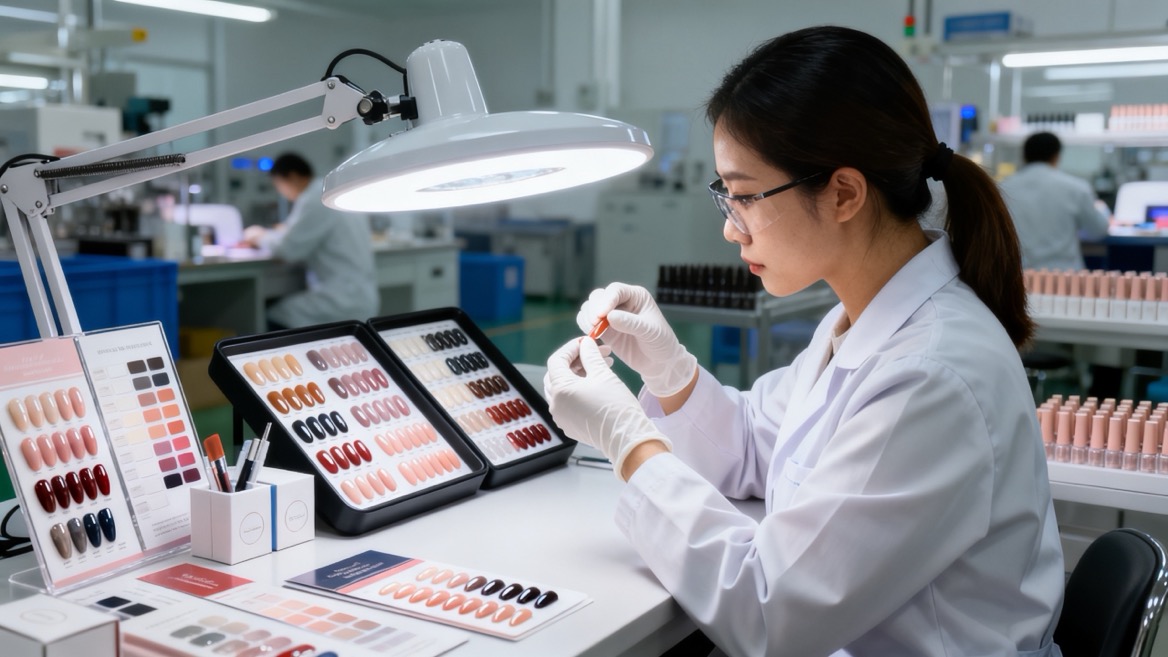
A quality supplier should be able to discuss not only appearance, but also the production controls behind the result: coating thickness, drying or curing process, surface inspection, packaging design, and batch consistency.
Whether the goal is a glossy or matte manicure, preparation is the foundation. The most beautiful top coat cannot fully correct poor nail prep, dust contamination, uneven color layers, or insufficient curing.
Remove old polish, oil, dust, and moisture from the natural nail or artificial nail surface. Shape the nails consistently and gently push back cuticles when appropriate. For press-on nails, inspect the inside curve and outer surface before application.
A clean surface improves adhesion and reduces the risk of premature lifting.
Apply color in thin, controlled layers. Allow each layer to dry or cure according to the product system. Thick layers may wrinkle, shrink, or create uneven curing in gel applications.
For press-on nail manufacturing, color application should be standardized by shade, finish, and design complexity. A soft pastel solid color requires different visual inspection criteria from a glitter, chrome, or hand-painted art design.
Use enough product to cover the surface evenly, but avoid flooding the sidewalls or cuticle area. Float the brush lightly over the nail rather than pressing too hard. Use as few strokes as possible to reduce streaking.
For both finishes, cap the free edge when the product format and design allow. This helps protect the edge area, which is often the first point to show wear.
Air-dry, LED, UV, and hybrid systems require different handling. Follow the product-specific instructions for curing time, lamp compatibility, and any required wipe step. Under-curing can affect appearance, adhesion, and surface performance.
For a professional product range, brands should validate the complete system rather than assuming every lamp or top coat will perform identically.
Avoid immediate contact with oils, lotions, cleaning agents, or abrasive materials until the finish has fully set. For a matte look, consumers should understand that hand cream and cuticle oil may temporarily make the surface look shinier.
For reusable press-on nails, include simple care instructions in the packaging. This small step can reduce avoidable complaints and improve perceived product quality.
One of the most commercially useful approaches is not choosing only matte or only glossy. It is combining both finishes in a single design.
A mixed-finish design adds contrast without necessarily increasing the number of colors, decorations, or components. This can be useful for brands seeking a premium-looking collection with controlled development costs.
- Matte black nails with glossy French tips
- Glossy nude nails with matte floral patterns
- Matte burgundy nails with a glossy swirl design
- Glossy jelly bases with matte graphic details
- Matte press-on nails with high-gloss logo accents
- Matte pastel nails with glossy hearts, stars, or bows
- Glossy marble nails with selective matte sections
- Matte neutral nails with glossy chrome-inspired linework
For a private-label collection, mixed finishes can create a strong "designed" impression in product photography. They also offer a clear reason for consumers to choose a premium set rather than a basic solid-color option.
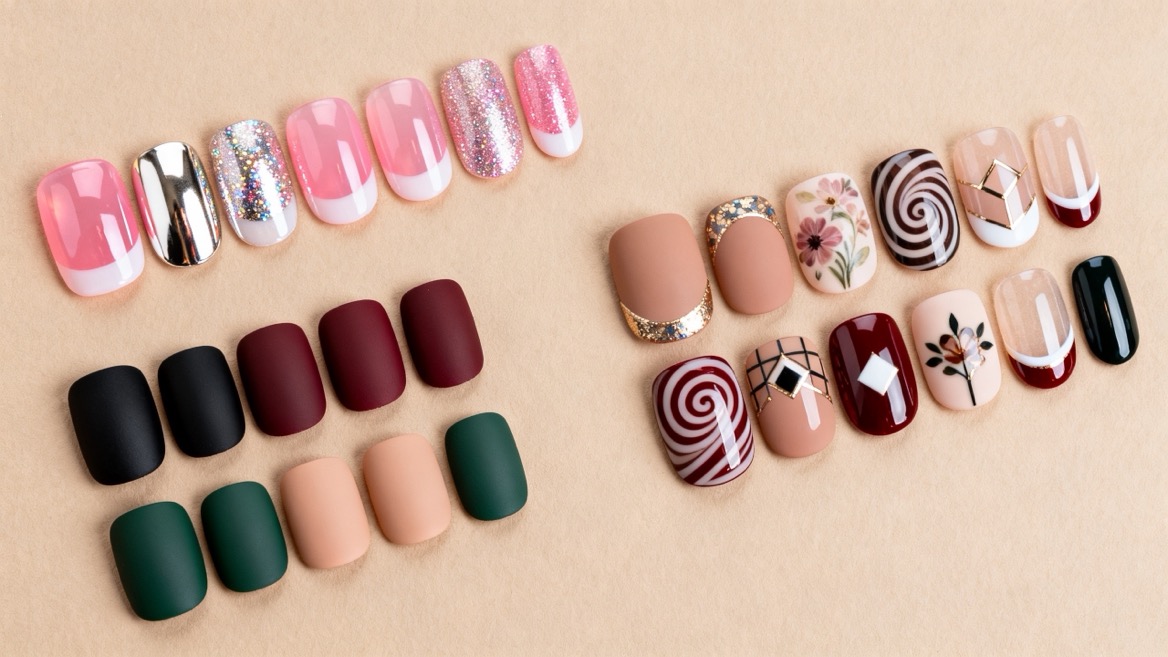
The best finish is linked to the customer profile and retail environment.
Choose a glossy top coat when your target customer wants a classic manicure effect, vibrant color payoff, sparkling nail art, or a highly recognizable salon-inspired appearance. Glossy is also a reliable choice for broad retail collections, beginner-friendly press-on nail sets, holiday designs, bridal collections, and social-media-led color launches.
Choose a matte top coat when your customer values contemporary style, minimalism, dark colors, subtle luxury, or seasonal fashion direction. Matte is especially effective in curated collections where design storytelling matters as much as color variety.
Before developing a collection, ask these five questions:
1. Who is the end customer?
A mainstream beauty shopper may prefer glossy classics, while a fashion-led audience may respond well to matte or mixed-finish sets.
2. What is the hero design?
Glitter, chrome, jelly, and rhinestones usually benefit from gloss. Minimal art, dark shades, and graphic patterns often work beautifully in matte.
3. Where will the product be sold?
E-commerce product pages may benefit from glossy visuals that catch attention, while boutiques and curated stores may use matte packaging and finishes to support a premium aesthetic.
4. What wear experience do you promise?
If your messaging emphasizes long-lasting polish, test both scratch resistance and finish retention under real handling conditions.
5. Can one color palette support multiple finishes?
This is often the most efficient way to expand a product line without creating unnecessary complexity.
For brands, wholesalers, and chain retailers, top-coat selection should be part of product development from the beginning—not an afterthought once colors are finalized.
At Dongguan YoungMei Technology Co., Ltd., we support nail product projects with a focus on manufacturing practicality as well as appearance. For a press-on nail, nail sticker, or related nail product program, the development process can include design confirmation, color matching, surface-finish selection, sample evaluation, packaging alignment, production planning, and final quality inspection.
A useful sample review should check the product under more than one lighting condition. A finish that looks excellent under studio lights may appear different in daylight, retail lighting, or smartphone photography. This is especially important for glossy surfaces, where glare can affect images, and matte surfaces, where uneven areas can become visible from certain angles.
- Can you provide both glossy and matte sample options for the same design?
- Can the factory produce mixed-finish nail art with clean boundaries?
- What quality checks are used for scratches, dust, bubbles, uneven coating, and color inconsistency?
- Can the finish be matched to existing brand samples or approved color references?
- Is the product suitable for your target market's labeling, ingredient, and packaging requirements?
- Can the supplier support fast sampling before bulk production?
- Can the factory provide coordinated products, such as press-on nails, adhesive tabs, nail glue, prep pads, files, and retail packaging?
The strongest supplier relationship is built on clear specifications. Instead of requesting "high quality," define the desired gloss level, matte effect, color reference, product size range, packaging style, logo placement, order quantity, and inspection standard.
The ideal answer is often both. Glossy top coat should be the foundation of most nail collections because it is versatile, familiar, visually bright, and compatible with a wide range of colors and decorative effects. Matte top coat should be used to create differentiation, fashion relevance, seasonal depth, and premium mixed-finish designs.
If your brand is launching its first press-on nail range, begin with glossy hero designs and add selected matte or mixed-finish sets to test customer response. If your brand already has a stable color portfolio, use matte finishes to create a fresh collection without rebuilding the entire product line.
Ready to develop glossy, matte, or mixed-finish nail products for your brand? Contact Dongguan YoungMei Technology Co., Ltd. to discuss OEM/ODM press-on nails, nail stickers, custom designs, packaging solutions, sampling, and one-stop sourcing for global wholesale and retail programs.
Yes. A matte top coat is designed to reduce shine over an existing colored or glossy nail surface. Make sure the layer underneath is fully dry or cured before application to help prevent streaks, dragging, or uneven finish.
Usually, yes. A glossy surface reflects more light, which can make color look deeper, clearer, and more vibrant. This is especially noticeable with jelly shades, glitter, metallics, bright reds, and highly saturated colors.
Both can perform well when the formula, surface preparation, and application process are appropriate. However, they may show wear differently. Glossy finishes can reveal fine scratches, while matte finishes can develop shiny rubbed areas after contact with oils, creams, or friction.
Glossy is often the best starting point for a broad press-on nail collection because it is versatile and familiar to consumers. Matte is an excellent option for fashion collections, dark-color designs, minimalist concepts, and premium mixed-finish sets.
Yes. Combining a matte base with glossy tips, patterns, logos, swirls, or raised details can create strong visual contrast. Mixed-finish designs can make a collection look more customized and higher value.
Matte top coat works especially well with black, burgundy, deep green, navy, brown, nude, taupe, gray, and muted pastel colors. It can also give French tips, marble designs, and geometric patterns a more modern look.
Matte surfaces can become shinier after repeated rubbing, contact with oils or lotions, or exposure to friction. Applying the product evenly, allowing full drying or curing, and avoiding heavy oils on the finished surface can help maintain the intended effect.
Yes. An experienced OEM/ODM nail product manufacturer can support finish selection during sampling and product development. Buyers should provide references for desired shine level, texture, design, color, packaging, and target market requirements before bulk production.
1. [U.S. Food and Drug Administration — Nail Care Products]
2. [Health Canada — Safety of Cosmetic Ingredients]
3. [Michigan State University Center for Research on Ingredient Safety — Trending: Nail Polish]
4. [Arora et al. — Safety and Efficacy of Nail Products, Cosmetics]
5. [Mia Secret — Guide to Top Coat Nail Polish]