
- All
- Product Name
- Product Keyword
- Product Model
- Product Summary
- Product Description
- Multi Field Search
English
Views: 236 Author: Young Mei Publish Time: 09-01-2026 Origin: Site


Content Menu
● Press-On Nail Glue vs Adhesive Tabs at a Glance
>> How Press-On Nail Glue Works
● What Are Adhesive Tabs for Press-On Nails?
● Durability: Which Holds Better?
● Application Experience: Glue Requires Precision, Tabs Deliver Speed
>> How to Apply Press-On Nails With Glue
>> How to Apply Press-On Nails With Adhesive Tabs
● Removal and Natural Nail Care
>> Removing Glue-Applied Press-On Nails
● Safety and Ingredient Communication
● A Manufacturer’s View: The Best Retail Strategy Is Often Both
>> Three Product Strategies for Beauty Brands
● Choosing the Right Adhesive for Your Nail Collection
● Build a Better Press-On Nail Kit With YoungMei
● FAQ
>> 1. Do press-on nails last longer with glue or adhesive tabs?
>> 2. Are adhesive tabs better for reusable press-on nails?
>> 3. Can a press-on nail kit include both glue and adhesive tabs?
>> 4. Why do adhesive tabs fall off quickly?
>> 5. Is nail glue safe for press-on nails?
>> 6. Which is better for long press-on nail shapes: glue or tabs?
>> 7. Can children use press-on nails with adhesive tabs?
>> 8. What should an OEM press-on nail brand customize besides nail designs?
For brands developing press-on nail collections, the press-on nail glue vs adhesive tabs decision is not simply about how a nail is attached. It affects product positioning, customer satisfaction, repeat purchases, perceived safety, wear time, packaging design, and the type of consumer your collection will attract.
At Dongguan YoungMei Technology Co., Ltd., we have spent more than 15 years manufacturing press-on nails, nail stickers, adhesive accessories, and customized nail products for global brands, wholesalers, and retail chains. From a product-development perspective, the best option is rarely “glue” or “tabs” alone. The most successful private-label collections often give consumers a clear choice—or include both methods in one well-designed kit.
This guide compares press-on nail glue and adhesive tabs in practical detail, including durability, application experience, removal, nail health considerations, retail positioning, and OEM/ODM development opportunities.

Press-on nail glue generally delivers a stronger, longer-lasting bond. Adhesive tabs provide a quicker, lower-commitment application experience that is especially useful for short wear, style changes, first-time users, and reusable nail sets.
| Comparison Factor | Press-On Nail Glue | Adhesive Tabs |
|---|---|---|
| Typical intended wear | Long wear | Short wear to medium wear |
| Hold strength | High | Light to moderate |
| Application speed | Fast, but requires precision | Very fast and beginner-friendly |
| Repositioning time | Limited after contact | Slightly more forgiving |
| Removal method | Soaking and gradual loosening | Gentle lifting and adhesive release |
| Best for | Travel, work, events, active routines | Parties, photoshoots, quick style changes |
| Reuse potential | Possible after residue cleaning | Often easier when removed carefully |
| Consumer profile | Durability-focused buyers | Convenience-focused buyers |
| Kit positioning | Premium long-wear manicure | Instant, temporary manicure |
| Recommended brand strategy | Include glue and prep tools | Include multiple tab sizes and application tools |
The core difference is commitment. Nail glue is designed for consumers who want their manicure to stay in place. Adhesive tabs are designed for consumers who want flexibility.
For a growing beauty brand, this creates an important merchandising opportunity: one nail design can serve different use occasions when supplied with the right attachment accessories.
Press-on nail glue is usually a fast-bonding adhesive formulated to attach an artificial nail tip to the natural nail plate. Many nail glues use cyanoacrylate-based chemistry, which is known for creating a quick and firm bond when applied correctly.
For consumers, the main attraction is clear: a press-on manicure can feel more secure during daily activities, commuting, travel, typing, household tasks, and special occasions.
For brands, glue-ready press-on nails support a more premium promise:
Longer perceived value
More salon-like wear
Better stability for long or sculpted nail shapes
Stronger performance for consumers with active routines
Higher suitability for event, bridal, holiday, and travel collections
However, glue is not automatically the right choice for every customer. It requires more careful preparation, accurate placement, and patient removal. A product that promises long wear should also provide clear instructions, because poor removal—not simply using glue—is often what creates a negative customer experience.
A small amount of glue is applied to the natural nail, the artificial nail, or both. The user aligns the press-on nail near the cuticle area and presses it firmly into place.
A reliable bond depends on several variables:
The natural nail must be clean and dry
Surface oil must be removed
The press-on nail must fit the nail plate properly
The glue amount must be controlled
The user must press evenly to reduce trapped air
The manicure should be protected from water immediately after application
From a manufacturing standpoint, fit matters as much as adhesive strength. A well-shaped press-on nail that closely matches the natural nail curve creates a larger contact area. This can improve the consumer’s experience without asking them to use excessive glue.
Adhesive tabs are double-sided pressure-sensitive stickers, often supplied as pre-cut nail-shaped pieces or sheets with multiple sizes. They attach to the natural nail on one side and the press-on nail on the other.
They are commonly called:
Press-on nail adhesive tabs
Nail glue stickers
Gel adhesive tabs
Double-sided nail stickers
Press-on nail sticky tabs
Adhesive tabs are popular because they make a manicure feel accessible. A consumer can select a tab, press it onto the natural nail, remove the protective film, and attach the press-on nail in minutes.
This simplicity makes tabs particularly suitable for:
First-time press-on nail users
Short events and celebrations
Fashion photoshoots
Social media content creation
Teen-oriented nail collections
Children’s press-on nail kits, subject to age-appropriate design and supervision
Consumers who change nail looks frequently
Reusable press-on nail collections
Convenience is the main selling point. A tab-based product should not be marketed as a permanent or salon-equivalent attachment solution. Instead, it should be positioned as an easy, stylish, temporary manicure option.
If the consumer’s first question is, “Which one lasts longer?” the answer is nail glue.
A properly applied glue-based press-on manicure may remain attached for approximately one to two weeks, depending on nail preparation, nail shape, glue quality, water exposure, hand activity, and removal habits. Adhesive tabs are usually better suited to short wear periods, although actual performance varies significantly by tab thickness, adhesive formulation, fit, and consumer behavior.
| Wear Situation | Better Choice | Why |
|---|---|---|
| One-night dinner or party | Adhesive tabs | Fast application and quick removal |
| Wedding weekend | Nail glue | More reliable hold across multiple days |
| Vacation or business trip | Nail glue | Better for consistent wear during travel |
| Content shoot or product photography | Adhesive tabs | Easy to change styles between looks |
| Office wear with frequent handwashing | Nail glue | Stronger attachment is usually needed |
| Weekend style experiment | Adhesive tabs | Supports low-commitment wear |
| Long almond, coffin, or stiletto nails | Nail glue | Longer extensions need stronger support |
| Reusable nail set | Adhesive tabs or careful glue removal | Tabs may simplify reapplication |
Adhesive tabs are affected by heat, moisture, pressure, oil, and friction. Repeated handwashing, showering, dishwashing, hair washing, or prolonged water exposure can reduce their hold.
Tabs may also lift earlier when:
The user chooses a tab that is too small
The natural nail was not cleaned before application
The press-on nail does not match the wearer’s nail curve
Air is trapped between the tab and nail surface
The consumer applies lotion, cuticle oil, or sunscreen immediately before use
The user presses only the center instead of the full nail surface
For this reason, brands should avoid making fixed wear-time promises unless they have tested the exact adhesive-tab specification, nail material, fit range, and kit instructions.
The application journey strongly influences reviews. Even a beautiful nail design can receive poor feedback when the customer feels the process is messy, confusing, or difficult.
A quality glue-based kit should include press-on nails, a sizing guide, a nail file, a cuticle stick, a cleaning wipe, and clear instructions.
A practical application sequence is:
Choose the correct nail sizes before opening the glue.
Push back cuticles gently to create a clean application area.
Lightly shape the natural nail edge if needed.
Clean the nail plate to remove oil and residue.
Apply a controlled amount of glue to avoid overflow onto surrounding skin.
Align the press-on nail carefully near the cuticle line.
Press firmly from the base toward the tip for approximately 15 to 30 seconds.
Avoid water exposure immediately after application to support initial bond performance.
The best glue application is not the one using the most adhesive. Excess glue can leak onto the skin, create an uneven fit, and make later removal more difficult.
Tabs make the process faster and more approachable:
Select a tab that closely matches the natural nail width.
Clean and dry the natural nail.
Apply the tab firmly to the natural nail.
Remove the top protective film.
Align the press-on nail carefully.
Press from cuticle to free edge for 10 to 20 seconds.
Avoid water and oil exposure for the first period after application.
For OEM and private-label brands, tab size assortment is a major detail. A sheet with too few widths may create poor fit for customers with narrow, wide, or curved nail beds. A better tab range can improve product usability without changing the nail design itself.
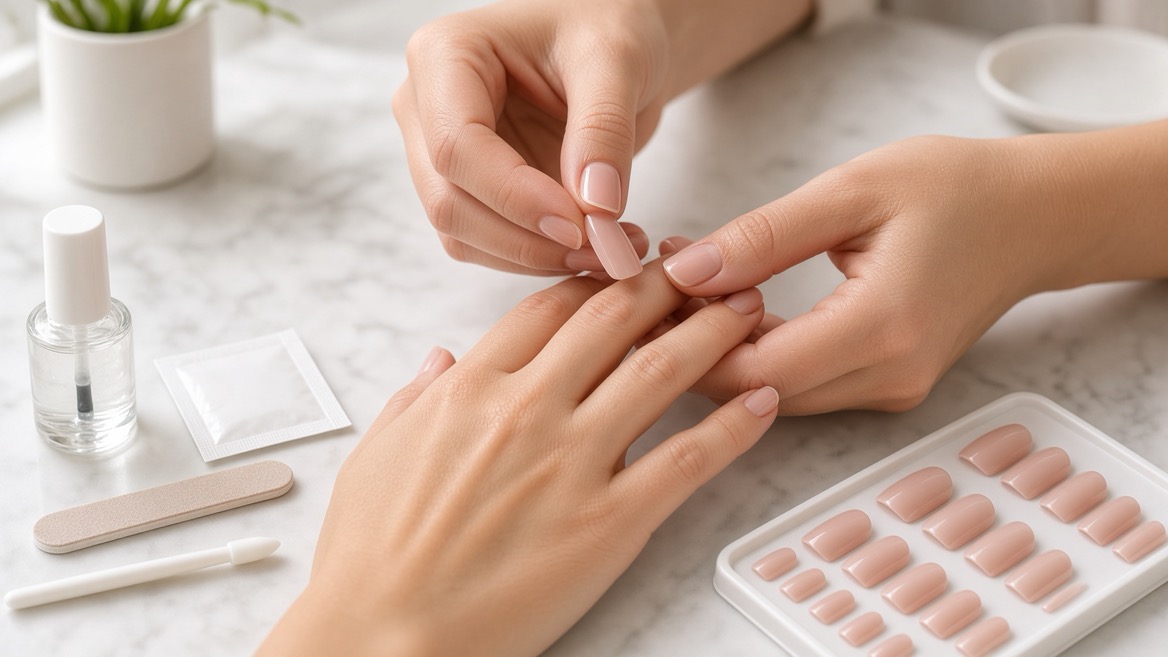
The removal process is one of the most important areas for customer education. Consumers should never forcefully pull off a press-on nail, regardless of whether it was attached with glue or tabs.
Forced removal can lift layers of the natural nail plate and may make nails appear thin, rough, or damaged.
Glue-applied nails should be loosened gradually. A suitable removal method may involve soaking, using a compatible remover as directed, and gently lifting only after the adhesive has softened.
Key guidance for consumers:
Do not pry nails off suddenly
Do not use tools to force a gap beneath the nail
Do not tear off nails when one corner begins lifting
Do not over-file the natural nail during cleanup
Use gentle aftercare once the set is removed
Artificial nail products and adhesives can cause irritation or allergic contact reactions in sensitive individuals. Reported reactions associated with nail-product ingredients can include redness, swelling, discomfort, itching, or dermatitis. Consumers who experience these symptoms should stop using the product and seek advice from an appropriate healthcare professional, especially if symptoms are severe or persistent. [References 1–5]
Tabs are generally easier to remove, but they still require patience. The press-on nail should be loosened from the side and lifted gradually. Warm water and gentle movement may help soften the attachment, depending on the tab material and the manufacturer’s instructions.
Tabs can leave adhesive residue. This should be rolled or gently removed rather than aggressively scraped from the natural nail.
A reusable nail set is only truly reusable when customers can remove it without bending, cracking, or damaging the underside of the press-on nail.
Brands should treat attachment accessories as part of the product—not as an afterthought.
Nail adhesives may contain ingredients that can cause irritation or allergic reactions for some people. Public health and dermatology sources note that certain acrylates, methacrylates, and cyanoacrylate-related substances used in nail products and adhesives may trigger contact dermatitis in sensitized individuals. [References 1–5]
A responsible press-on nail kit should communicate clear use guidance:
Avoid direct skin contact with liquid glue
Use in a ventilated area where appropriate
Keep products away from children
Do not use on irritated, injured, infected, or damaged nails
Stop use if irritation occurs
Follow the supplied removal instructions
Keep small tabs and nail accessories away from young children who may put them in their mouths
Provide ingredient and warning information appropriate to the target market
For global brands, labeling should be reviewed according to the regulations of the destination market. Requirements can differ between regions, and product claims should match actual testing, documentation, and intended use.
After working with different private-label buyers, wholesalers, and retail programs, one pattern is consistent: consumers do not all want the same wear experience.
Some buyers want a manicure that lasts through a busy week. Others want a fresh look for Friday night and bare nails again by Sunday. A brand that offers only one attachment option may lose part of its addressable market.
| Strategy | Best For | Recommended Contents |
|---|---|---|
| Long-wear collection | Premium, bridal, travel, office, active users | Press-on nails, nail glue, prep pad, file, removal guide |
| Quick-change collection | Trend-driven, fashion, younger, event-focused users | Press-on nails, multiple adhesive-tab sheets, prep pad, file |
| Dual-adhesive collection | Broad consumer appeal and gift sets | Press-on nails, glue, tabs, prep pad, file, instructions |
| Reusable wardrobe collection | Subscription boxes, seasonal launches, fashion retailers | Multiple nail styles, extra tabs, storage case, reuse guide |
The dual-adhesive kit is particularly effective for online retail because it reduces the customer’s fear of choosing the wrong method. The customer can use tabs for a short event and glue for a longer occasion.
This also creates stronger product storytelling. Instead of selling only “false nails,” a brand can sell a flexible manicure system.
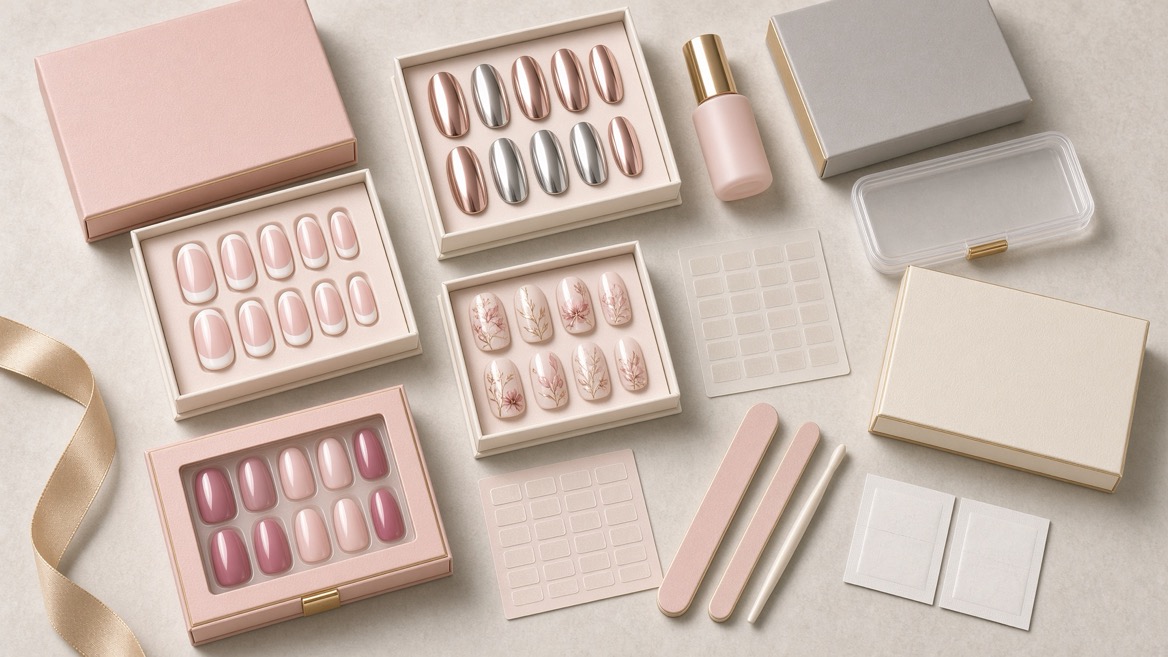
Use this checklist when developing a press-on nail range.
Choose nail glue when your target customer values:
Long wear
Strong attachment
Salon-inspired performance
Longer nail shapes
Travel-ready manicures
Special-event reliability
A more permanent-looking result
Choose adhesive tabs when your target customer values:
Fast application
Easy style switching
Short-term wear
Easier removal
Reusable nail sets
Beginner-friendly kits
Low-commitment beauty routines
Choose both when your brand wants:
Wider customer appeal
Better product value perception
More versatile gift sets
Higher online conversion potential
Fewer “which adhesive should I use?” questions
More opportunities for add-on accessory sales
For a beauty brand, the question is not only “press-on nail glue vs adhesive tabs.” The more important question is: Which attachment experience best matches your target customer, price point, retail channel, and brand promise?
Dongguan YoungMei Technology Co., Ltd. supports global brands, wholesalers, and chain retailers with customized press-on nails, nail stickers, adhesive tabs, packaging development, rapid sampling, and integrated sourcing solutions. With more than 15 years of manufacturing experience, our team can help you develop a product range based on nail shape, material, finish, size assortment, attachment method, accessory configuration, branding, and packaging requirements.
Whether you are launching a durable long-wear press-on nail line, a quick-change fashion collection, or a dual-adhesive kit designed for broader retail appeal, contact our team to discuss OEM/ODM customization and sample development.
Press-on nails usually last longer with nail glue because glue provides a stronger bond between the artificial nail and the natural nail plate. Adhesive tabs are generally better for temporary wear, quick changes, and occasions where easy removal is more important than maximum durability.
In many cases, yes. Adhesive tabs can make reuse easier because they often leave less hardened adhesive residue on the underside of the press-on nail. However, careful removal and cleaning are still important to protect the nail set for future use.
Yes. A dual-adhesive press-on nail kit can include both options, allowing consumers to choose between short-term and long-term wear. This is a strong option for private-label brands that want to serve different customer needs with one product set.
Adhesive tabs may lift early if the natural nail is oily, damp, or not properly prepared. Incorrect tab size, poor nail fit, trapped air, water exposure, and frequent handwashing can also reduce wear time.
Nail glue can be used safely when consumers follow the supplied instructions, avoid skin contact, use an appropriate amount, and remove the nails carefully. Some people may be sensitive to adhesive ingredients, so users should discontinue use if irritation, swelling, itching, or discomfort occurs. [References 1–5]
Nail glue is usually the more suitable choice for long almond, coffin, stiletto, and other extended nail shapes. Longer nails experience greater leverage during everyday movement, so they generally require a stronger attachment method.
Adhesive tabs may be more appropriate than liquid glue for age-appropriate children’s nail products because they avoid direct use of fast-bonding liquid adhesive. However, adults should supervise use, follow product age guidance, and keep small components away from children who could swallow them.
In addition to colors and artwork, brands can customize nail shape, length, material, finish, size range, adhesive-tab specification, glue bottle style, accessory tools, warning labels, insert cards, storage boxes, logo placement, and retail packaging.