
- All
- Product Name
- Product Keyword
- Product Model
- Product Summary
- Product Description
- Multi Field Search
English
Views: 298 Author: Young Mei Publish Time: 11-12-2026 Origin: Site


Content Menu
● Custom Press-On Nails vs. French Press-On Nails: Understanding the Difference
>> What Are Custom Press-On Nails?
>> What Are French Press-On Nails?
● Quick Comparison for Salon Retail Buyers
● Which Option Better Matches Your Salon's Customers?
>> French Press-On Nails: A Recognizable Starting Point
>> Custom Press-On Nails: A Stronger Brand Connection
● Cost and Margin: Compare the Entire Retail Program
>> Calculate Contribution per Set
● Quality and Wear: Styling Is Not a Performance Specification
>> What to Inspect in French Press-On Nails
>> What to Inspect in Custom Press-On Nails
● An Overlooked Advantage: Custom French Press-On Nails
● A Practical Pilot: Test Before Expanding
>> Step 1: Establish a Fair Comparison
>> Step 2: Give Both Collections Comparable Support
>> Step 3: Measure More Than Revenue
>> Step 4: Reorder the Winning Specifications
● Market Opportunity: Category Growth Is Not a Salon Forecast
● Safety, Instructions, and Packaging Protect the Retail Experience
● What to Ask an OEM/ODM Press-On Nail Manufacturer
● Which Should Your Salon Choose?
>> Are Custom Press-On Nails Better Than French Press-On Nails?
>> Can French Press-On Nails Be Customized for a Salon Brand?
>> Which Option Offers Better Retail Margins?
>> Do French Press-On Nails Last Longer Than Custom Designs?
>> What Should a Salon Test Before Placing a Larger Order?
>> What Is the Minimum Order Quantity for Private-Label Press-On Nails?
For salon retail programs, custom press-on nails offer more opportunities for brand differentiation, while French press-on nails provide a recognizable style that can anchor an everyday collection. The strongest choice is often a combination: a French-inspired core range supported by exclusive custom designs.
However, these terms describe different things. "Custom" refers to how a product is developed or personalized. "French" describes its appearance. A salon can therefore sell custom French press-on nails under its own brand.
At Dongguan YoungMei Technology Co., Ltd., our manufacturing perspective starts with a practical question: which assortment fits your clients, protects your retail investment, and supports consistent reordering? This guide compares both options through that commercial lens.

Custom press-on nails are developed around a buyer's specifications. Depending on the project, customization may include:
- Nail shape, length, curvature, and size assortment.
- Colors, printed artwork, decorative effects, and finishes.
- Branded packaging and application instructions.
- Kit contents, such as adhesive tabs, glue, or preparation accessories.
- Collections designed around a salon's identity or promotional calendar.
For wholesale purchasing, clarify whether "custom" means customized packaging around an existing product or a newly developed nail design. These represent different development requirements.
Custom also does not automatically mean individually sized for each customer. A private-label collection may still use a standard multi-size assortment.
French press-on nails feature a contrasting tip over a base shade, commonly a white tip over a pink, nude, or sheer-looking base.
The category includes classic French tips, micro-French designs, colored tips, and variations in shape and length.
For salon retail, French is a design direction rather than a manufacturing model. A stock French set and an exclusive private-label French collection may look similar, yet involve different purchasing commitments.
The following table is a purchasing framework, not a guarantee of sales performance.
| Decision factor | Custom press-on nails | French press-on nails |
|---|---|---|
| Main distinction | Buyer-defined product or branding | Recognizable tip-based design |
| Brand exclusivity | Can support proprietary artwork and packaging | Depends on whether the collection is stock or customized |
| Development work | Increases with design and component changes | Potentially simpler when selecting an existing design |
| Inventory exposure | Depends on quantities, variants, and reorder terms | Depends on the same factors; French styling alone does not reduce risk |
| Quality priorities | Artwork accuracy, finish, fit, and consistency | Tip alignment, base shade, symmetry, fit, and consistency |
| Retail role | Signature collections and differentiated launches | A familiar foundation for the assortment |
| Best combination | Custom-branded products with selected French designs | French designs developed within a custom program |
Neither category automatically offers better margins, longer wear, or higher quality. Those outcomes depend on specifications, purchasing terms, application, and actual customer demand.
French designs give staff a straightforward visual story to explain. Buyers can compare tip thickness, base color, shape, and length without first understanding a complex collection concept.
That makes French press-on nails a reasonable starting hypothesis for salons building their first retail assortment.
Nevertheless, familiarity does not prove demand. A salon serving clients who favor expressive nail art may find classic French styles less relevant than colorful or decorative alternatives.
Use appointment history and customer conversations to choose the initial range.
Custom collections give salons more control over how their retail products relate to their services.
A salon could translate a recognizable color palette, bridal aesthetic, or signature design into a take-home collection. The product then supports the salon's identity rather than simply filling shelf space.
The commercial question is whether customers value that distinction enough to buy.
Before committing to a collection, show clients physical samples. Ask which design they would purchase, at what price, and for which occasion. Treat their answers as directional feedback rather than confirmed orders.
A factory quotation is only one part of the investment.
Custom development may involve artwork preparation, sample revisions, packaging setup, or additional components. Existing French designs may require fewer development steps, but that must be confirmed in the quotation.
Compare suppliers using the same specifications and delivery basis.
Use this working formula:
Contribution per set = net selling price − landed product cost − other variable selling costs.
Landed cost should reflect the costs relevant to your shipment, including freight and applicable import charges. Variable selling costs may include payment fees, commissions, or promotional materials.
Consider this hypothetical example:
| Item | French core set | Custom signature set |
|---|---|---|
| Net selling price | $18 | $24 |
| Landed product cost | $5 | $8 |
| Other variable selling costs | $2 | $3 |
| Contribution per set | $11 | $13 |
These figures are illustrative, not YoungMei quotations or industry averages. They also exclude fixed overhead and any development costs not allocated to each unit.
The custom set produces more contribution per sale in this example. It is not necessarily the better investment if it sells substantially more slowly.
A French finish does not inherently last longer than custom artwork. Likewise, a customized product is not automatically more durable.
Evaluate the complete system: nail construction, fit, surface finish, adhesive, instructions, and intended use.
Ask your team to review:
- Consistency of the tip line across sizes.
- Left-to-right symmetry.
- Base-shade consistency.
- Clean borders between the base and tip.
- Shape consistency and smooth edges.
Inspect the full size assortment, not only the largest display nails.
Review:
- Artwork positioning across different nail sizes.
- Color matching against the approved sample.
- Surface smoothness and decorative attachment.
- Coating consistency.
- Packaging accuracy and component completeness.
For either option, approve a physical reference sample and document acceptable variation before production. A shared specification is more useful than an undefined request for "premium quality."
Do not promise a fixed wear period or number of reuses without evidence appropriate to the supplied product and application method.
The most useful answer to this comparison may be custom French designs.
This approach combines a recognizable visual format with salon-specific product choices. Possible specifications include:
- A selected nude base suited to the collection's positioning.
- A distinctive tip width or color.
- A consistent short or medium-length profile.
- Branded packaging and a coordinated instruction insert.
From a manufacturing perspective, this creates a focused development brief. Buyers can define a small number of meaningful differences instead of launching numerous unrelated designs.
It also gives staff a clear explanation: a familiar French look developed specifically for the salon's collection.
Exclusivity should be discussed explicitly. Customized packaging alone does not establish exclusive ownership of an existing nail design.
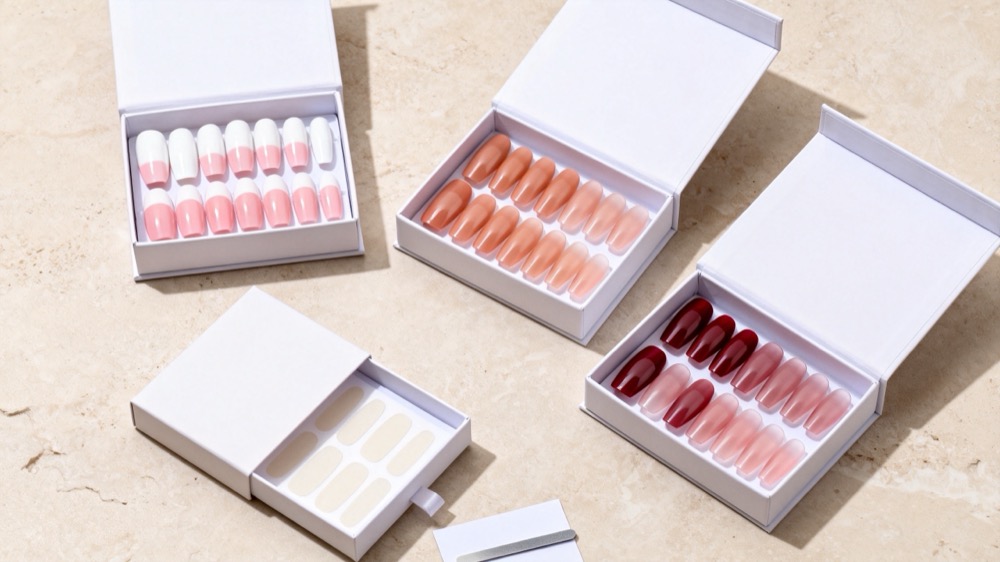
Rather than choosing a permanent winner immediately, compare a French core range with a small custom capsule.
Where possible, keep shape, length, adhesive format, and kit contents comparable.
Otherwise, sales differences may reflect fit or accessories rather than the design category you intended to test.
If prices differ, record that difference when interpreting results.
Use consistent shelf visibility and train staff to explain both options.
Unequal displays or stronger staff promotion can distort the results. Record stockouts, promotions, and display changes during the trial.
Track:
| Metric | What it helps reveal |
|---|---|
| Sell-through: units sold ÷ units available during the period | How effectively stock converts into sales |
| Contribution per set | Earnings available before fixed costs |
| Units sold per store-week | Sales pace across locations |
| Returns and complaint reasons | Fit, finish, instruction, or expectation problems |
| Customer requests for unavailable sizes or styles | Gaps in the assortment |
Compare similar selling periods. Avoid interpreting a short launch promotion as evidence of sustained demand.
Customers may respond more strongly to length, shape, or base shade than to the "French" or "custom" label.
Use that detail when reordering. A successful short French set does not automatically justify expanding into every French variation.
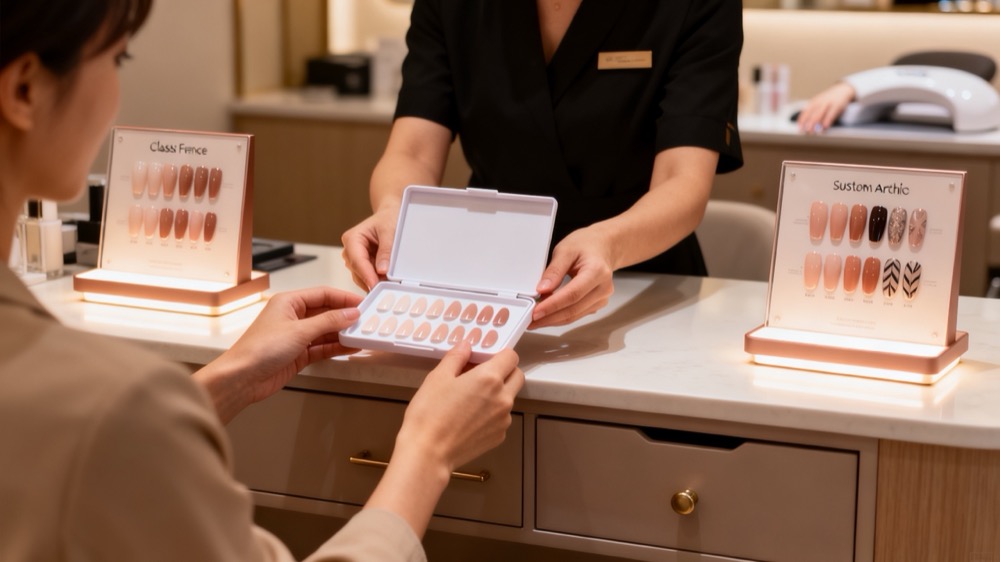
Grand View Research estimates the global press-on nails market at $782.9 million in 2025 and projects growth to approximately $1.32 billion by 2033.
This is a commercial research estimate, not an audited measure of salon retail sales. It signals interest in the broader category but does not establish demand for a specific salon, design, or price point.
The practical implication is to investigate the opportunity without treating market growth as permission to overstock.
Local customer feedback, pilot sell-through, and repeat purchases are more directly useful for your buying decisions.
The adhesive and removal process deserve as much attention as the visible design.
The American Academy of Dermatology notes that artificial-nail products and application processes can contribute to irritation or nail damage. Its guidance concerns artificial nails broadly; it should not be presented as a direct performance comparison between French and custom press-ons.
Provide product-specific application and removal instructions. Do not recommend forcibly peeling off bonded nails or promise "damage-free" wear.
For products sold in the United States, the FDA explains that nail products are generally regulated as cosmetics and that applicable labeling and warning requirements matter. Confirm requirements for the actual nail product, adhesive, remover, and kit configuration rather than assuming every component follows identical rules.
Other destinations require their own compliance review.
Before requesting a final quotation, prepare a brief covering:
1. Target customer and intended retail price.
2. Nail shape, length, and size assortment.
3. Design references and acceptable color variation.
4. Adhesive format and kit contents.
5. Packaging, labeling, and destination market.
6. Quantity per design and reorder expectations.
7. Sample approval, inspection, and delivery milestones.
Ask suppliers to distinguish sample preparation time from production and shipping time.
At Dongguan YoungMei Technology Co., Ltd., our offering includes more than 15 years of nail-product manufacturing experience, an owned factory, supply-chain coordination, and OEM/ODM support for international brands, wholesalers, and retail chains.
For a useful project discussion, bring your commercial requirements as well as your visual references. Both shape the proposed solution.
Choose a French-led pilot when you want to test a recognizable design direction with a focused assortment.
Choose a custom-led pilot when differentiation is central to your salon's identity and you have a clear development brief.
For many programs, the most practical structure is a small French foundation plus selected signature designs. Let customer response determine the eventual balance.
To discuss a YoungMei collection, send your target market, preferred styles, estimated quantities, and packaging requirements. Request a proposal that separates existing-design options from custom development, with sampling steps and production assumptions clearly stated.
Not inherently. Custom describes product development or personalization; French describes a design. Compare specific products and purchasing terms rather than assuming either label indicates better quality.
Yes. A French collection can incorporate selected colors, tip proportions, shapes, packaging, and other agreed specifications. Confirm which elements are customized and whether any design exclusivity applies.
Neither guarantees better margins. Compare landed costs, selling prices, variable expenses, development investment, and sales pace. A higher contribution per set can still come with slower inventory turnover.
The style category alone does not establish wear performance. Fit, construction, adhesive, application, removal, and daily activities all require consideration.
Test fit, finish, instructions, packaging clarity, and customer response. Then monitor sales pace, contribution, returns, and complaints during a controlled retail pilot.
It depends on the supplier and project. Ask for quantities by design, color, packaging configuration, and reorder—not simply a single minimum for the entire collection.
- Grand View Research. *Press-on Nails Market Size, Share & Trends Analysis Report, 2026–2033.* Source for the market estimate and forecast; these figures represent the publisher's research estimates. [grandviewresearch]
- U.S. Food and Drug Administration. *Nail Care Products.* Source for general nail-product regulation, safe-use directions, ingredient disclosure, and warnings. [fda]
- U.S. Food and Drug Administration. *Summary of Cosmetics Labeling Requirements.* Source for U.S. cosmetics labeling considerations, including imported products. [fda]
- U.S. Food and Drug Administration. *Cosmetics Labeling Guide.* Supporting guidance on cosmetic labeling requirements. [fda]
- American Academy of Dermatology. *Artificial Nails: Dermatologists' Tips for Reducing Nail Damage.* Source for general artificial-nail irritation and damage considerations, not a direct comparison of press-on styles. [aad]