
- All
- Product Name
- Product Keyword
- Product Model
- Product Summary
- Product Description
- Multi Field Search
English
Views: 294 Author: Young Mei Publish Time: 10-31-2026 Origin: Site


Content Menu
● Press-On Nails vs. Artificial Nails: What Are Wholesale Buyers Actually Purchasing?
>> Press-On Nails: A Finished, Branded Product
>> Professional Artificial Nails: A Customizable Application System
● Wholesale Customization Comparison at a Glance
● Design Customization: Repeatable Collections or Individual Artistry?
>> Custom Press-On Nails Support Consistent Collection Development
>> Professional Systems Offer Greater On-Hand Creative Freedom
● Shape, Size, and Fit: The Customization Layer Buyers Often Miss
>> Specify More Than Shape and Length
>> Separate Universal Sets From Personalized Sizing
● Materials and Adhesives: Compare Specifications, Not Marketing Names
>> Define the Attachment Experience
>> Treat Safety Claims Carefully
● Private Label Packaging: Where Press-Ons Offer Strong Brand Control
● MOQ, Lead Time, and Cost: Compare the Entire Development Project
>> Separate Existing-Platform Customization From New Development
>> Calculate Landed Cost per Sellable Set
● A Practical Wholesale Customization Scorecard
● From Design Brief to Approved Wholesale Product: Six Steps
>> 1. Define the Customer and Sales Channel
>> 2. Create a Measurable Specification
>> 3. Confirm Manufacturing Feasibility
>> 4. Evaluate Complete Samples
>> 5. Approve a Reference Sample
>> 6. Review the First Production Order
● Which Option Should Wholesale Buyers Choose?
>> Are Press-On Nails Different From Artificial Nails?
>> Which Option Offers Better Private Label Customization?
>> Can Wholesale Buyers Customize Nail Sizes and Curvature?
>> Do Custom Press-On Nails Always Have Lower Minimum Orders?
>> Are Press-On Nails Safer Than Acrylic Nails?
>> What Should Buyers Request Before Ordering?
Press-on nails vs. artificial nails: which option gives wholesale buyers greater control over product design, branding, and customer experience? For retail-ready collections, press-ons generally offer the stronger customization platform. For individually sculpted results delivered by trained technicians, salon-applied acrylic and gel systems offer greater freedom at the point of service.
However, this comparison needs one important clarification: press-on nails are themselves a type of artificial nail. In this article, "artificial nails" refers specifically to professional acrylic, sculpted gel, and gel-extension systems.
At Dongguan YoungMei Technology Co., Ltd., our focus is helping brands translate nail concepts into manufacturable products. Drawing on our stated background of more than 15 years in nail-product development and manufacturing, we approach this decision through a buyer's priorities: differentiation, repeatability, fit, packaging, and total commercial cost.
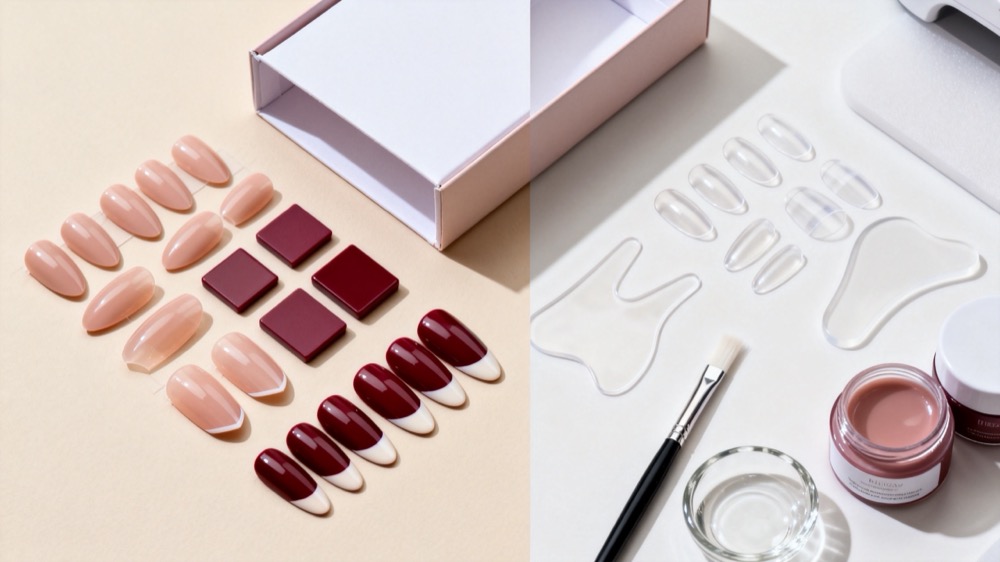
Press-on nails are preformed nail coverings applied with a compatible attachment system, commonly nail glue or adhesive tabs. Depending on the product, they arrive decorated and ready for application.
Wholesale buyers can specify the appearance of the finished set, its size assortment, accessories, and retail presentation. This makes private label press-on nails particularly suitable for brands selling a recognizable look directly to consumers.
The main commercial advantage is control: the buyer can approve the complete customer-facing product before bulk production.
Professional artificial nail systems include liquid-and-powder acrylics, sculpting gels, and full-cover gel extensions.
Customization may happen during manufacturing, application, or both. Suppliers develop materials and tips, while technicians adjust the final length, structure, color, and decoration.
These systems therefore serve a different purchasing model. A salon distributor may prioritize application consistency, compatible components, and professional education over consumer-ready packaging.
The distinction is not simply "customizable versus non-customizable." It is where customization happens—and who controls the final result.
| Buying consideration | Custom press-on nails | Professional artificial nail systems |
|---|---|---|
| Main customization stage | Before shipment | Before shipment and during application |
| Finished visual consistency | Approved design repeated across sets | Depends partly on technician execution |
| Individual fit | Limited by available sizes and curvature | Sculpted systems allow individual adjustment |
| Artwork | Factory-applied designs and decorations | Factory options plus technician-created artwork |
| Brand presentation | Finished sets, inserts, accessories, and boxes | Materials, tip boxes, kits, and education |
| Customer skill requirement | Depends on attachment and preparation method | Professional systems require appropriate training |
| Best commercial fit | Consumer brands, retailers, and gift collections | Salons, training businesses, and professional distributors |
These are buying-framework comparisons rather than universal performance rankings. Product construction and supplier capability can change the outcome.
For a brand launching coordinated collections, factory-finished press-ons offer a practical advantage: buyers can review the actual design customers will receive.
Customization briefs can cover:
- Solid colors, gradients, and French-tip proportions.
- Printed patterns and brand-specific artwork.
- Glossy, matte, shimmer, or textured effects.
- Rhinestones, charms, and dimensional decoration.
- Coordinated accent nails and collection themes.
Not every combination is production-ready. Fine lines may lose definition on small sizes. Large decorations may catch during wear. Different finishes may change the perceived color.
My recommendation is to approve artwork on physical nails across the size range—not only on a flat digital mockup.
A technician can adapt a sculpted acrylic or gel enhancement to an individual client's preferred silhouette and nail proportions.
That flexibility matters for bespoke salon services. It also makes the finished appearance less centrally controlled by the wholesale buyer.
Professional full-cover gel tips occupy a middle ground. They provide preformed structure but still allow further service customization. Existing commercial systems offer multiple shapes, lengths, sizes, and curvature options.
For buyers, the useful distinction is repeatable factory design versus individualized service design.
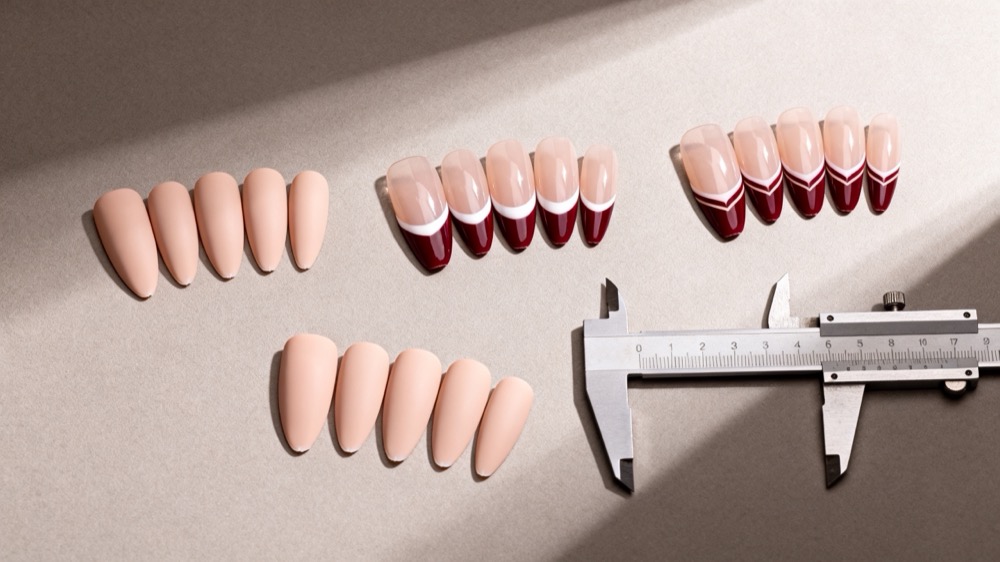
A visually attractive set is not automatically a well-designed product. Fit deserves its own development brief.
"Medium almond" does not fully define a nail.
A useful specification should also address:
- Width and length measurements by size.
- Side-to-side curvature.
- Cuticle-edge profile.
- Thickness distribution.
- Flexibility and structural feel.
- Size identification and assortment.
Two nails with similar widths can fit differently because their curvature differs. Professional tip ranges that distinguish flatter and more sculpted profiles illustrate why width alone is insufficient.
For wholesale press-on nails, request a size chart and assess samples on a representative range of intended users.
A multi-size retail set offers convenience, but it cannot guarantee an ideal fit for every customer.
A more tailored size program may improve fit for a narrower audience, while adding inventory complexity. Sculpted professional enhancements allow more individual adjustment, but require a service rather than a finished retail set.
Buyers should choose the fit model that matches their channel instead of treating additional sizes as an automatic improvement.
Terms such as "gel," "acrylic," and "soft gel" do not, by themselves, establish equivalent construction or performance across suppliers.
Request clear information about the nail body, decorative layers, attachment system, and removal method.
For custom press-on nail kits, decide whether the product will include:
- Adhesive tabs.
- Nail glue.
- Both options.
- A separately purchased attachment product.
Each configuration changes packaging, instructions, purchasing cost, and the customer experience.
Avoid promising a fixed wear duration without testing the actual combination of nail, adhesive, preparation instructions, and intended use. Likewise, do not describe every press-on as reusable: removal technique, decoration, and adhesive residue can affect reuse.
Neither category should be marketed as universally damage-free or allergy-free.
Artificial nail materials and application products can cause irritation or allergic reactions. Preparation, maintenance, and removal can also affect natural nails.
For light-cured systems, follow the specified application and curing instructions. For glue-on products, provide appropriate adhesive warnings and removal guidance.
Claims such as "hypoallergenic," "non-toxic," or "safe for everyone" require suitable substantiation—not merely an attractive label.
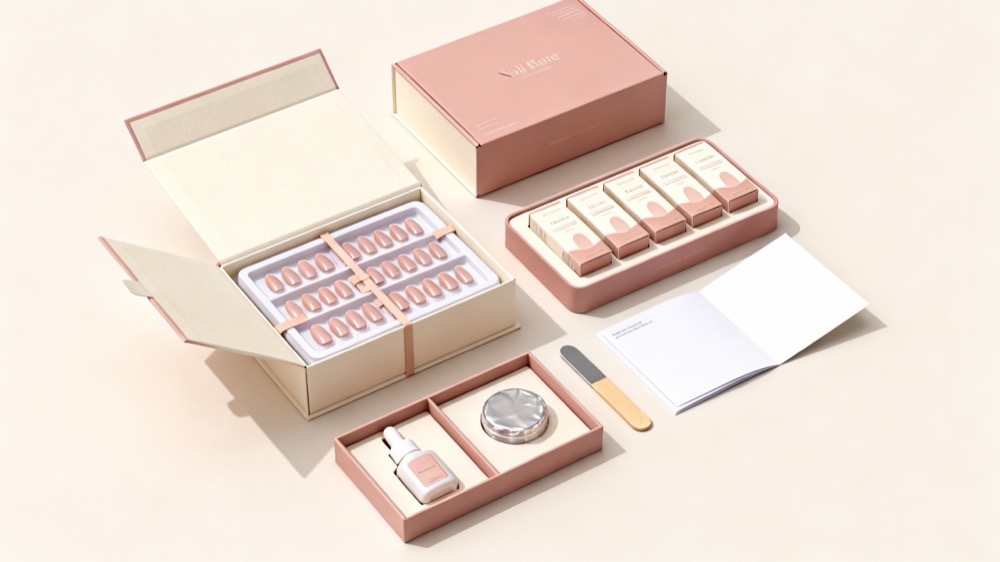
Custom press-on nails allow buyers to coordinate the visible product with the full retail experience.
Packaging development can include:
- Branded boxes and display windows.
- Internal trays and nail arrangement.
- Application and removal instructions.
- Multilingual inserts.
- Accessory compartments.
- Barcodes and retailer-specific information.
However, customization should improve usability rather than simply add decoration.
Can customers identify the shape and length immediately? Can they understand what is included? Can they locate the correct sizes without confusion?
Professional artificial nail suppliers can also customize packaging, but the priorities differ. Clear system identification, size organization, and professional instructions may matter more than gift-style presentation.
For either category, review the final packed sample—not just the box artwork.
There is no reliable universal minimum order quantity or production timeline for either category.
For custom press-on nails, requirements may vary with existing molds, artwork complexity, decoration, packaging construction, and component availability.
Professional systems may involve different cost drivers, including formulation development, component compatibility, testing, and technical documentation.
Ask suppliers to quote these routes separately:
1. Existing product with branded packaging.
2. Existing nail shape with custom colors or artwork.
3. Custom shape, sizing, or tooling.
4. New material or attachment-system development.
This prevents a simple private label project from being confused with a substantially more complex development program.
Compare more than the factory unit price.
Include packaging, accessories, tooling, testing, inspection, freight, duties, and foreseeable rework.
A lower quote can become less attractive if the supplier excludes inserts, uses unsuitable packaging, or leaves important specifications unresolved.
For professional channels, also consider training and system-support requirements.
The following framework is a proposed purchasing tool, not a published industry benchmark.
Score each shortlisted product from one to five, using physical samples and written evidence.
| Evaluation factor | Suggested weight | Evidence to review |
|---|---|---|
| Fit and comfort | 25% | Measurements and representative user trials |
| Design repeatability | 20% | Samples across sizes and production runs |
| Channel suitability | 20% | Retail or professional-use requirements |
| Landed commercial cost | 15% | Complete quotation and logistics assumptions |
| Documentation and instructions | 10% | Product information and destination review |
| Reorder consistency | 10% | Specifications and change-control process |
These weights deliberately prioritize fit and repeatability over visual novelty.
Adjust them to match your business. A salon distributor may assign more weight to system compatibility, while a retail chain may emphasize packaging and assortment consistency.
Specify whether you serve first-time home users, fashion-focused shoppers, salon clients, or professional technicians.
Document shape, dimensions, finish, size mix, attachment method, accessories, packaging, and target market.
Ask which features use existing production platforms and which require additional development or tooling.
Review appearance, fit, edge finish, decoration security, instructions, and packaging protection. Agree on suitable tests for the intended claims.
Keep an approved reference sample and written specifications. Define acceptable variation and how production changes will be authorized.
Check the actual bulk product before scaling. Track customer feedback by issue—fit, adhesion, finish, or instructions—rather than grouping everything under "quality."
Choose custom press-on nails when your priority is a recognizable, retail-ready collection with coordinated artwork, accessories, and packaging.
Choose professional artificial nail systems when your customers need technician-led shaping, individualized services, and compatible application products.
Neither category automatically delivers better quality or margins. The stronger choice is the one that fits your sales channel and can be reproduced to an agreed specification.
Dongguan YoungMei Technology Co., Ltd. offers OEM/ODM development, sampling, and one-stop sourcing for press-on nails, nail stickers, and related nail products.
Send your target market, design references, preferred shapes, estimated quantities, packaging requirements, and launch schedule to request a project-specific feasibility review, quotation, and sampling plan.
Press-on nails belong to the broader artificial nail category. This comparison distinguishes finished press-on sets from professional acrylic, sculpted gel, and gel-extension systems.
Press-ons generally offer more direct control over the complete consumer-ready set. Professional systems offer customization too, but technicians often determine the final appearance during application.
Potentially, yes. Availability depends on existing molds, technical capability, tooling requirements, and order economics. Confirm dimensions and curvature through physical samples before approving production.
No. Minimum orders depend on the supplier and specification. New tooling, specialist decoration, or custom packaging can change the requirement substantially.
A universal safety ranking would be misleading. Materials, adhesives, application, removal, and individual sensitivities all matter. Neither option should be promoted as risk-free.
Request a complete specification, representative samples, itemized pricing, packaging details, relevant product documentation, lead-time assumptions, and written quality-acceptance criteria.
1. U.S. Food and Drug Administration — "Nail Care Products." Regulatory context, methacrylate sensitization, labeling warnings, and product safety responsibilities. [fda]
2. U.S. Food and Drug Administration — "Summary of Cosmetics Labeling Requirements." U.S. labeling context; requirements must be assessed for the actual product and destination. [fda]
3. American Academy of Dermatology — "Artificial nails: Dermatologists' tips for reducing nail damage." Application, maintenance, removal, and natural-nail considerations. [aad]
4. Aprés Nail — "Gel-X® Natural Round Medium Box of Tips – Pro." Manufacturer example of half sizes and different nail-curvature profiles; not independent comparative performance evidence. [apresnail]
5. Velnora Nails — "Press-On Nail OEM / ODM & Private Label Manufacturing." Supplier example of artwork, shape, sizing, packaging, and project-specific quotation options; not evidence of YoungMei's individual capabilities. [velnoranails]