
- All
- Product Name
- Product Keyword
- Product Model
- Product Summary
- Product Description
- Multi Field Search
English
Views: 298 Author: Young Mei Publish Time: 11-05-2026 Origin: Site


Content Menu
● What Are Custom Press-On Nails and Stock Press-On Nails?
>> Custom Press-On Nails: Products Developed Around Your Brand
>> Stock Press-On Nails: Existing Products With Fewer Development Steps
● Custom Press-On Nails vs. Stock Press-On Nails: Comparison Table
● Which Option Costs Less for a Private Label Launch?
>> Compare Total Launch Cost, Not Just Unit Price
>> An Illustrative Break-Even Calculation
● MOQ and Lead Time: Ask More Precise Questions
>> What Does the Minimum Order Quantity Apply To?
>> Separate Production Time From Launch Readiness
● Does Customization Improve Quality and Customer Experience?
>> Quality Depends on Specifications and Execution
>> Fit Can Matter More Than Elaborate Artwork
● Branding and Exclusivity: What Are You Actually Buying?
>> Branded Packaging Is Not Product Exclusivity
>> Differentiate Beyond the Nail Surface
● Safety, Labeling, and Claims: Neither Route Removes Responsibility
● A Practical Quality-Control Plan for Either Sourcing Route
>> Test Claims Under Defined Conditions
● The Hybrid Launch Strategy: Stock First, Custom Where It Matters
● Which Option Fits Your Business Stage?
>> Choose Stock Press-On Nails When:
>> Choose Custom Press-On Nails When:
● Build Your Private Label Collection With YoungMei
>> 1. Can I Launch a Private Label Brand With Stock Press-On Nails?
>> 2. Do Custom Press-On Nails Always Require New Molds?
>> 3. Are Stock Press-On Nails Always Ready to Ship?
>> 4. Which Option Offers Better Profit Margins?
>> 5. Can I Start With Stock Nails and Customize Later?
>> 6. How Can I Protect an Exclusive Design?
Custom press-on nails build differentiation; stock press-on nails reduce the complexity of getting started. For a private label launch, the better choice depends on your budget, launch deadline, customer knowledge, and need for exclusivity. Neither option automatically delivers better quality or stronger profits.
At Dongguan YoungMei Technology Co., Ltd., our perspective starts with a practical principle: validation should guide customization. With more than 15 years of experience in nail product development and manufacturing, our role is to help brands connect product decisions with commercial goals—not simply add more custom features.
This guide compares both approaches and explains when a stock, custom, or hybrid collection makes the most sense.
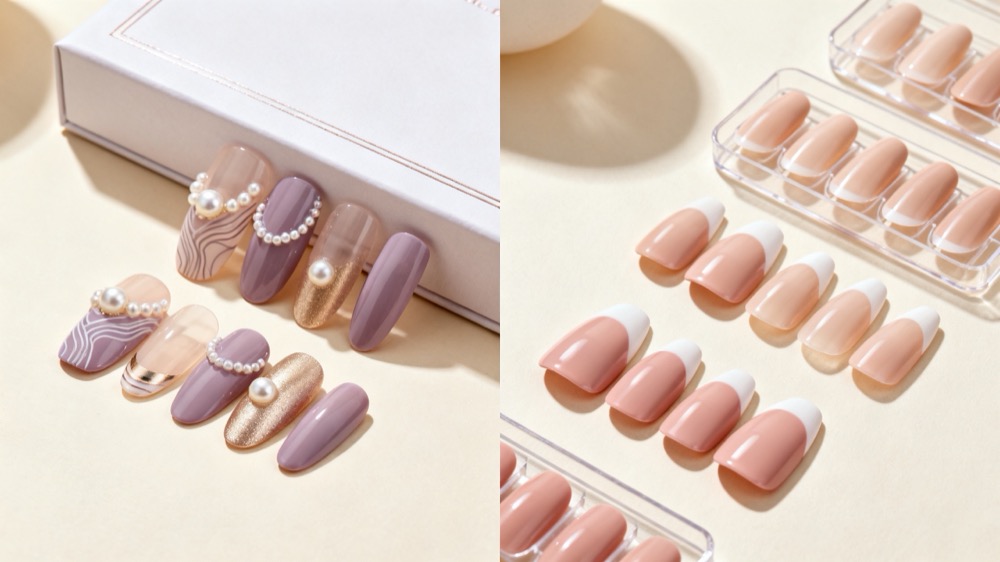
Custom press-on nails are manufactured to an agreed specification rather than selected unchanged from an existing catalog.
Depending on the factory's capabilities and your development budget, customization may include:
- Nail artwork, colors, and decorative finishes.
- Shape, length, curvature, and size assortment.
- Material and thickness specifications.
- Adhesive options and application accessories.
- Packaging, inserts, and kit configuration.
Not every custom project needs a new mold. Existing nail shapes with exclusive artwork can offer meaningful differentiation without the expense of developing a new physical structure.
Stock press-on nails use existing designs and specifications. They may be available from inventory or require another production run, so "stock design" does not necessarily mean "ready to ship."
Some suppliers allow branded packaging around existing nails; others restrict ready-stock products to their original presentation. Confirm which arrangement applies before planning your launch. Supplier service descriptions distinguish among ready-to-ship products, existing designs with branded packaging, and broader customization.
Private label therefore describes how the product reaches customers under your brand—not necessarily how extensively the nails themselves were developed.
| Decision factor | Custom press-on nails | Stock press-on nails |
|---|---|---|
| Differentiation | More control over appearance and specifications | Existing designs may be available to competitors |
| Initial investment | May include development, sampling, and tooling | Usually fewer product-development expenses |
| Launch preparation | More approval stages | Fewer stages if inventory and packaging are ready |
| Minimum order quantity | Depends on design and production requirements | Depends on inventory and branding arrangement |
| Quality control | Specifications can be tailored to brand priorities | Existing products still require inspection |
| Packaging | Can be developed around the complete kit | Branding options depend on supplier flexibility |
| Exclusivity | Must be negotiated and documented | Should generally not be assumed |
| Best application | Validated demand and distinctive positioning | Market testing and simpler initial assortments |
These are directional comparisons, not guaranteed quotation terms. Request both options against the same requirements before comparing prices.
Stock products often require less development spending. However, the cheapest factory quotation may not produce the lowest commercial cost.
Compare:
1. Product and accessory costs.
2. Sampling and development charges.
3. Tooling, printing, and packaging setup.
4. Inspection, freight, and applicable import charges.
5. Warehousing, fulfillment, and selling fees.
6. Expected returns, replacements, and unsold inventory.
Packaging deserves separate attention. Its minimum order quantity may differ from the nail order minimum. A low product commitment can still leave your business holding unused printed boxes. Published supplier guidance explicitly separates packaging minimums from nail-product minimums.
Suppose a custom collection requires $1,500 in additional development spending.
If it generates $2 more contribution per sold set than the stock alternative, the business needs 750 sales to recover that additional investment.
Contribution means revenue remaining after the relevant variable costs—not simply retail price minus factory price.
This example is hypothetical, not a YoungMei quotation or an industry benchmark. Its lesson is straightforward: customization makes financial sense when its incremental contribution justifies its incremental cost.
A quotation stating "500 sets minimum" is incomplete unless it explains the unit of commitment.
Ask whether the minimum applies to:
- Each design.
- Each color or finish.
- Each shape and length.
- Each packaging version.
- The total purchase order.
Supplier-published minimums vary substantially, demonstrating why there is no universal minimum for private label press-on nails. Design complexity and packaging requirements can change the answer.
Request a quotation matrix showing each proposed SKU, its minimum, and its permitted variations.
An inventory item can still need packaging approval, accessory sourcing, assembly, inspection, and shipping.
A custom order may also require artwork revisions, physical samples, or tooling approval.
Build your schedule backward from the required warehouse arrival date:
1. Delivery and receiving.
2. Transit and customs allowance.
3. Final inspection and packing.
4. Production and assembly.
5. Sample and artwork approval.
Ask when the lead-time clock starts. A schedule beginning after sample approval is different from one beginning after the initial inquiry.
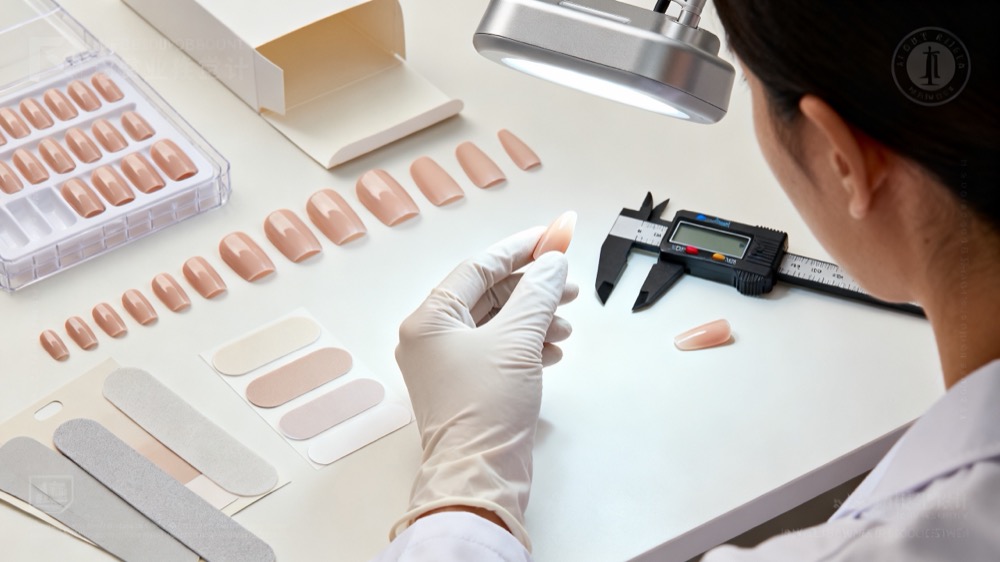
Custom nails are not automatically better than stock nails. A carefully inspected existing product may outperform a custom design with poorly controlled thickness or inconsistent decoration.
Evaluate both options against the same checklist:
- Size coverage and left-right pairing.
- Curvature and comfortable sidewall fit.
- Edge smoothness.
- Color and artwork consistency.
- Decoration placement and attachment.
- Kit completeness.
- Packaging protection.
Use an approved physical sample as the production reference. Photographs alone may not show curvature, flexibility, or surface texture accurately.
From a product-development perspective, fit is a valuable starting point because it affects how customers experience the entire kit.
For a pilot collection, record which sizes customers use, which they cannot match, and whether particular lengths interfere with daily activities.
If feedback repeatedly identifies missing sizes, adding more decorative finishes will not solve the underlying problem.
This is where custom development becomes purposeful: change a measurable customer problem rather than customize for its own sake.
An existing design inside your branded box can support a coherent launch. However, it may still be available to other buyers.
Similarly, paying for custom artwork does not automatically establish exclusive rights to the design. Supplier guidance cautions that private labeling alone does not establish exclusivity.
Address these questions in writing:
- Who owns the artwork and production files?
- Can the supplier sell the design elsewhere?
- Does exclusivity cover a territory, channel, or period?
- Who owns any paid tooling?
- What happens to unused branded packaging?
For commercially significant exclusivity, obtain appropriate legal review rather than relying on a product-page description.
A stock-based collection can still have a clear identity through thoughtful assortment, accessible instructions, consistent photography, and relevant positioning.
Conversely, a custom collection can feel generic if its designs do not connect with a defined customer.
Start with a specific audience and use occasion. Then decide which product features deserve investment.
For U.S. launches, applicable requirements should be reviewed across the actual kit, including relevant nail products, adhesives, and other included preparations. FDA guidance explains that nail products are generally regulated as cosmetics and identifies labeling and warning considerations. Product-specific classification still requires review.
Before approving packaging:
- Confirm the intended sales markets.
- Identify every included component.
- Review applicable labeling and warning requirements.
- Request relevant specifications and supporting documentation.
- Establish a complaint and batch-tracing process.
Avoid unsupported statements such as "allergy-free," "damage-free," or a guaranteed wear duration.
The American Academy of Dermatology notes that substances used with artificial nails can cause reactions and advises against using artificial nails to cover existing nail problems. Instructions and marketing should reflect these limitations rather than promise universal suitability.
Replace "premium quality" with observable acceptance criteria.
Your inspection plan can address:
- Agreed artwork and color references.
- Approved dimensions and tolerances.
- Missing or duplicated sizes.
- Visible surface defects.
- Loose decorations.
- Incorrect accessories or instructions.
- Packaging damage and labeling errors.
Agree on defect categories, inspection methods, and corrective-action procedures before production.
If your brand wants to advertise a wear period, document how that claim will be evaluated.
Record the adhesive used, preparation instructions, participant conditions, and removal method. Do not transfer a result from one kit configuration to another without considering the differences.
For stock products, request a current representative sample. For custom products, confirm that the approved sample represents the intended production process—not merely a handmade concept.
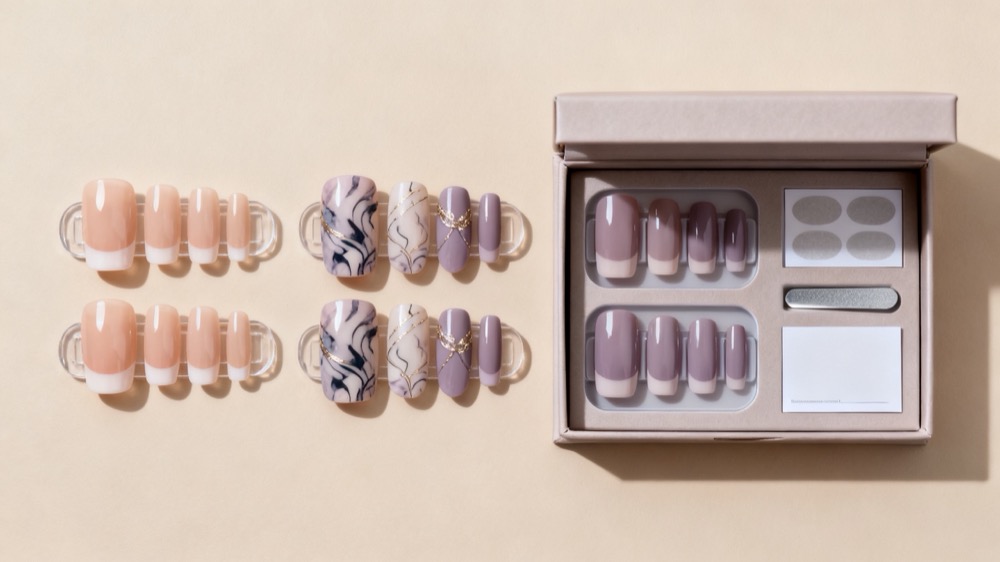
A hybrid collection combines existing nail platforms with selected brand-specific elements.
For example, a brand could use an established shape and size assortment while developing exclusive artwork and custom packaging.
This approach can reduce the number of variables requiring development while preserving a distinctive presentation.
A practical progression is:
1. Launch a focused assortment.
2. Track sales and customer feedback by SKU.
3. Identify fit, finish, or packaging problems.
4. Customize the features linked to repeatable demand.
5. Expand only after reviewing replenishment performance.
This is a proposed planning framework, not a claim that one launch sequence works for every brand.
- You are still testing your audience.
- Your deadline leaves little room for development.
- Preserving working capital is a priority.
- Existing products meet your quality requirements.
- Exclusivity is not central to your positioning.
- You have evidence of customer demand.
- Existing products leave an important need unmet.
- Your brand depends on distinctive design or fit.
- Your budget supports development and approvals.
- You can support the required order commitment.
Choose a hybrid route when you know which features customers value but do not yet need a fully proprietary product.
Dongguan YoungMei Technology Co., Ltd. develops and manufactures press-on nails, nail stickers, and related nail products. Our own factory and established supply chain support OEM/ODM customization, rapid sampling, consistent-quality objectives, and one-stop sourcing for brands, wholesalers, and retail chains.
Send YoungMei your target market, preferred styles, estimated quantity, packaging requirements, target cost, and launch date.
Request a side-by-side proposal for stock-based and custom development, including sample requirements, minimums, production milestones, and quality checkpoints. That comparison provides a stronger purchasing basis than choosing from unit price alone.
Yes, where the supplier permits rebranding. Confirm packaging options, product availability, labeling responsibilities, and any restrictions before ordering.
No. Custom artwork, finishes, or packaging may use existing nail platforms. New dimensions or structural changes may require additional development.
No. A stock design may be catalog-based rather than physically available. Request inventory confirmation and a schedule for the complete branded kit.
Neither guarantees better margins. Compare contribution after product, packaging, logistics, selling expenses, returns, and development costs.
Yes. Keep detailed SKU-level feedback so later customization addresses demonstrated demand rather than assumptions.
Document ownership, permitted use, exclusivity scope, and tooling arrangements. Seek legal advice where the commercial value warrants it.
- U.S. Food and Drug Administration. [Nail Care Products]. Regulatory context, ingredient labeling, and safety considerations.
- U.S. Food and Drug Administration. [Cosmetics Labeling Guide]. U.S. cosmetic labeling guidance.
- American Academy of Dermatology. [Manicure and Pedicure Safety]. Artificial-nail precautions and potential reactions.
- Huizi. [Custom Press-On Nails Wholesale]. Supplier example distinguishing stock, branded existing designs, and custom development.
- GOODNAIL. [Private Label Nail Tips & Press-On Nails]. Supplier-specific packaging options and separate minimums.
- Ennio Nails. [MOQ, Lead Time & Packaging Options for OEM Press-On Nails]. Supplier-published sourcing considerations, not universal benchmarks.
- SENAILGLOBAL. [Private Label Press-On Nails: MOQ, Samples & First Orders]. Order specifications and exclusivity considerations.