
- All
- Product Name
- Product Keyword
- Product Model
- Product Summary
- Product Description
- Multi Field Search
English
Views: 219 Author: Young Mei Publish Time: 10-16-2026 Origin: Site


Content Menu
● What Makes a Fall Nail Design Worth Wearing?
● 1. Modern French Tips in Autumn Colors
>> Autumn French Nail Ideas to Explore
● 2. Chocolate, Caramel, and Autumn Neutral Nails
>> Build a Cohesive Neutral Set
● 3. Burgundy, Black Cherry, and Dark Jelly Finishes
>> Choose Opacity Deliberately
● 4. Tortoiseshell and Animal-Print Fall Nails
>> Keep Patterns Clear on Smaller Nails
● 5. Velvet Cat-Eye and Reflective Finishes
>> Review Reflective Nails Beyond a Still Photograph
● 6. Sheer Natural Nails with Minimal Autumn Accents
>> Make Minimal Designs Feel Intentional
● How to Choose Fall Press-On Nails for Your Lifestyle
● Applying Autumn Press-On Nails: A Practical Sequence
>> 1. Check Your Natural Nails First
>> 2. Dry-Fit the Complete Set
>> 3. Prepare According to the Product Instructions
>> 4. Apply the Specified Adhesive
● From Trend Inspiration to a Private-Label Fall Collection
>> Stage One: Define the Customer and Collection
>> Stage Two: Approve a Complete Product Sample
>> Stage Three: Build a Feedback Process
● Develop Your Autumn Nail Collection with YoungMei
>> What Fall Nail Colors Should I Consider?
>> Which Fall Nail Designs Work on Short Nails?
>> How Long Do Fall Press-On Nails Last?
>> Are Press-On Nails Damage-Free?
>> Can Brands Customize Autumn Press-On Nail Collections?
>> What Should Buyers Approve Before Bulk Production?
Fall nail design trends bring together rich colors, expressive patterns, and finishes that make a manicure feel personal. Whether you want short autumn press-on nails for everyday wear or a distinctive private-label collection, the strongest starting point is the same: choose a design that looks appealing, fits comfortably, and suits its intended use.
Today's autumn nail ideas extend beyond pumpkin orange and chocolate brown. Current editorial coverage highlights animal prints, velvet-like cat-eye effects, dark jelly colors, and unexpected cool-toned accents alongside familiar seasonal shades. These are creative directions, not a guarantee that every style will sell equally well.
At Dongguan YoungMei Technology Co., Ltd., our focus is turning creative ideas into practical nail products. With more than 15 years of manufacturing experience, we support brands, wholesalers, and chain retailers through product development, OEM/ODM customization, and production.
Our guiding principle is balance: expressive design, considered fit, and clear product information should work together.
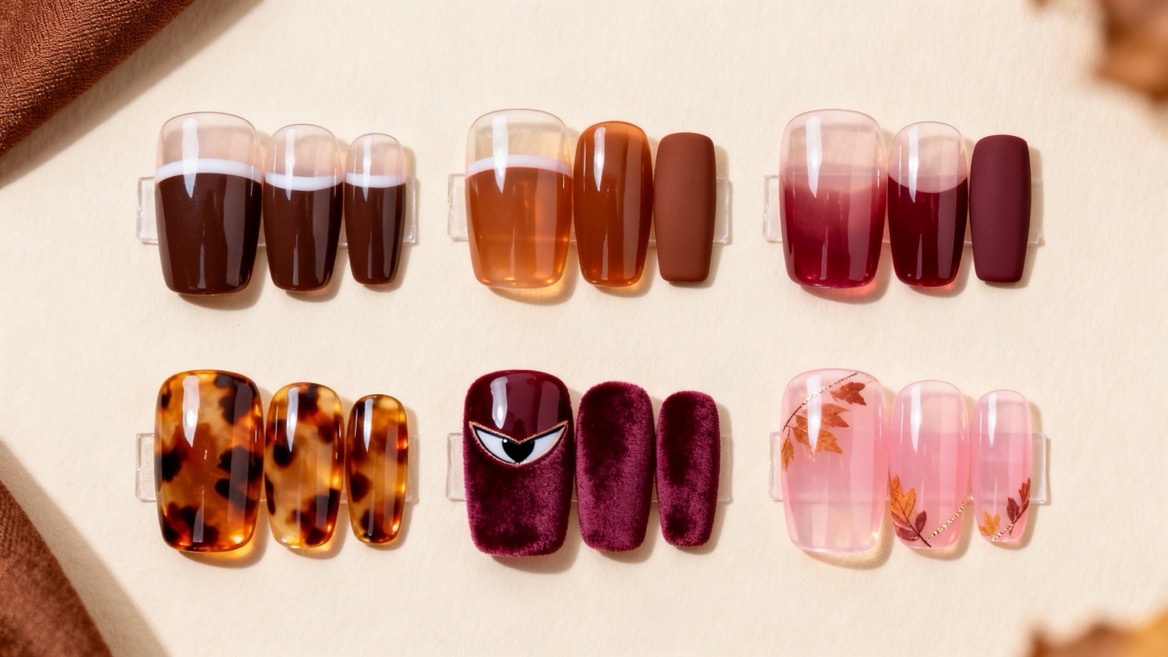
A beautiful photograph is only the beginning. Before choosing a manicure or developing a collection, consider three questions:
- Does the color suit the wearer's wardrobe and preferences?
- Does the length match their daily activities?
- Can the design remain attractive across different nail sizes?
From a product-development perspective, I would start with the wearer's routine rather than the most elaborate decoration. Someone who types throughout the day may prefer a compact shape. Another customer may want longer nails for occasional styling.
For brands, these differences suggest separate product options rather than one supposedly universal set.
The six directions below combine seasonal inspiration with practical considerations for wearers and professional buyers.
French manicures offer a familiar structure with plenty of room for seasonal interpretation. Instead of white tips, consider espresso, burgundy, olive, or caramel.
A narrow colored edge creates a restrained look. A deeper smile line makes the contrast more pronounced. Tortoiseshell tips introduce pattern without covering the entire nail.
- Espresso tips over a sheer beige base.
- Burgundy tips with a soft pink background.
- Olive micro-French details on short nails.
- Amber tortoiseshell tips with a translucent base.
For a first autumn set, I would choose one strong contrast rather than several competing accents. It makes the design easier to coordinate with everyday clothing.
For custom press-on nails, review the tip placement across the complete size range. A French line that looks balanced on the largest nail may appear disproportionately thick on a smaller one.
Approve the full set, not just the hero nail.
Brown-based palettes provide a flexible foundation for fall nail designs. Chocolate, caramel, taupe, and creamy beige can work as solid colors, coordinated gradients, or backgrounds for decorative details.
The important choice is not simply "brown." It is the relationship between undertone, opacity, and finish.
A reddish chocolate shade creates a different impression from a gray-brown taupe. An opaque cream looks different from a translucent coffee-colored finish, even when both belong to the same palette.
Choose one of these approaches:
1. Use a single shade across all nails.
2. Arrange related colors from light to dark.
3. Pair a solid neutral with one patterned accent.
4. Repeat one detail, such as a fine metallic line.
For brands, keep a physical color reference alongside digital artwork. Screen images are useful for communication, but final sample approval should concern the actual product.
Compare samples under consistent lighting and record which finish was approved.
Burgundy and black cherry offer a darker alternative to earthy neutrals. Current autumn coverage also emphasizes vampy jelly finishes: translucent colors that create depth rather than a completely opaque appearance.
This distinction matters when selecting press-on nails. A solid wine-red nail and a sheer burgundy nail may have similar color names but deliver noticeably different results.
Opaque finishes suit customers who want consistent coverage. Jelly-style finishes suit those who prefer a more translucent effect.
For a custom collection, define:
- The target color depth.
- The intended translucency.
- The acceptable variation between sizes.
- How the finished nail should appear when worn.
Do not approve a translucent design only against a white sample tray. Review it on representative nail backgrounds as well.
For wearers, examine close-up product images before buying. If visible translucency is part of the design, decide whether that appearance matches your expectations.
Animal prints remain part of current autumn nail coverage, including leopard, fawn-inspired spots, and combinations with magnetic backgrounds. Tortoiseshell also provides a recognizable seasonal direction through amber, caramel, and dark brown layering.
These patterns can be interpreted subtly or boldly.
For a quieter manicure, use one or two patterned nails alongside solid colors. For a statement set, repeat the pattern while varying its placement.
A pattern should remain readable on the narrowest nail in the set.
During development, check whether:
- Spots remain distinct rather than merging.
- Dark areas overwhelm the background.
- Important details disappear near the sidewalls.
- Pattern placement looks intentional across sizes.
My recommendation is to evaluate the smallest nail early. It often reveals whether a complex design needs simplification.
For patterned nail stickers, request a physical sample on the intended base color. The final appearance should be assessed as a complete combination, not as separate artwork files.
Cat-eye nails create a light-responsive appearance through magnetic effects. Current expert commentary describes a softer velvet direction, with shimmer spread across the nail rather than concentrated into one sharp line.
Autumn interpretations could include smoky brown, deep teal, plum, or wine-colored backgrounds.
For wearers, the attraction is movement: the finish looks different as the hand changes position.
For buyers, that same movement makes sample evaluation especially important.
Request:
- A short video showing several viewing angles.
- Images in diffuse daylight.
- Images under ordinary indoor lighting.
- Physical samples of the approved effect.
A dramatic studio photograph should not be the only approval reference.
Record the intended shimmer direction, background shade, and visual intensity. This gives the production team a clearer target and helps avoid disagreements based on differently lit photographs.
Not every fall manicure needs a dark color or complex pattern. Sheer beige, muted pink, and understated accents offer another direction.
Possible details include a narrow brown tip, a small burgundy mark, or a restrained metallic line.
Current autumn coverage also shows interest in combining dark shades with lighter accents and choosing colors according to personal style rather than rigid seasonal rules.
Minimal artwork leaves more of the base visible. That makes consistency important.
For a custom set, review:
- Base-color uniformity.
- Surface clarity.
- Decoration placement.
- Smoothness around the edges.
For wearers, choose a base you genuinely like rather than assuming every product described as "nude" will suit you.
A restrained design can still feel distinctive when its proportions and color relationships are carefully considered.
Use this table as a selection framework, not a promise of performance.
| Preference | Suggested starting point | What to evaluate |
|---|---|---|
| Understated everyday styling | Short autumn French tips | Fit, tip proportion, comfortable length |
| Warm seasonal colors | Chocolate or caramel solids | Undertone and finish |
| Rich, dramatic color | Burgundy or black cherry | Opacity and overall length |
| Pattern-focused styling | Tortoiseshell or animal accents | Pattern clarity across sizes |
| Light-responsive effects | Velvet cat-eye nails | Appearance in different lighting |
| Minimal decoration | Sheer bases with fine accents | Base consistency and placement |
Shape selection should begin with fit. Dry-fit each nail before application and assess width, curvature, and comfort.
Do not force an unsuitable tip onto the natural nail simply because its decoration is appealing. For retail collections, offer clear size information so customers can evaluate the product before purchase.
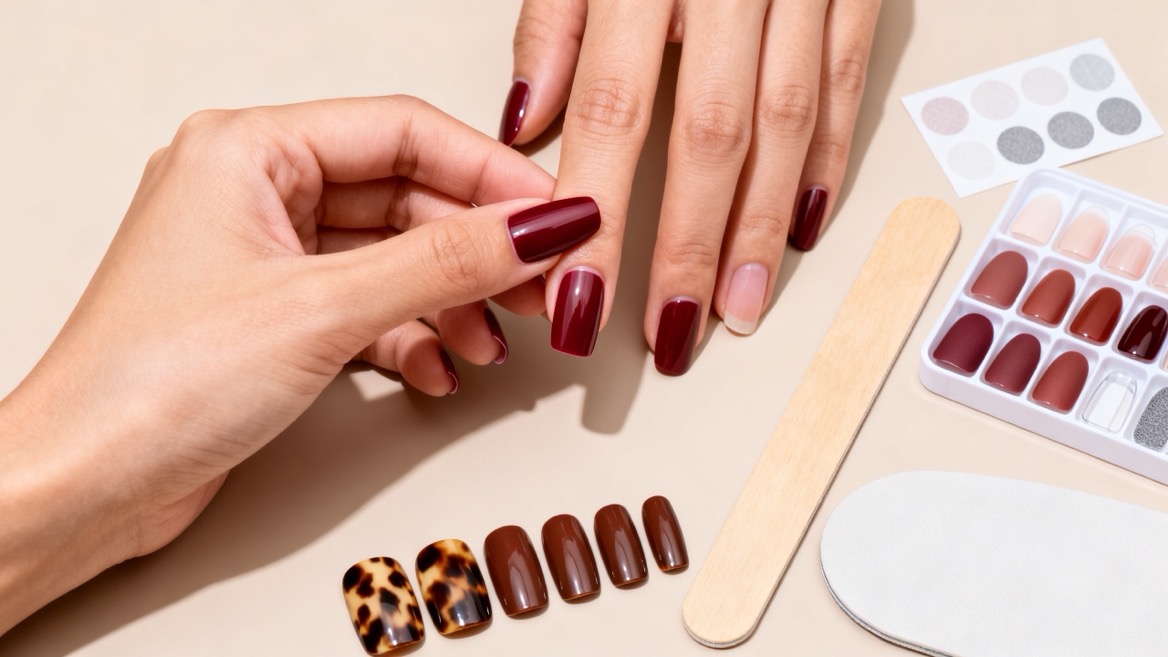
Application requirements differ between products. Follow the instructions supplied with the nail set and its adhesive rather than borrowing steps from an unrelated product.
Do not use artificial nails to hide damaged or unhealthy nails. Dermatology guidance warns that covering existing problems can make them worse. Seek professional advice if you have pain, unexplained changes, or suspected infection.
Arrange the nails in order before opening the adhesive. Check that each tip fits without pressing uncomfortably into surrounding skin.
This also lets you confirm the placement of accent nails.
Preparation should be gentle and product-specific. Avoid aggressive filing or unnecessary cuticle cutting. Cuticles help protect the nail and surrounding skin from infection.
Follow the stated quantity, positioning, and holding time. Avoid adhesive contact with skin.
Adhesive tabs and liquid glue should not be treated as interchangeable products with identical instructions or expected wear.
Use the recommended removal method. Do not pull attached nails off to meet a schedule.
If irritation or a rash develops, discontinue use and seek medical advice. Keep the product information available so a clinician can identify what was used.
For beauty brands and wholesalers, translating fall nail trends into products requires more than selecting attractive artwork.
I would organize the development process around three stages.

Decide whether the range serves understated daily styling, expressive fashion looks, or occasional wear.
Then specify:
- Shapes and lengths.
- Color families.
- Decorative techniques.
- Nail-size assortment.
- Adhesive options.
- Packaging and instruction requirements.
An illustrative starting range could contain two solid colors, one French design, one patterned design, and one reflective finish. This is a planning example, not a proven sales formula.
Review the entire retail set, including accessories and instructions.
Ask the manufacturer to confirm:
- What is included in each pack.
- Which design elements are customizable.
- How repeat-order colors are controlled.
- What inspection criteria apply.
- Which documents relate to the actual product.
Avoid broad claims such as "damage-free," "hypoallergenic," or guaranteed wear durations unless appropriate evidence supports the exact claim.
After launch, collect structured feedback rather than relying only on star ratings.
Useful categories include fit, application clarity, color expectations, comfort, removal, and packaging completeness.
Separate design preferences from product problems. A customer who dislikes a shade raises a different issue from a customer who cannot find a suitable nail size.
This distinction makes future improvements more actionable.
Dongguan YoungMei Technology Co., Ltd. provides manufacturing and customization support for global nail-product businesses. Our company information describes integrated research, production, wholesale supply, and OEM/ODM services.
For your next collection, send our team your target market, design references, preferred shapes, estimated quantity, packaging requirements, and intended launch date.
We can use that brief to discuss sampling, customization, and production planning. Confirm project-specific timelines and specifications before placing an order.
Chocolate, burgundy, caramel, olive, and taupe provide useful starting points. Current coverage also highlights teal, plum, and lighter accents paired with dark colors. Choose according to personal preference or your collection's customer profile.
Consider micro-French tips, solid colors, small tortoiseshell accents, and restrained line details. Review the artwork at its actual size so decorative elements remain clear rather than crowded.
There is no universal duration. Follow the specific product's guidance and avoid assuming that different adhesives or nail sets perform identically. Brands should support wear-time claims with appropriate product testing.
No artificial-nail product should automatically be described as risk-free. Nail condition, preparation, adhesive exposure, and removal matter. Artificial nails can worsen existing nail problems, and some application products can cause irritation or allergic reactions.
Yes. YoungMei describes customization covering shapes, materials, designs, and related product development. Confirm the available options, sample process, packaging scope, and production requirements for your particular project.
Approve the complete set: color, finish, size assortment, artwork placement, accessories, packaging, and instructions. Keep an agreed physical reference sample and written specifications for subsequent inspection.
- The Nailest — "Six Fall Autumn 2021 Nail Design Trends." Original inspiration supplied for this rewrite. Search-indexed material confirms several themes, but the full page was unavailable during review. [thenailest]
- InStyle — "6 Fall Nail Trends to Watch, From Bambi Prints to Glossy Cool Tones," September 26, 2026. Supports the current design directions and includes commentary from nail professionals and brand founders. [instyle]
- The State News — "From Doe Print to Tortoise Shell: The Fall Nail Trends Defining the Season," October 12, 2026. Supplementary context on animal patterns, tortoiseshell, and seasonal colors. [statenews]
- American Academy of Dermatology — "Artificial Nails: Dermatologists' Tips for Reducing Nail Damage." Supports guidance concerning damaged nails, aggressive filing, cuticle protection, and artificial-nail risks. [aad]
- American Academy of Dermatology — "Manicure and Pedicure Safety." Supports guidance concerning existing nail problems, allergic reactions, and seeking professional care. [aad]
- YoungMei — "About Us." Company-published information supporting manufacturing experience and customization services; it is not independent verification of all company claims. [youngmeinails]