
- All
- Product Name
- Product Keyword
- Product Model
- Product Summary
- Product Description
- Multi Field Search
English
Views: 263 Author: Young Mei Publish Time: 09-27-2026 Origin: Site


Content Menu
● Why Nail Dust Capture Matters
● The Seven Buying Factors That Matter Most
>> 1. Capture Performance at Your Working Distance
>> 2. Workstation Fit and Hand Position
>> 3. Filter Design and Replacement Costs
>> 4. Corded Versus Cordless Operation
>> 5. Noise During a Real Service
>> 6. Cleaning, Durability, and Serviceability
>> 7. Total Cost, Not Sticker Price
● How to Test a Collector Before Buying
● Which Collector Fits Your Workflow?
● A More Complete Approach to Salon Air Quality
● What Professional Buyers Should Request
● Choose for the Work You Actually Do
>> Is a nail dust collector the same as salon ventilation?
>> Does a higher wattage mean stronger suction?
>> Should I choose a corded or cordless collector?
>> How often should I replace a nail dust collector filter?
>> Can a dust collector remove acetone or other chemical vapors?
>> Is a more expensive collector always better?
>> What should a salon chain check before a bulk order?
A nail dust collector should do more than make your manicure table look clean. During filing, shaping, and product removal, dust forms close to the technician's and client's breathing zones. The right machine captures that dust where it is produced, fits the way you work, and remains practical to maintain. If you are comparing a corded model with a cordless one—or deciding whether a premium machine is worth the price—start with actual capture performance rather than a headline wattage or an attractive housing.
This guide builds on a hands-on comparison of two premium machines, the Anemone and Valentino dust collectors. The original reviewer bought both units independently and reported that Valentino appeared to capture dust better in her setup, while Anemone's cordless design offered greater mobility. Those observations are useful, but they are not standardized performance tests. Here is how to turn them into a more reliable buying process for a home studio, busy salon, or multi-location business.

Filing artificial nails and finishes can release visible debris and finer airborne particles. Nail services may also involve chemical vapors from liquids, adhesives, and removers. A collector designed for filing dust should not automatically be assumed to control those vapors. Dust capture and vapor control are different purchasing questions.
Local exhaust ventilation aims to draw contaminants away at the workstation before they spread through the room. General room ventilation remains important, too. A tabletop machine that recirculates filtered air is not necessarily equivalent to a system that exhausts outdoors. Likewise, an advertised filter does not prove that every particle or vapor is removed under real working conditions.
The practical goal is straightforward: put the capture inlet close to the filing point, operate it whenever dust is generated, and keep the filter and airflow path in good condition. Do not wait until you can see a cloud. Visible dust is only one clue about whether your setup is working.
A collector's most important job is to pull dust into its inlet while you file in your normal position. Ask a supplier for measured airflow and test conditions, not only fan speed. Airflow, inlet geometry, leaks, filter loading, and the position of the client's hand all affect what reaches the filter.
Fan RPM tells you how fast a component turns; wattage tells you about electrical input. Neither, alone, establishes dust-capture efficiency. A large grille can accommodate hand filing across a wider area, but a large opening is not automatically better if suction at the actual filing point is weak. A smaller inlet can be effective when it is positioned close to the dust source. Test the complete machine, with its usual filter installed, at the speed you can tolerate during a full appointment.
Buyer question: Can the seller show repeatable capture results at a stated distance and with a loaded as well as a clean filter?
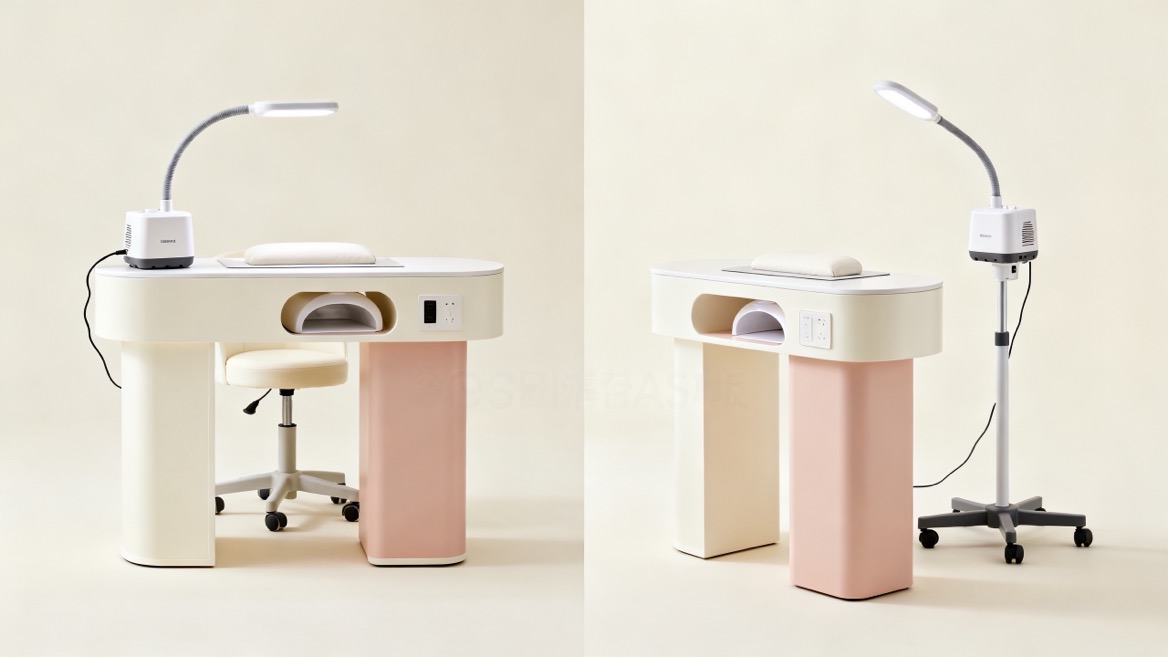
Flat and angled collectors solve different ergonomic problems. An angled housing may support the client's wrist and help keep the nails above the inlet. A flat model may fit a compact desk or mobile kit more easily. Measure your table, chair height, armrest, lamp position, and working space before ordering.
Check whether the client can rest comfortably without blocking the intake. Also consider where your e-file cord will run and whether your own shoulders remain relaxed. A collector that forces you to lean forward for every service is a poor fit, however impressive its specifications look. For a shared salon station, ask several technicians to try the layout; a workable setup for one person may not suit everyone.
Do not use the intake surface as storage for powders, loose accessories, or liquids. Check the manufacturer's cleaning instructions before exposing the casing to acetone or disinfectants. Product compatibility depends on the specific materials and finish, not on how similar two machines appear.
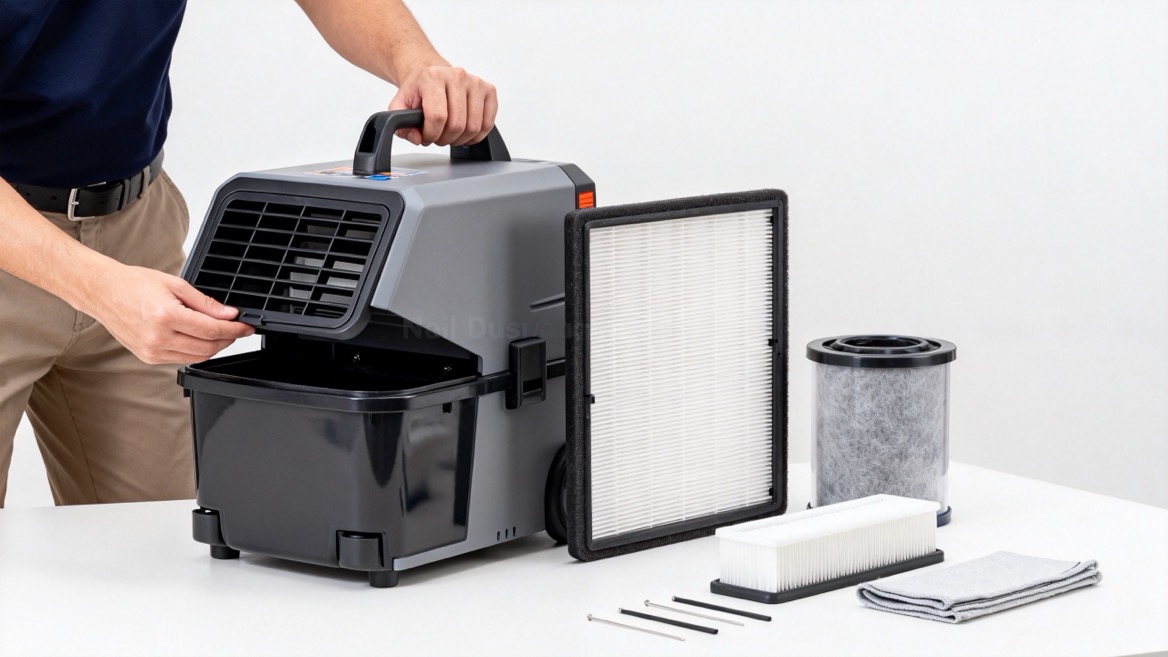
Filters are a recurring operating expense, not a minor accessory. Identify the exact compatible part number, pack size, availability, replacement interval, and disposal instructions. Ask whether the filter is washable or single-use; do not wash or reuse one unless the maker explicitly allows it.
The original comparison described two different approaches: a reusable or periodically replaced Valentino filter under the grille and disposable Anemone filter sheets. Its prices and suggested intervals were snapshots from that review, not current quotes. They also reflected the reviewer's workflow, so they should not become universal cleaning rules.
For each candidate, calculate cost per service: filter cost divided by the number of appointments it can safely cover under the maker's instructions. Then check what happens if shipping is delayed or a filter model is discontinued. A cheap collector with difficult-to-source consumables can become the expensive choice after a year.
A cordless nail dust collector can be valuable for mobile technicians, training rooms, temporary stations, and desks without a convenient outlet. A corded model avoids charging interruptions and may be simpler to plan around in a fixed workstation.
Before paying extra for portability, request the runtime at your intended working speed, charging time, battery replacement policy, and whether the unit can operate safely while plugged in. Do not assume every cordless model supports pass-through operation or that a failed battery requires replacing the whole machine. These are model-specific questions.
Think in appointments rather than advertised hours. If a device runs for less than your longest back-to-back service block, you need a charging plan, a spare unit, or another model. For multi-station purchasing, standardizing chargers and replacement parts can matter as much as the purchase price.
A powerful fan that is too loud to use consistently offers little practical benefit. Compare sound at the technician's position, at the speed needed to capture dust, with the filter installed. Ask for a measured sound level in decibels and the testing distance; an isolated decibel claim is hard to compare without those details.
In the original reviewer's experience, Valentino sounded slightly quieter than Anemone at full power. That is a subjective comparison, not a universal specification. Stronger suction can sometimes coincide with more noise, but noise alone does not prove better capture. Listen for rattling, vibration, and changes when the client rests a hand on the housing.
If possible, trial a unit through a complete removal service. A 30-second demonstration may miss the cumulative effect of motor noise during a full workday.
Filing dust builds up where customers cannot always see it. Check how the grille lifts off, whether the filter can be changed without releasing a cloud of collected dust, and whether debris can be removed without touching the motor or damaging seals. Follow the manufacturer's cleaning and electrical safety instructions.
A busy salon should also ask about replacement grilles, power adapters, batteries, warranty exclusions, and local repair arrangements. Check whether cleaning supplies used at the station are compatible with exposed surfaces. A machine that is quick to maintain is more likely to be maintained between appointments.
Before committing to a large order, request a sample unit and repeat the cleaning procedure yourself. Time the filter change, inspect the edges for gaps, and check that the unit sits securely after reassembly. These small details can affect day-to-day use far more than a polished product photo.
A higher price does not guarantee better capture; a lower price does not automatically mean poor construction. Compare total cost of ownership across the period you expect to use the collector.
| Cost or value factor | What to verify before ordering |
|---|---|
| Machine | Purchase price, included accessories, shipping, and warranty |
| Consumables | Filter price, replacement frequency, and reliable availability |
| Downtime | Repair turnaround, spare parts, and backup-unit needs |
| Workflow | Setup time, cleaning time, mobility, and usable noise level |
| Documentation | Airflow evidence, electrical information, and clear instructions |
Consider a salon with six appointments a day. Even a modest difference in per-client filter spending accumulates over hundreds of services. Conversely, a costlier machine may be worthwhile if it is easier to clean and stays in service longer. Build the comparison with current written quotes and your actual booking pattern, not another technician's historical prices.
This is the most useful step missing from many product comparisons. A short, repeatable trial cannot replace laboratory testing, but it can reveal obvious problems with your station layout and workflow.
1. Set up the real station. Use your normal chair, table, armrest, lighting, and compatible clean filter.
2. Run your usual service. Compare machines on the same type of filing task, at a similar position and pace.
3. Watch where dust travels. Note buildup on the table, your sleeves, the client's hand, and surfaces beyond the intake. Do not deliberately generate extra dust to create a visual test.
4. Check comfort and noise. Record whether the technician changes posture or reduces fan speed to continue working.
5. Repeat after regular use. Recheck performance as the filter loads, following the maker's maintenance schedule.
6. Record the decision. Use the same checklist for every unit, including filter cost and spare-part availability.
A visible-dust check is only a screening tool. It cannot establish how much fine airborne material is captured or whether chemical vapors are controlled. For a high-volume workplace, request credible test reports and seek qualified ventilation advice when assessing exposure or local requirements.
| Work setting | Prioritize | Watch out for |
|---|---|---|
| Home studio | Compact footprint, manageable noise, easy filter access | Buying on price without checking replacement filters |
| Mobile nail technician | Carry weight, battery runtime, charging plan | Assuming cordless operation lasts a full booking day |
| Busy salon station | Consistent capture, cleanability, parts supply | Filters that become costly or difficult to source |
| Multi-location buyer | Repeatable specifications, documentation, standardized consumables | Comparing models using incompatible test conditions |
The original Anemone-versus-Valentino comparison illustrates this tradeoff well. The reviewer liked the Anemone's portability and reported better overall capture with the Valentino in her personal setup. Neither observation establishes a winner for your table, filter condition, service type, or local market. Treat a review as a shortlist, then test the finalists using the same conditions.
A dust collector belongs in a wider control plan. Keep the work area ventilated, use product labels and safety data sheets to understand chemical hazards, and close chemical containers when they are not in use. If your service produces both filing dust and solvent vapors, ask specifically how each will be controlled.
A particle filter is not proof of vapor removal. Likewise, a mask intended for particles is not a substitute for ventilation or protection against gases. Employers should assess workplace conditions and applicable requirements rather than treating a countertop collector as an all-purpose safety device.
This distinction matters when marketing products, too. Avoid claims such as "eliminates all harmful dust" or "purifies every chemical" unless the exact configuration has credible supporting evidence. Accurate specifications and clear operating instructions help professionals choose equipment responsibly.
When sourcing for a salon chain or distribution business, put the evaluation criteria into a written request for quotation. Ask each supplier for the same information: model and filter numbers, airflow measurement method, test distance, noise-test conditions, power input, dimensions, replacement-part lead times, warranty terms, and maintenance instructions. Request evidence for any filtration or vapor-control claims.
Then sample units from the proposed production configuration, not just an attractive prototype. Log the lot number, filter version, accessories, and any differences between the sample and the quoted specification. This makes later reorders easier to verify and gives your purchasing team a fair basis for comparison.
For brands building a broader nail-care assortment, equipment decisions should also fit the service menu. A press-on nail retail display may generate little on-site filing dust, while an application or removal station may need a dedicated capture setup. Match the equipment to the actual task instead of purchasing by category label alone.
The best nail dust collector is the one your team can position correctly, run consistently, clean safely, and support with available parts. Shortlist machines using documented performance, then test comfort, capture, noise, and upkeep at your own workstation. If you supply salons or retail chains, request a sample and a written specification sheet before placing a volume order.
Dongguan YoungMei Technology Co., Ltd. focuses on OEM/ODM press-on nails, nail stickers, and related nail products, with in-house production and supply-chain support. If you are planning a coordinated professional or retail nail assortment, contact our team with your target market, product brief, estimated quantities, and packaging requirements to discuss sampling and customization. For dust-collector selection, use the evaluation checklist above and obtain machine-specific evidence from the equipment supplier.
No. A collector can provide local dust capture at the work surface, while room ventilation addresses the broader space. A recirculating tabletop unit should not automatically be treated as equivalent to an outdoor-exhaust system. Assess both the service and the workstation.
Not necessarily. Wattage describes electrical input, not how much dust reaches the filter. Inlet design, airflow, positioning, and filter condition also matter. Ask for performance data collected under comparable conditions.
Choose cordless if moving between stations is a real operational need and the verified runtime covers your appointments. Choose corded if you mainly work at a fixed desk and want to avoid charging logistics. Confirm any plug-in operation with the manufacturer.
Follow the instructions for the exact machine and filter. Replacement depends on the filter design, workload, and allowable cleaning method. Check and maintain the unit between services as directed; do not adopt another brand's schedule.
Do not assume so. Dust collection and vapor control require different evidence and may require different ventilation arrangements. Ask for test data covering the specific chemical and configuration rather than relying on a generic filtration claim.
No. Compare capture at the working position, comfort, filter availability, warranty, serviceability, and long-term costs. Price is useful as a budget constraint, not as proof of performance.
Request consistent specifications, comparable test results, a production-equivalent sample, consumable pricing, lead times, and warranty terms. Trial the unit at a representative station and document staff feedback before standardizing it across locations.
- [Paola Ponce Nails, "How Do I Choose a Nail Dust Collector? Comparing Two $350 Machines"] — Source of the independent, self-purchased Anemone and Valentino comparison, including the reviewer's observations about design, filters, mobility, noise, and perceived capture. Historical pricing and service-life comments are not current specifications.
- [National Institute for Occupational Safety and Health, "Nail Technicians: Workplace Safety and Health"] — Guidance on occupational hazards, workstation ventilation, portable local-exhaust units, and ergonomics.
- [Occupational Safety and Health Administration, "Health Hazards in Nail Salons: Chemical Hazards"] — Guidance on salon chemical exposure, ventilation, product safety data sheets, and the limits of particle respirators for vapors.
- [National Institute for Occupational Safety and Health, "An Evaluation of Local Exhaust Ventilation Systems for Controlling Hazardous Exposures in Nail Salons"] — Laboratory evaluation of airflow, source capture, and noise for selected ventilation configurations; its findings do not constitute a performance rating of the two machines discussed here.