
- All
- Product Name
- Product Keyword
- Product Model
- Product Summary
- Product Description
- Multi Field Search
English
Views: 257 Author: Young Mei Publish Time: 11-18-2026 Origin: Site


Content Menu
● Is the Gel Lifting, or Is Your Natural Nail Separating?
● How to Remove Lifted Soak-Off Gel Polish at Home
● How Nail Technicians Handle Lifted Builder Gel and Hard Gel
>> Check the removal method before choosing a tool
>> Know when a rebalance makes sense
● What Not to Do When a Gel Nail Lifts
● Why Do Gel Nails Keep Lifting? A Pattern-Based Checklist
>> Lifting near the cuticle or sidewalls
>> Lifting at the tip or on the same finger
>> Several nails lifting early
● What Nail Brands Can Learn From a "Lifting" Complaint
● Develop a Nail Kit With Clear Removal Instructions
● FAQs
>> Can I fix one lifted gel nail without removing the whole set?
>> Can I put nail glue under a lifted gel nail?
>> Why won't my builder gel come off with acetone?
>> What does green discoloration under lifted gel mean?
>> Can I apply a press-on immediately after removing lifted gel?
>> Is it normal for gel nails to lift after just a few days?
To remove lifting from a gel nail, first check what has separated: the gel coating or your natural nail. If only the coating has lifted and you know it's soak-off gel polish, follow the product's removal instructions rather than peeling it back. If you're wearing a thick builder overlay, hard gel, or a product you can't identify, ask a nail technician to assess it. If the natural nail itself is lifting from the skin underneath, or you notice pain, swelling, or unusual discoloration, skip the cosmetic repair and seek medical advice.
A lifted corner can look like a quick fix. But the best next step depends less on the size of the gap than on what created it. Here's how to tell the difference, choose the right removal method, and troubleshoot a manicure that keeps lifting in the same place.

Gel lifting happens when the coating loses its grip on the nail plate, the hard part of the nail you can see. A lifted edge might catch on a towel, or you might notice a pale pocket under an otherwise intact coating. Onycholysis is different: it means the natural nail plate has separated from the nail bed. The detached area often looks white or opaque, so color alone won't tell you which layer has lifted.
Look at the nail in good light without prying up the coating or sliding a tool underneath it. If the manicure is opaque and you can't tell what's separating, don't try to find out by peeling it.
| What you notice | What to do next |
|---|---|
| A loose edge on known soak-off gel polish, with no pain or skin changes | Follow the product's soak-off directions and remove the coating from the affected nail. |
| A pocket under a thick builder overlay or an enhancement you can't identify | Book a professional assessment. Ask whether the product is soak-off or file-off. |
| The natural nail itself appears to be lifting | Leave the area uncovered and arrange a dermatology assessment. |
| Greenish discoloration, increasing tenderness, swelling, or drainage | Don't cover the area with polish or a press-on. Seek medical advice promptly. |
| Itching, peeling, or blisters around the nails after a manicure | Stop using the suspected products and seek medical advice before applying another set. |
This method is for gel polish you can confirm is designed to soak off. It isn't a universal removal method for every product sold as "gel." If you had your nails done at a salon, ask for the product name and removal instructions before starting.
1. Prepare your work area. Work in a ventilated space away from flames. Gather 100% acetone, cotton, plastic food wrap, petroleum jelly, and a soft washcloth. Protect the work surface from spills.
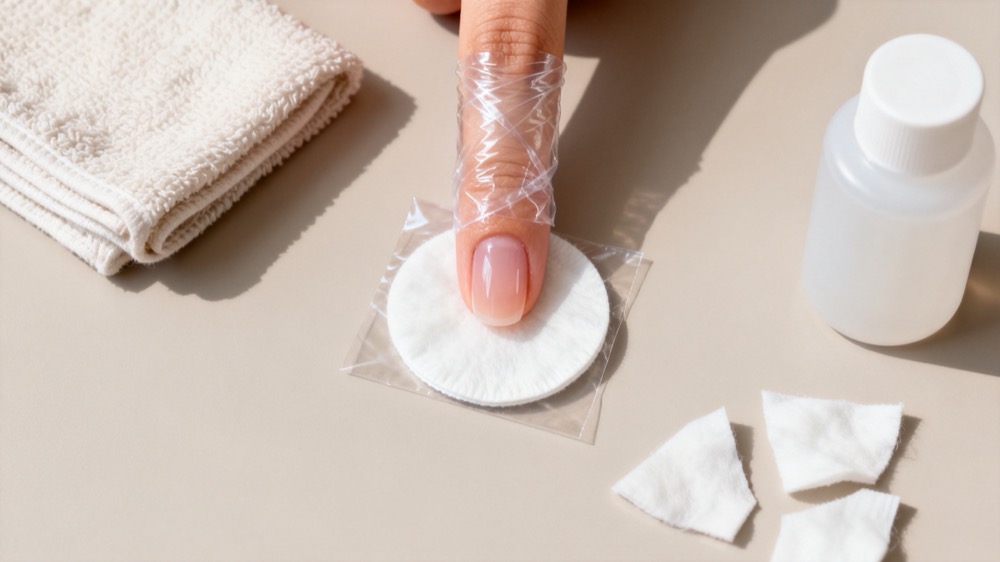
2. Protect the surrounding skin. Apply a thin layer of petroleum jelly around the nail and cuticle. Cut the cotton to the size of the nail so the acetone stays where you need it.
3. Apply the wrap. Wet the cotton with acetone, place it directly on the coating, and secure it with plastic food wrap. It should stay in place without squeezing the finger.
4. Check whether the gel has softened. Follow the product's timing. For standard gel polish, a dermatology home-removal method uses a 10-minute wrap as an initial check. If the polish has softened, gently wipe it away with a warm, damp washcloth, rubbing the nail rather than the surrounding skin.
5. Stop if the coating resists. Don't scrape with a metal pusher or wedge a stick under the lifted edge. Check the product directions or ask the salon to remove it. Once you're done, wash with mild soap and water and moisturize the surrounding skin.
The useful test is whether the softened coating wipes away without force. If you have to lever it off, it isn't ready to come away. Even a small flap can pull on the coating that's still attached.
"Builder" tells you what a gel does: it adds structure. It doesn't tell you how the gel comes off. Some builder systems are designed to soften in acetone; file-off hard gels are removed mechanically. Packaging can be misleading here, too: a gel in a pot isn't necessarily removed the same way as another gel in a pot. If you don't know which system was used, check with the salon rather than experimenting with long soaks or a home e-file.
A fill addresses the gap left by nail growth. A rebalance also restores the shape and placement of the overlay's structure as the nail grows. On a compatible structured gel system, a trained technician may remove all detached product, retain sound material where the system permits, and rebuild the overlay. Filling the growth area alone won't correct a lifted pocket or restore structure that has shifted forward.
That decision depends on what the technician finds after inspecting the nail. A small lift on an otherwise sound overlay is different from several pockets, a crack through the enhancement, or a nail that hurts when pressed. If the nail or surrounding skin shows concerning changes, the priority is assessment, not rebuilding the manicure.
- Don't peel or pick. The loose section can pull on the bonded gel and damage the surface of the natural nail.
- Don't clip off a section that's still partly bonded. Cutting the visible flap doesn't show you how far the separation extends, and the movement can tug on the attached area.
- Don't glue it down or seal it with top coat. Covering the opening doesn't restore the original bond or let you inspect what's underneath.
- Don't hide discoloration with an opaque polish or press-on. It's more useful to leave the nail visible so a healthcare professional can assess it.
- Don't use an e-file to chase a white line toward the natural nail. If you can't tell where the coating ends, stop rather than thinning the nail plate.
Where and when lifting starts can help narrow down what to check. It can't prove the cause. A corner that lifts after a knock tells a different story from several nails that lift near the cuticle shortly after application.
Check whether the gel touched surrounding skin or pooled at the edges. Review how the nail plate was prepared and whether residue remained where the coating needed to bond. Aim for a clean application margin, not more aggressive filing. For lamp-cured products, use the manufacturer-specified lamp, layer thickness, and cure time. Gel feeling firm on top isn't a reason to substitute a different lamp or guess at the cure.
Ask what that finger does that the others don't. A thumb used to pry open packaging or a finger repeatedly catching on equipment is worth noting. Compare the length and shape against the wearer's routine, and check whether the free edge was finished as the product instructions specify. If the same nail lifts again, take a photo before removal. It's easier to compare the location across appointments than to rely on memory.
Review what changed across the whole set: base coat, color, lamp, application thickness, or prep routine. Record the product names, application date, and first day of lifting. If you're troubleshooting a service on healthy nails, change one variable at a time. Switching the lamp, base, and prep routine together might improve the next set, but it won't tell you which change mattered. If lifting comes with itching, swelling, or blisters, stop troubleshooting with new applications and get the reaction assessed.
At Dongguan YoungMei Technology Co., Ltd., we approach lifting reports from a product and packaging perspective, drawing on more than 15 years of nail-product manufacturing experience. The first question we'd put on a customer-service intake form is simple: "What lifted—the coating, the press-on, or your natural nail?" Those answers should lead to different instructions. A prefinished press-on coming loose, for example, shouldn't automatically trigger the soak-off procedure for gel polish.
For a press-on or nail sticker launch, use the sample stage to check whether the insert answers three questions without help from customer service:
1. How do I identify my product and attachment method?
2. What should I do if an edge comes loose, and how do I remove this specific product?
3. When should I stop using it instead of reapplying it?
Test the instructions as well as the nails. Give the sample kit to someone who hasn't seen the development brief and ask them to find the removal instructions without prompting. If they can't tell whether the directions apply to adhesive tabs, liquid glue, or the decorative nail itself, revise the insert before approving the packaging.
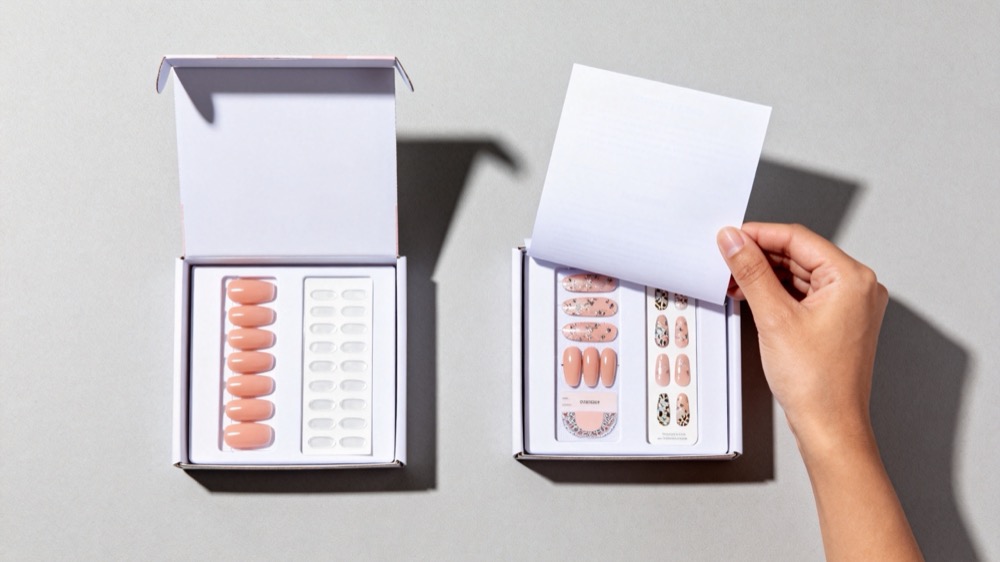
If you're sourcing private-label press-on nails or nail stickers, request an OEM/ODM sample brief from Dongguan YoungMei Technology Co., Ltd. Share your target market, retail format, preferred attachment method, and launch schedule. Our in-house factory and supply chain support rapid sampling and one-stop sourcing. Use the sample review to approve the fit, finish, and customer-facing removal instructions together—before the packaging goes into production.
Often, yes. A problem on one nail doesn't automatically require removing all ten. Remove the coating from that nail if it's confirmed soak-off polish. For a structured overlay, a technician can decide whether an isolated repair or rebalance makes sense. Don't leave detached material under a fresh layer.
No. Nail glue isn't a repair for detached gel polish or builder gel. It hides the gap without resolving the original separation. Use the correct removal method and check the natural nail before deciding whether to reapply anything.
It may be a file-off product, or the system may require a specific preparation step before soaking. Don't assume that more time in acetone will solve the problem. Identify the exact product and check its instructions. If you can't confirm them, have a technician remove it.
Greenish discoloration can be associated with a bacterial nail infection, but color alone doesn't establish the cause. Don't buff the spot away or cover it. Have it assessed, especially if it appears alongside soreness, swelling, drainage, or separation of the natural nail.
Don't apply one over a damaged, painful, discolored, or separating nail. If the natural nail and surrounding skin look healthy after removal, follow the specific press-on kit's application directions. Press-on adhesives can also cause reactions, so switching products isn't a workaround for suspected allergy.
It can happen, but repeated early lifting is worth investigating. Photograph the affected nail and note when and where the lift started. One isolated edge after a knock is a different clue from multiple nails lifting near the cuticle shortly after the same service.
- Paola Ponce Nails. [How To Remove Lifting From A Gel Nail]. Original professional demonstration of detached-product removal and rebalancing for a structured soft-gel overlay.
- American Academy of Dermatology. [Dermatologist's Secret for Removing Gel Nail Polish at Home]. Shari Lipner, MD, PhD, FAAD, explains acetone wraps, the 10-minute check, and how to avoid scraping the nail. [aad]
- American Academy of Dermatology. [12 Nail Changes a Dermatologist Should Examine]. Clinical guidance on natural nail separation, discoloration, and when to seek an assessment. [aad]
- DermNet. [Nail Cosmetics Allergy]. Clinical background on reactions to nail cosmetics and adhesives, including symptoms and patch testing. [dermnetnz]
- U.S. Food and Drug Administration. [Nail Care Products]. Guidance on product labels, ventilation, skin contact, and adverse reactions. [fda]
- National Institute for Occupational Safety and Health. [NIOSH Pocket Guide to Chemical Hazards: Acetone]. Reference for acetone's flammability and handling precautions. [cdc]