
- All
- Product Name
- Product Keyword
- Product Model
- Product Summary
- Product Description
- Multi Field Search
English
Views: 210 Author: Young Mei Publish Time: 10-06-2026 Origin: Site


Content Menu
● Mega Stick Base vs Platinum Bond
>> Product Differences at a Glance
>> Mega Stick Base Performance
>> Platinum Bond Duo Performance
>> Packaging and Product Names
● Choosing and Applying the Right Gel
>> Match Flexibility Before Strength
>> Structure Without Excess Bulk
>> Controlled Application Workflow
>> Diagnosing Lifting More Carefully
● Manufacturing and Buyer Insights
>> Separate Tips From Gel Services
>> Build a Meaningful Evaluation
>> Calculate Cost Per Successful Service
>> Develop Your Custom Nail Range
>> Which Gel Suits Bendy Nails?
>> Is Platinum Bond Duo Hard Gel?
>> Does Platinum Bond Need Base?
>> Can Mega Stick Build Extensions?
>> Which Product Is Better Value?
Choosing between Kokoist Mega Stick Base vs Platinum Bond Duo Builder comes down to flexibility, structure, and the condition of the natural nail. Mega Stick Base prioritizes flexible adhesion, while Platinum Bond Duo combines adhesion with a firmer builder function for structured overlays and short extensions.
From a nail-product manufacturing perspective, I would start with a different question than "Which gel is stronger?" I would ask: "Which product's behavior best matches the nail and the intended service?"
This guide is prepared from the product-development perspective of Dongguan YoungMei Technology Co., Ltd., a manufacturer with more than 15 years of experience in press-on nails, nail stickers, and related nail products. It draws on published product specifications and educator guidance, rather than claiming an independent laboratory comparison or personal wear test.

Both products belong to a soak-off gel system, but they serve different priorities. Understanding that distinction helps prevent unsuitable product selection and unrealistic expectations.
| Comparison point | Kokoist Mega Stick Base | Platinum Bond Duo Builder |
|---|---|---|
| Primary role | Flexible adhesion base | Two-in-one base and builder |
| Cured character | Soft and flexible | Semi-hard and more structural |
| Strongest practical fit | Shorter, flexible natural nails | Firmer nails needing structured reinforcement |
| Overlay approach | Modest reinforcement and flexible coverage | Structured overlay with sufficient thickness |
| Extension role | Not the primary choice for building length | Suitable for short extensions within system guidance |
| Separate base requirement | Functions as the base | Contains its own adhesion component |
| Full-cover tip application | Historically recommended for Kokoist Gelip attachment | More relevant to overlays and rebalancing |
| Main application concern | Run-off toward skin | Overly thin areas, especially near the free edge |
| Removal category | Soak-off | Soak-off |
Neither column represents a universal winner. Compatibility matters more than choosing the product with the hardest cured finish.
Kokoist describes Mega Stick Base as a soft gel with adhesion, durability, and flexibility. Its educational material identifies it as the softest of the foundation gels discussed alongside Platinum Bond Duo and Excel Builder.
That makes flexibility its defining advantage. A natural nail that bends needs a coating capable of accommodating some movement rather than resisting every small deformation.
Mega Stick Base is therefore a practical starting point for shorter nails, flexible nail plates, and services where adhesion matters more than substantial architectural support.
However, flexible reinforcement is not the same as a rigid extension structure. When a client wants significant added length or a pronounced apex, the service may require a dedicated builder system.
Its flowing consistency also demands control. Work on one or two nails at a time, use a measured amount, and keep uncured gel away from the surrounding skin.
Platinum Bond Duo combines a base function with a builder function. The duo refers to adhesion and structure within one product.
Kokoist's published education describes its cured character as semi-hard. It behaves more like a structural gel than Mega Stick Base, while remaining part of a soak-off system.
This makes it relevant for naturally firmer nails, structured overlays, and short extensions. A separate Mega Stick Base layer is not automatically necessary because Platinum Bond Duo already contains an adhesion component.
The important limitation is application thickness. Educator guidance warns that excessively thin Platinum Bond Duo can crack or lift, particularly where the free edge becomes insufficiently supported.
That does not mean "apply as much as possible." It means building balanced structure, preserving support where needed, and keeping every layer within the product's curing requirements.
Packaging can create confusion. Kokoist's educational comparison states that Mega Stick Base in a pot and bottle uses the same formulation.
For the historical Platinum Bond Duo range, the bottle product was named Bonding Duo in a Bottle and described as a thinner formulation for brush-on application. These names should not be treated as interchangeable specifications.
There is also a purchasing consideration: retailers describe Platinum Filler Base as a later product positioned between the older Platinum Bond Duo and Bonding Duo formulas, with discontinued-product wording appearing in some listings.
Consequently, verify the exact product name, current availability, regional instructions, and container label before purchasing. This historical comparison should not replace the directions supplied with a newer product.
My product-selection framework begins with three questions:
1. Does the natural nail bend easily?
2. Is the goal adhesion, reinforcement, or added length?
3. Can the technician maintain the required structure throughout the service?
For a short, bendy nail, Mega Stick Base is generally the more logical starting point. For a firm nail needing a structured overlay, Platinum Bond Duo better matches the intended role.
Consider two illustrative clients. One has short nails that flex during everyday tasks. The other has firm natural nails and wants a more defined overlay.
Giving both clients the same semi-hard coating simply because it feels stronger overlooks their different needs. These examples illustrate a selection method; they are not documented wear-test results.
A structured manicure distributes gel deliberately. It does not cover the nail with a uniformly thick layer.
With Platinum Bond Duo, preserve appropriate support through the stress area and free edge. Avoid filing away the very structure the product was selected to provide.
With Mega Stick Base, keep expectations proportionate. Its flexibility can benefit adhesion and comfort, but it should not be expected to perform identically to a firmer builder.
Published educators give differing extension-length examples for Platinum Bond Duo. Rather than turning those examples into a universal millimeter limit, follow the applicable system guidance and assess the client's nail geometry.
The useful principle is proportion: added length increases the demands placed on the enhancement.
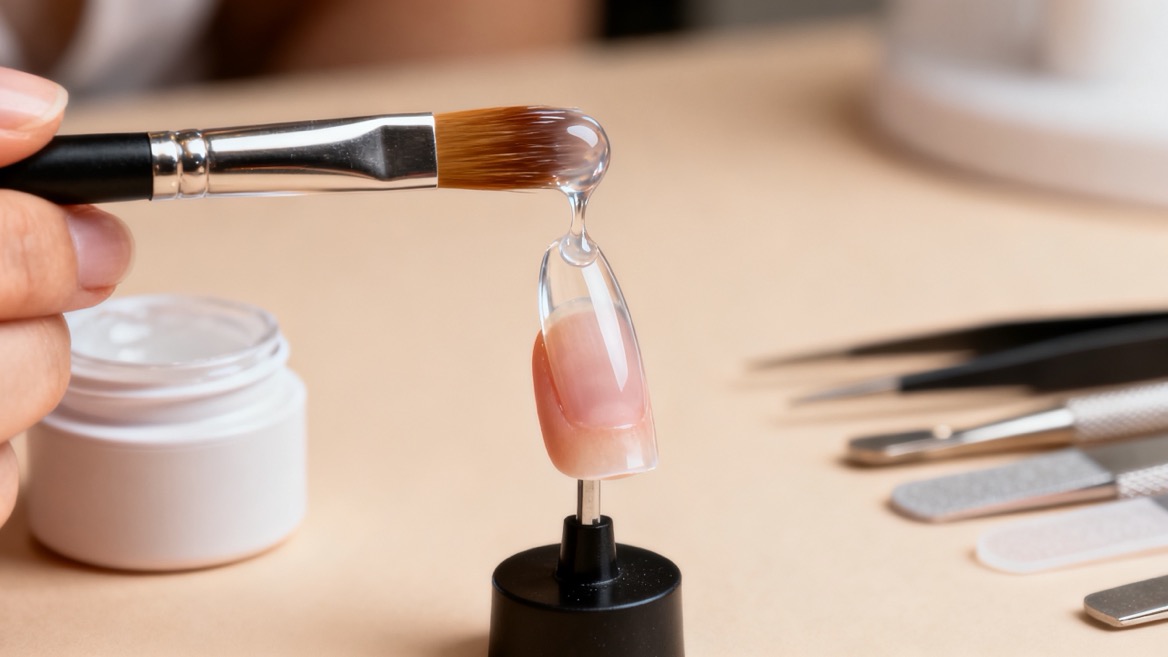
The following workflow is a decision aid, not a substitute for professional training or current product instructions.
1. Assess the nail plate, existing damage, flexibility, length, and signs of lifting.
2. Remove nonliving cuticle from the nail plate and prepare gently according to the system's instructions.
3. Remove dust and surface contamination using the recommended preparation method.
4. Apply the selected gel without touching skin or flooding the sidewalls.
5. Build only the amount of structure appropriate to the product and service.
6. Cure each layer using the specified lamp compatibility, timing, and application requirements.
7. Inspect the cured enhancement before applying color and top coat.
8. Explain maintenance, removal, and warning signs to the client.
For Mega Stick Base, Kokoist lists LED curing at 30–60 seconds and UV curing at 60–120 seconds. These are published product timings, not permission to use any lamp with a matching timer.
Do not transfer those timings to Platinum Bond Duo or another builder without checking its instructions. A flash cure holds a shape temporarily; it does not replace the required full cure.
When lifting occurs, replacing the gel immediately can hide the actual cause. Use the location and timing of the failure to guide your review.
| Observation | What to investigate |
|---|---|
| Lifting around the cuticle | Remaining nonliving tissue, skin contact, or poor perimeter control |
| Separation near the free edge | Nail flex, inadequate support, or excessive filing |
| Cracks through the overlay | Product selection, insufficient structure, or excessive length |
| Several nails failing similarly | Repeated preparation, application, or curing problems |
These are investigation prompts, not definitive diagnoses.
Kokoist's Platinum Bond Duo application lesson emphasizes retaining sufficient material near the free edge and performing final shaping after the structured application. That is a more useful adjustment than indiscriminately adding product everywhere.
Kokoist lists a 5–10-minute soak-off time for Mega Stick Base. Treat that as a product reference, not a guaranteed removal time for a complete manicure containing additional layers.
Do not peel or force off bonded material. The American Academy of Dermatology advises against picking gel polish and recommends limiting acetone exposure to the fingertips during removal.
Uncured gel should never remain on the skin. Kokoist warns that skin exposure can cause allergic reactions and advises stopping use and contacting a physician if itching, redness, or swelling occurs.
Likewise, HEMA-free does not automatically mean allergy-free. Avoid transferring ingredient claims from a bottle version to a potted product or assuming that one ingredient exclusion guarantees suitability.
For brands selling press-on nails, this comparison reveals an important distinction: a finished press-on product and a salon-applied gel enhancement are different systems.
Mega Stick Base has historically been recommended for attaching Kokoist's Gelip full-cover tips. That does not prove compatibility with every opaque, decorated, or third-party press-on nail.
An opaque tip can obstruct light needed to cure material underneath. Do not assume a light-cured gel will cure adequately beneath an arbitrary finished press-on.
For product development, specify the intended attachment method, compatible components, preparation steps, and removal procedure. Nail stickers also require their own application instructions; they should not inherit gel-extension directions.
A stronger supplier evaluation compares complete systems rather than isolated claims such as "maximum adhesion."
For an internal sample trial, record:
- Natural-nail condition and flexibility.
- Product identity and batch information.
- Preparation method and application amount.
- Lamp model and curing procedure.
- Intended wear period and maintenance schedule.
- Lifting location, cracking, and removal observations.
Photograph consistent views at application and follow-up. Keep conditions comparable before attributing a result to the formula.
This is a proposed evaluation framework, not evidence that YoungMei has tested Kokoist products. It helps buyers separate product behavior from inconsistent technique.
Container price alone does not reveal service value. A less expensive gel can cost more overall if it causes rework or slows application.
Use this purchasing framework:
Service cost = product used + application labor + expected rework + removal labor.
Avoid universal wear-duration promises unless supported by a defined test. Instead, evaluate how reliably a product performs for the intended nail type and service.
For retail programs, also consider instruction clarity, packaging protection, batch traceability, and customer-support requirements.
Dongguan YoungMei Technology Co., Ltd. supports global brands, wholesalers, and chain retailers with OEM/ODM customization, rapid sampling, and one-stop sourcing for press-on nails, nail stickers, and related products.
Our factory and supply-chain capabilities are relevant to turning a product concept into a coordinated range—not to implying affiliation with Kokoist or equivalence to its formulas.
Contact the YoungMei team with your target market, preferred nail shapes, decoration concepts, packaging requirements, and intended attachment method. Request a tailored sampling plan for your next nail-product collection.
Mega Stick Base is generally the more appropriate starting point because its soft, flexible character better matches flexible natural nails. Damaged or symptomatic nails require assessment rather than automatic coating.
Kokoist describes it as semi-hard, with structural behavior resembling hard gel. However, it belongs to a soak-off system rather than being classified solely by traditional hard-gel removal behavior.
Not automatically. Platinum Bond Duo combines adhesion and builder functions. An additional compatible base may be considered within system guidance, but it should not replace troubleshooting preparation or structural problems.
It is primarily an adhesion base, not the main choice for constructing added length. Select a suitable builder system when the service requires extension architecture.
Published Kokoist education permits Mega Stick Base beneath Platinum Bond Duo in some circumstances. Follow compatible-system instructions and cure each required layer correctly.
The better value is the product that reliably fits the intended service. Compare usage, application time, rework, and removal—not just the container price.
- [Paola Ponce Nails — "Kokoist Mega Stick Base vs Platinum Bond Duo Builder"]. Original comparison and educator perspectives on flexibility, overlays, fills, and application thickness. Its clientele percentages are personal estimates and are not presented here as verified performance data. [paolaponcenails]
- [Kokoist USA — "What's The Difference Between Mega Stick, PBD, & Excel Clear Gels"]. Product roles, packaging distinctions, layering, and extension guidance. [kokoistusa]
- [Kokoist USA — "MEGA Stick Base Soft Gel Coat Gel 100g"]. Published curing and soak-off times, preparation instructions, and skin-contact warnings. [kokoistusa]
- [Kokoist USA — "How To Apply A True No-Lift, No-Chip Application Using Kokoist Platinum Bond Duo"]. Published December 2, 2021. Structured application, free-edge support, and flash-versus-full curing. [kokoistusa]
- [Kioko Nail Supply — "KOKOIST — Platinum Filler Base"]. Retailer description of product positioning and discontinued-product wording; regional availability requires confirmation. [kiokonailsupply]
- [American Academy of Dermatology — "Gel Manicures: Tips for Healthy Nails"]. Guidance on avoiding picking and reducing unnecessary acetone exposure. [aad]