
- All
- Product Name
- Product Keyword
- Product Model
- Product Summary
- Product Description
- Multi Field Search
English
Views: 288 Author: Young Mei Publish Time: 10-15-2026 Origin: Site


Content Menu
● Press-On Nails vs. Acrylic Nails: The Essential Differences
>> What Are Private Label Press-On Nails?
>> What Are Private Label Acrylic Nail Systems?
● Which Nail Product Fits Your Private Label Business Model?
>> Press-On Nails for Consumer-Focused Brands
>> Acrylic Systems for Professional Brands
● Customization: Finished Design vs. Technician-Created Results
>> How Press-On Nail Customization Supports Brand Identity
>> How Acrylic Customization Supports Professional Positioning
● Cost and Profitability: Compare Contribution, Not Factory Price
>> An Illustrative Private Label Cost Model
● Product Quality: What Brands Should Test Before Ordering
>> Press-On Nail Quality Control
>> Acrylic System Quality Control
● Safety and Compliance: Avoid Blanket Claims
>> What This Means for Your Brand
● Market Insight: Growth Does Not Replace Product Validation
● Expert Framework: Validate a Collection Before Scaling
>> Step 1: Define One Primary Customer
>> Step 2: Translate Positioning Into Specifications
>> Step 3: Test Samples With Representative Users
>> Step 4: Establish Acceptance Criteria
>> Step 5: Launch a Controlled Pilot
● Inventory and Sustainability: Design for Realistic Use
● How YoungMei Supports Private Label Press-On Nail Development
>> Are Press-On Nails Better Than Acrylic Nails for Private Label Brands?
>> Can Press-On Nails Match the Appearance of Acrylic Nails?
>> How Long Do Press-On Nails Last Compared With Acrylic Nails?
>> Are Press-On Nails Reusable?
>> Should a New Brand Launch Both Categories?
>> What Should a Brand Request From a Press-On Nail Manufacturer?
Press-on nails vs. acrylic nails is more than a comparison of manicure styles. For private label brands, it is a choice between two different product experiences, supply chains, and customer relationships. Press-on nails generally suit ready-to-wear retail collections, while acrylic nail systems are better aligned with professional application and salon distribution.
At Dongguan YoungMei Technology Co., Ltd., our manufacturing perspective starts with one question: what must your customer achieve after opening the package? Drawing on our company's 15-plus years of experience in nail product development and production, we approach this decision through product usability, customization, quality control, and commercial practicality.
For brands targeting consumers, wholesalers, and chain retailers, press-ons usually offer the more straightforward starting point. However, acrylic systems can be the stronger choice when professional nail technicians are your core customers.
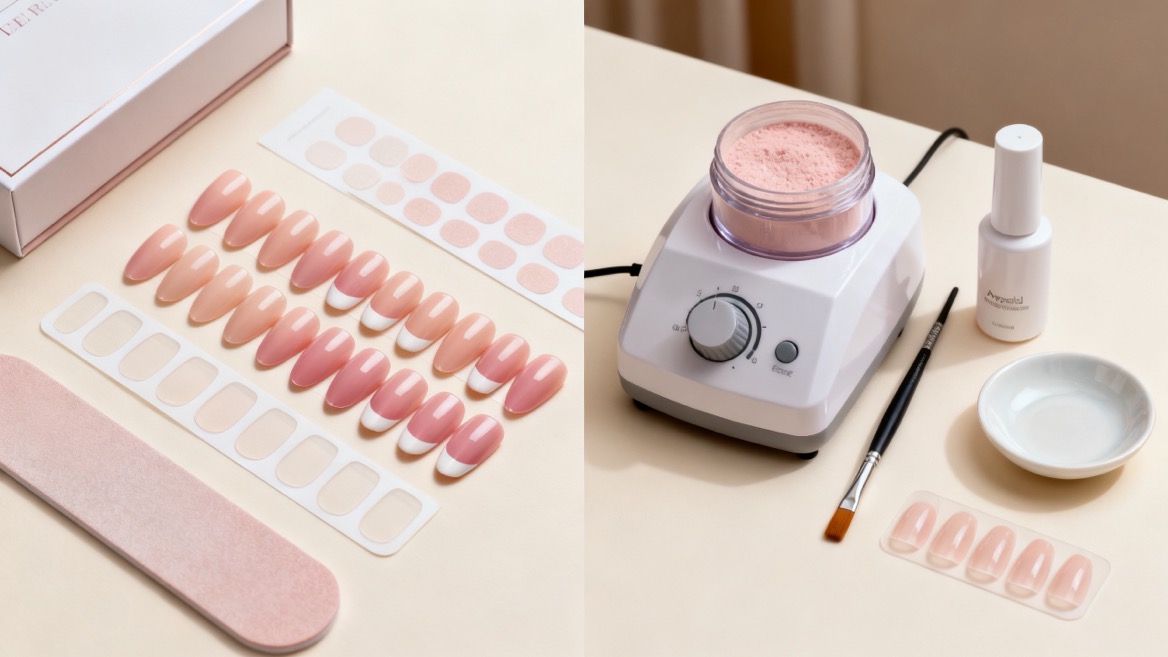
Press-on nails are preformed artificial nails that consumers attach using compatible nail glue or adhesive tabs. The shape, length, color, and decoration are established before application.
A private label press-on nail collection typically combines finished nails with branded packaging, application accessories, and instructions. Depending on the agreed specification, a kit may include multiple sizes, adhesive tabs, glue, a nail file, and a preparation stick.
The customer buys a finished look rather than the materials needed to build one.
Traditional acrylic enhancements are created by combining a liquid monomer with a polymer powder. A technician shapes the mixture over the natural nail, a tip, or a form before finishing the surface.
For a private label business, this usually means selling an acrylic application system—not a finished manicure. Products may include powders, liquids, primers, brushes, and supporting accessories.
Traditional liquid-and-powder acrylic systems should not be confused with UV-cured gel systems. Their application processes and product requirements differ.
| Comparison factor | Press-on nails | Traditional acrylic systems |
|---|---|---|
| Product format | Finished, preformed nails | Materials for building enhancements |
| Primary audience | Consumers and retail shoppers | Nail technicians and trained users |
| Application | Attach using suitable adhesive | Mix, sculpt, shape, and finish |
| Customization | Designed during manufacturing | Created during application |
| Maintenance | Replace or remove according to instructions | Typically requires professional upkeep |
| Quality challenge | Fit, finish, consistency, and adhesion | Formulation consistency and application performance |
| Brand experience | Largely controlled before purchase | Shared between supplier and applicator |
| Natural channel fit | E-commerce, wholesale, and retail | Professional distributors and salons |
Press-on nails are a practical option when your brand promise centers on convenience, coordinated designs, and accessible at-home application.
They allow customers to see the intended result before purchasing. Product photography can show the actual design, shape, and finish included in the package.
This makes press-ons well suited to:
- Beauty brands expanding into nail accessories.
- Fashion retailers coordinating nails with seasonal collections.
- Wholesalers supplying multiple retail accounts.
- Online brands selling occasion-specific designs.
- Chain retailers requiring standardized, shelf-ready products.
The main challenge is not simply creating attractive nails. It is delivering a fit and application experience that supports the promised look.
Acrylic systems make more sense when your commercial advantage lies in professional performance, technical education, or established salon relationships.
Technicians may evaluate working time, consistency, sculpting behavior, and compatibility with other products. A visually attractive package cannot compensate for unpredictable application performance.
From a product strategy perspective, I would prioritize acrylic systems when the brand already understands technician workflows and can support product training.
Neither category automatically guarantees repeat purchases. Press-on customers may return for new designs; acrylic customers may reorder consumables. Both depend on satisfaction, availability, and credible positioning.
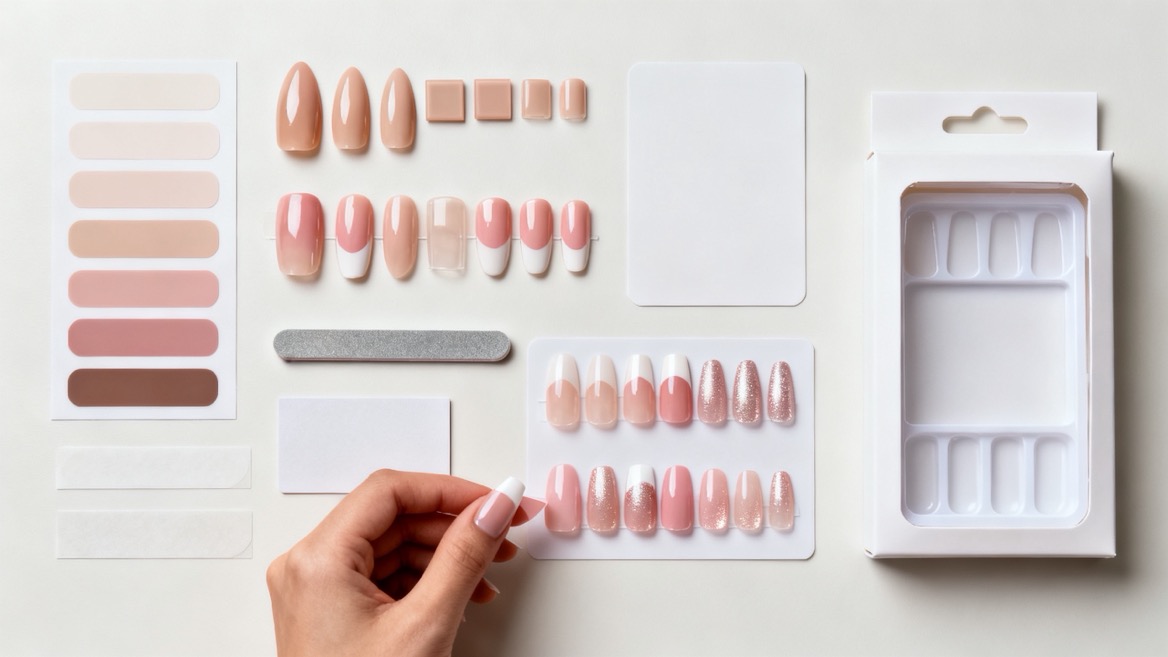
Private label press-on nails offer several opportunities to create a recognizable collection:
- Shape and length.
- Color palettes and coordinated accent nails.
- Printed patterns and decorative finishes.
- Size assortment and nail curvature.
- Packaging layout and brand presentation.
- Adhesive options and application accessories.
However, visual customization should follow fit validation—not replace it.
A beautiful design can still disappoint if the nails feel too curved, lack suitable widths, or have uncomfortable edges. Ask your manufacturer which features require new tooling, additional processing, or separate minimum order quantities.
Acrylic brands can differentiate through powder shades, system performance, packaging formats, and education.
The finished manicure also depends heavily on the technician. This creates creative flexibility but reduces the brand's direct control over the final result.
For brands seeking consistent, ready-to-wear designs across retail locations, press-ons offer a clearer route. For brands selling professional creative tools, acrylic systems may fit better.
A lower unit quotation does not necessarily produce a stronger business.
Press-on nail brands must account for packaging, accessories, freight, fulfillment, design inventory, customer acquisition, and refunds. Acrylic brands must also evaluate technical support, training, component compatibility, and any transport requirements associated with the specific formulations.
Consider this hypothetical press-on kit:
| Item | Illustrative amount per order |
|---|---|
| Net selling price | $15.00 |
| Landed product cost | $4.00 |
| Fulfillment cost | $2.00 |
| Payment and platform fees | $0.60 |
| Customer acquisition cost | $3.00 |
| Returns and support allowance | $0.40 |
| Contribution before fixed overhead | $5.00 |
These figures are a planning example, not YoungMei pricing or an industry benchmark.
The useful lesson is the calculation: subtract variable selling costs from revenue before comparing product categories. Factory price alone overlooks the expenses that determine whether a launch can scale.
For acrylic systems, build the same model around your actual distribution channel. Wholesale pricing, professional support, and replenishment patterns can materially change the outcome.
A press-on nail inspection plan should cover more than appearance.
Assess:
1. Size accuracy and assortment completeness.
2. Curvature across representative natural nail shapes.
3. Thickness, flexibility, and edge smoothness.
4. Color and finish consistency.
5. Decoration attachment and surface durability.
6. Adhesive performance under the stated application method.
7. Packaging protection and accessory completeness.
8. Clarity of application and removal instructions.
Do not promise a universal wear duration based on a few successful samples. Adhesive choice, preparation, fit, and customer behavior can all affect performance.

Acrylic systems require formulation-specific evaluation.
Review consistency between batches, handling characteristics, intended component compatibility, labeling, and supporting technical documentation.
Performance testing should reflect the intended user. A professional system evaluated only by inexperienced users may generate misleading conclusions; a consumer-positioned kit tested only by experts may conceal usability problems.
For both categories, agree on inspection criteria and an approved reference sample before production.
Neither press-on nails nor acrylic nails should be presented as universally harmless.
The American Academy of Dermatology explains that filing required for acrylic application can thin natural nails. It also notes that maintenance and application chemicals can contribute to damage or irritation.
The U.S. Food and Drug Administration identifies irritation and allergic reactions as potential concerns with nail products, including sensitivity to reactive methacrylate monomers.
For acrylic systems, evaluate formulation safety, skin-contact precautions, instructions, and professional handling requirements.
For press-on kits, evaluate the complete product—including glue, adhesive tabs, coatings, accessories, and removal guidance. A preformed nail does not establish the safety of every accompanying component.
Avoid unsupported claims such as:
- "Damage-free."
- "Allergy-free."
- "Completely non-toxic."
- "Suitable for everyone."
- "Guaranteed reusable."
Requirements depend on the destination market and individual components. Confirm applicable labeling, safety documentation, and transport obligations with qualified specialists before shipment.
Grand View Research estimates that the global press-on nails market was worth $738 million in 2024 and projects approximately $1.075 billion by 2030, with a reported 6.5% compound annual growth rate for 2025–2030.
These are research estimates and forecasts, not guaranteed sales outcomes.
The commercially useful implication is that press-ons represent an established category with projected expansion. The figures do not prove that a particular design, price point, or private label collection will succeed.
Rather than copying a large assortment immediately, validate a focused proposition:
- Who is the customer?
- Which occasion or routine does the product serve?
- What makes the fit or design distinctive?
- Why would the customer purchase again?
A small, coherent collection can provide clearer learning than a broad launch with too many overlapping designs.
Choose a clear initial audience, such as occasional manicure users, fashion-led shoppers, or professional technicians.
Trying to serve all three can produce conflicting requirements.
For press-ons, specify shape, length, finish, size assortment, adhesive method, packaging, and intended use.
For acrylic systems, specify the intended application workflow, component range, and technical performance requirements.
Evaluate fit, application, appearance, comfort, removal, and instruction clarity.
Record unsuccessful experiences as carefully as successful ones. A recurring complaint about sizing may matter more than enthusiastic feedback about the packaging.
Agree on measurable criteria for dimensions, visible defects, completeness, and packaging protection.
Separate cosmetic preferences from defects that affect function.
Track sell-through, returns, support questions, and repeat purchase behavior before expanding.
This approach does not eliminate risk. It makes the reasons for success or failure easier to identify.
Press-on collections can accumulate slow-moving designs if brands launch too many combinations of shape, length, and finish.
Acrylic ranges can also become complex when powders, liquids, and accessories multiply across sizes and shades.
Control assortment growth through a consistent core range and selective launches.
Sustainability claims require similar discipline. Press-ons may be reusable under suitable conditions, but reusability depends on removal, adhesive residue, decoration durability, and product condition.
Avoid calling either category inherently sustainable without evidence. Instead, document specific improvements, such as packaging material reductions or tested reuse instructions.
Dongguan YoungMei Technology Co., Ltd. specializes in the development and production of press-on nails, nail stickers, and related nail products.
With more than 15 years of experience, our own factory, and an established supply chain, we support global brands, wholesalers, and chain retailers through OEM/ODM customization, rapid sampling, consistent quality, and one-stop sourcing.
The strongest project brief connects creative direction with commercial requirements.
Share your target market, sales channel, preferred designs, packaging needs, estimated quantity, and launch schedule. Request a sample-development plan, a component specification, and an itemized quotation.
For consumer-facing private label brands, start by validating a press-on collection that customers can understand, apply, and purchase confidently.
Usually, for consumer retail and ready-to-wear collections. Acrylic systems may be more suitable for brands serving technicians and professional distributors. The strongest choice follows your customer and channel.
They can deliver a similar styled appearance, depending on shape, finish, and fit. They do not provide the same individually sculpted application process.
There is no universal comparison. Press-on wear depends on fit, preparation, adhesive, and use. Acrylic enhancements require maintenance as nails grow; dermatologists note touch-ups commonly occur every two to three weeks.
Some can be reused when their construction, adhesive method, and removal process permit it. Validate the intended reuse procedure before making a packaging claim.
Not necessarily. Start with the category that best matches your audience and support capabilities. Expand after validating demand and operational consistency.
Request samples, customization options, minimum order quantities, component details, inspection criteria, documentation relevant to the destination market, lead times, and clearly itemized pricing.
1. [American Academy of Dermatology — "Artificial nails: Dermatologists' tips for reducing nail damage."] Supports the discussion of acrylic preparation, natural nail damage, irritation, and maintenance intervals. [aad]
2. [U.S. Food and Drug Administration — "Nail Care Products."] Supports the explanation of acrylic materials, methacrylate sensitization, skin-contact precautions, and product safety responsibilities. [fda]
3. [Grand View Research — "Press-on Nails Market Size And Share Report, 2025–2030."] Source of the market valuation, forecast, and growth rate. These figures are estimates rather than audited industry sales. [grandviewresearch]
4. ["Dermatologic Conditions Associated With Various Types of Popular Nail Cosmetics: A Systematic Review" — PubMed Central.] Supports the distinction between traditional acrylic systems and UV-cured systems, and the discussion of potential adverse reactions. [pmc.ncbi.nlm.nih]