
- All
- Product Name
- Product Keyword
- Product Model
- Product Summary
- Product Description
- Multi Field Search
English
Views: 295 Author: Young Mei Publish Time: 10-27-2026 Origin: Site


Content Menu
● Press-On Nails vs. Salon Nail Tips: Understanding the Difference
● Product Flexibility at a Glance
● Design Customization: Finished Collections or an Open Canvas?
>> Press-On Nails Support Consistent Brand Presentation
>> Salon Nail Tips Support Service-Level Creativity
● Fit and Structure: Why Shape Alone Is Not Enough
● Manufacturing Flexibility: What Actually Changes the Project?
>> Press-On Nail Customization Has Several Layers
>> Salon Nail Tip Development Prioritizes Repeatability
● Inventory Flexibility: Finished Designs vs. Replenishable Components
● Cost and Margin: Compare the Complete Commercial Model
● Wear, Removal, and Safety: Avoid Category-Wide Promises
● A Practical Product-Flexibility Scorecard for Beauty Brands
>> Step 1: Weight Your Commercial Priorities
>> Step 2: Score Actual Supplier Proposals
>> Step 3: Check the Non-Negotiables
● A Sampling-to-Launch Workflow That Reduces Guesswork
● Which Format Should Your Beauty Brand Choose?
● Develop Your Nail Product Range With YoungMei
>> Are Press-On Nails and Full-Cover Salon Tips the Same?
>> Which Offers More Private-Label Customization?
>> Do All Salon Nail Tips Require a UV or LED Lamp?
>> Can a Beauty Brand Sell Both Product Categories?
>> Are Press-On Nails Always Reusable?
>> What Should Buyers Confirm Before Ordering?
Press-on nails vs. salon nail tips is more than a comparison of application methods. For beauty brands, it determines how products are customized, stocked, sold, and expanded. Flexibility means different things depending on whether you need ready-to-sell collections or adaptable professional supplies.
Press-on nails generally offer greater flexibility for consumer-facing launches, branded designs, and retail bundles. Salon nail tips provide more freedom for technician-led customization and professional service systems. Neither format automatically delivers lower costs or better performance.
At Dongguan YoungMei Technology Co., Ltd., our perspective comes from over 15 years of experience in nail-product development and manufacturing. We believe the right choice starts with your customer, sales channel, and customization requirements—not simply the appearance of the finished manicure.

Press-on nails are preformed artificial nails designed to cover the natural nail. They are commonly supplied with finished colors, patterns, or decorative effects and attached using compatible nail glue, adhesive tabs, or pre-applied adhesive.
For beauty brands, they function primarily as finished consumer products. The manufacturer completes much of the visual design before the customer opens the package.
However, not every press-on product has identical requirements. Adhesion, preparation, removal, and potential reuse depend on the specific nail-and-adhesive combination.
Salon nail tips are extension components that technicians incorporate into a manicure service.
This category includes:
- Partial-cover tips attached near the free edge and combined with a compatible overlay.
- Full-cover tips applied using an appropriate adhesive system.
- Soft-gel extension tips designed for a specified gel application and removal process.
These distinctions matter. A traditional partial-cover tip and a full-cover soft-gel extension do not necessarily require the same preparation, equipment, or finishing steps.
Some full-cover shapes resemble press-ons. The commercial difference is often the intended workflow: a finished retail manicure versus a component in a professional service.
The following comparison describes typical business models, not guaranteed performance for every product.
| Comparison factor | Press-on nails | Salon nail tips |
|---|---|---|
| Primary customer | Consumers, retailers, beauty brands | Technicians, salons, professional distributors |
| Main customization point | Before shipment | During the manicure service |
| Design flexibility | Factory-finished collections | Technician-created finishes |
| Packaging options | Branded kits, gift sets, retail displays | Bulk assortments, refill packs, professional kits |
| Inventory challenge | Finished designs can become slow-moving | Size demand can become uneven |
| Application requirements | Depend on the selected adhesive | Depend on the extension system |
| Expansion opportunities | Adhesives, nail stickers, accessories | Compatible application and finishing products |
| Strongest commercial advantage | Ready-to-sell brand experiences | Adaptable professional workflows |
Private-label press-on nails let brands define a coordinated visual identity through shape, length, color, decoration, and packaging.
A collection might include minimalist everyday styles, seasonal patterns, or statement designs. Because the appearance is created before sale, the brand can approve a reference sample and inspect production against agreed criteria.
This supports consistent product photography and merchandising. It does not eliminate variation: decorative placement, color matching, and surface finish still require controlled specifications.
From a manufacturing perspective, I would prioritize repeatable execution over an overly complicated first collection. A design that photographs beautifully but cannot be reproduced consistently creates avoidable commercial risk.
Salon nail tips leave more design decisions with the technician. One suitable base shape can support different colors, artwork, and finishes.
This flexibility is especially useful for professional buyers whose clients request individualized results.
However, the finished appearance depends partly on technician skill and the products used. Brands gain application-level versatility but have less control over the final manicure.
The distinction is straightforward: press-ons package a finished look; salon tips provide a foundation for creating one.
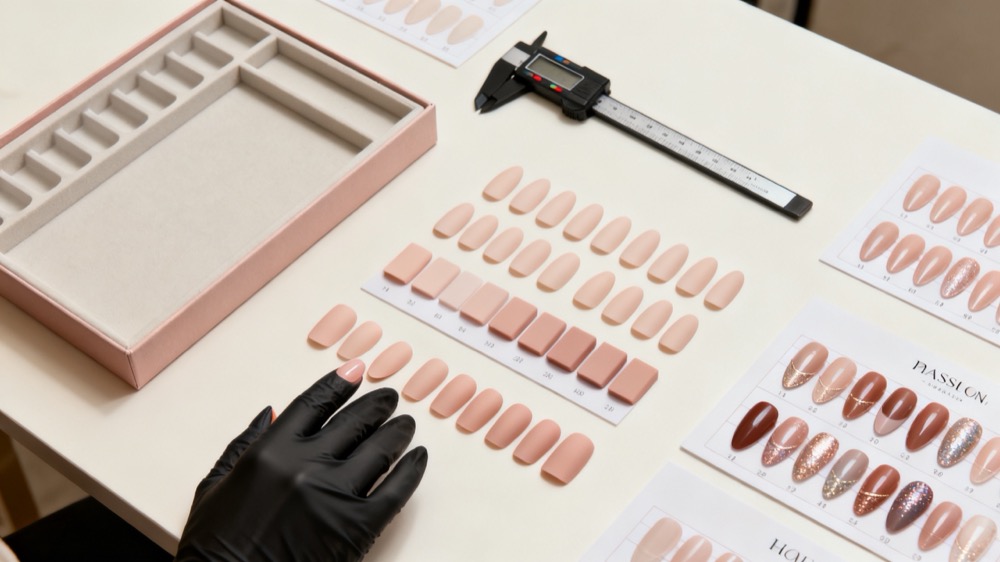
Product development should evaluate more than almond, square, or coffin silhouettes.
Relevant specifications include:
- Width across the natural nail.
- Sidewall coverage and curvature.
- Cuticle-edge thickness.
- Apex profile and free-edge thickness.
- Length consistency across sizes.
- Resistance to cracking or unwanted deformation.
A visually attractive nail can still disappoint if its curvature creates pressure or leaves gaps.
Professional tip ranges also demonstrate why fit requires more than a simple size number. Some extension assortments include intermediate sizes and different structural profiles to accommodate different nail shapes.
For either format, ask your supplier for dimensional specifications and physical samples. Do not assume that identical size labels mean identical dimensions across suppliers.
Custom press-on nail manufacturing can involve existing nail shapes with new decoration, revised size assortments, customized packaging, or newly developed tooling.
These are different projects.
Using an established shape may reduce development work compared with creating a new mold. However, intricate decoration, special components, and packaging development can still affect cost and timing.
Separate your request into three categories:
1. Existing components you can accept.
2. Appearance changes you require.
3. Structural changes you cannot compromise on.
This makes supplier quotations easier to compare.
Professional buyers may place greater emphasis on dimensional consistency, application compatibility, and reliable replenishment.
For example, a distributor might need the same shape across multiple lengths, with individual-size refill packs.
That can create a durable product platform. However, compatibility must be evaluated with the intended application system. A tip should not be described as universally compatible without supporting evidence.
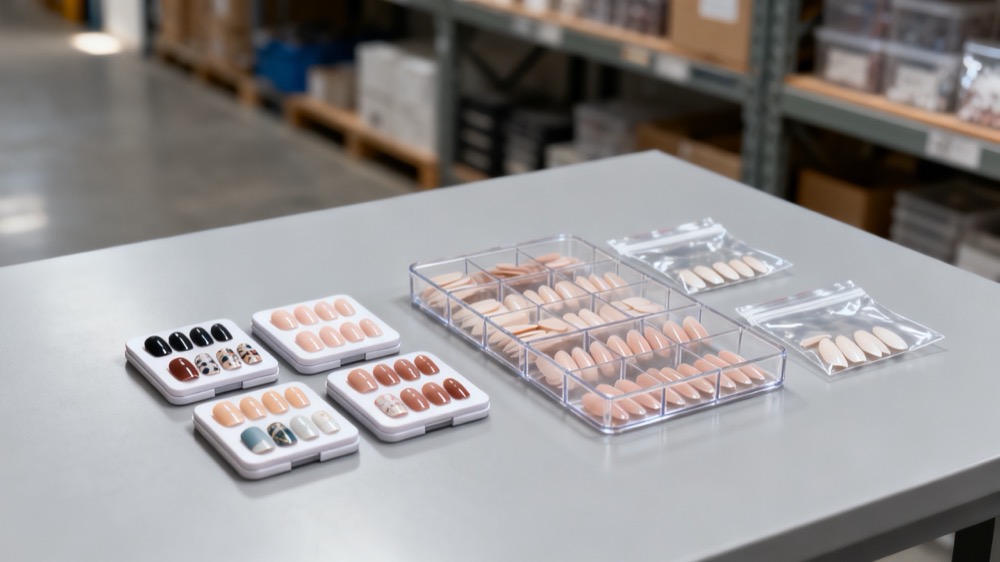
Press-on nails allow brands to merchandise distinct collections, but every design, shape, and length combination can create another stock-keeping unit.
Imagine an illustrative launch with six designs, three shapes, and two lengths. That produces 36 finished-product combinations before packaging variants are added.
This is a planning example, not a sales forecast.
Salon tips can concentrate inventory around undecorated components. Nevertheless, different sizes may sell at different rates, leaving some compartments depleted while others remain full.
A useful sourcing question is:
"Can we reorder our fastest-moving designs or individual sizes without purchasing an entire assortment?"
For press-on brands, ask about repeat orders for proven styles. For professional ranges, investigate refill availability and whether replenishment quantities match actual demand.
There is no reliable universal answer to which format is cheaper.
Press-on economics can include decoration, adhesive accessories, retail packaging, inspection, fulfillment, returns, and customer acquisition.
Salon-tip economics can include bulk packaging, professional distribution, educational support, compatibility testing, and replenishment logistics.
Compare three figures:
1. Landed cost: the cost of getting saleable inventory into your warehouse.
2. Contribution per order: revenue remaining after relevant variable costs.
3. Inventory exposure: capital tied up in stock that has not sold.
A lower factory price does not automatically create a stronger business. Slow-moving designs, missing sizes, or high complaint rates can outweigh an initial purchasing advantage.
Press-on nails are not automatically temporary, and salon tips are not automatically longer-lasting in every situation.
Wear depends on fit, preparation, adhesive or application system, user behavior, and removal practices.
Likewise, "reusable" should be treated as a product-specific claim. Nail condition after removal, adhesive residue, and the validated removal method all matter.
For beauty brands, responsible product development includes:
- Clear preparation and application instructions.
- Adhesive-specific warnings.
- Appropriate removal directions.
- Traceable product and component information.
- Evidence supporting advertised performance.
Nail products can cause allergic reactions or other injuries. Avoid unsupported claims such as "damage-free," "allergy-free," or "safe for everyone."
For gel-based extension systems, follow the relevant manufacturer's instructions for compatible products and curing equipment. Do not transfer one system's procedure to another without verification.
Instead of choosing by appearance alone, evaluate both formats against your operating model.
Assign each priority a weight from one to five:
- Consumer application convenience.
- Control over the finished appearance.
- Technician customization.
- Packaging differentiation.
- Replenishment simplicity.
- Compatibility with existing sales channels.
Score each proposed product from one to five against those priorities, then multiply each score by its weight.
Use documented specifications and sample results—not category assumptions.
For example, a press-on proposal with restrictive packaging quantities may offer less launch flexibility than a professional-tip proposal using readily available components.
A high total score cannot compensate for unacceptable fit, unsupported claims, or missing safety information.
Treat these as approval gates rather than optional scoring categories.
This framework is a purchasing tool, not a published industry benchmark.
A structured pilot reveals whether the proposed flexibility works in practice.
1. Define the buyer. Specify consumer retail, wholesale distribution, or professional use.
2. Create a technical brief. Include dimensions, finishes, accessories, packaging, and intended application.
3. Review samples systematically. Record fit observations, appearance differences, and packaging issues.
4. Validate intended use. Evaluate the complete system under documented conditions.
5. Approve a reference sample. Agree on inspection criteria and acceptable variation.
6. Launch a controlled assortment. Expand after reviewing demand and complaints.
For press-ons, track fit-related returns, application questions, and sales by design.
For salon tips, track size consumption, technician feedback, and repeat orders.
Do not use a small pilot to justify broad durability or safety claims. Match the strength of your claims to the strength of your evidence.
Choose press-on nails when your main objective is a finished consumer product with coordinated designs, branded packaging, and opportunities for seasonal merchandising.
Choose salon nail tips when your customers prioritize professional customization, consistent extension components, and replenishable supplies.
A combined portfolio can also make sense. However, it should use separate product instructions, packaging, and commercial positioning rather than presenting every full-cover nail as interchangeable.
The strongest strategy is not necessarily the widest assortment. It is the assortment your customers understand and your supply chain can reproduce reliably.
Dongguan YoungMei Technology Co., Ltd. develops and manufactures press-on nails, nail stickers, and related nail products. With over 15 years of experience, our own factory, and an established supply chain, we support global brands, wholesalers, and retail chains through OEM/ODM customization, rapid sampling, and one-stop sourcing.
Send our team your target market, sales channel, preferred designs, packaging requirements, and estimated order quantities. We can review feasible options and prepare a sampling proposal aligned with your launch priorities.
Exact specifications, timelines, minimum quantities, and testing requirements should be confirmed for each project.
They can look similar, but their intended use may differ. Press-ons are generally sold as finished consumer products. Professional full-cover tips may be components of a specified extension system.
Press-ons generally offer more finished-design and retail-packaging opportunities. Salon tips offer customization through shapes, structural specifications, size assortments, and professional product positioning.
No. Application requirements depend on the tip and bonding system. Certain gel-based systems require compatible curing equipment; other systems use different adhesives or overlays.
Yes. Separate consumer and professional ranges can serve different buyers. Each range needs appropriate instructions, product descriptions, and performance evidence.
No. Reuse depends on the product, adhesive, removal method, and condition after removal. Brands should validate reuse claims for the specific combination they sell.
Confirm fit specifications, materials, decoration standards, packaging, application compatibility, inspection criteria, order quantities, replenishment options, and claim-supporting documentation.
- U.S. Food and Drug Administration. "Nail Care Products." Authoritative guidance on nail-product safety, warnings, allergic reactions, and appropriate use. [fda]
- The Nail Collective. "How to Apply Aprés Gel-X: Step-by-Step Tutorial." A system-specific illustration of professional full-cover extension preparation, bonding, shaping, and curing—not a universal application protocol. [thenailcollectivelv]
- LA Nail Supplies. "APRÉS Gel-X Sculpted Round Long, 600pc." Commercial product specifications illustrating intermediate sizes, structural design, and professional extension assortments; supplier descriptions are not independent comparative testing. [lanailsupplies]
- Walmart. "KISS imPRESS Color No Glue Mani 30 Pcs Press On Nails." A retail example of a consumer press-on kit containing varied sizes and preparation accessories, not evidence of category-wide performance. [walmart]