
- All
- Product Name
- Product Keyword
- Product Model
- Product Summary
- Product Description
- Multi Field Search
English
Views: 298 Author: Young Mei Publish Time: 10-29-2026 Origin: Site


Content Menu
● Press-On Nails vs. Semi-Cured Gel Nails: At-a-Glance Comparison
● What Are Press-On Nails and Semi-Cured Gel Nails?
>> Press-On Nails: Preformed Shapes With Immediate Visual Impact
>> Semi-Cured Gel Nails: Flexible Strips Finished Under a Lamp
● Which Product Is Easier to Sell to First-Time Customers?
>> Press-On Nails Have a Simpler Initial Proposition
>> Semi-Cured Gel Nails Require More Pre-Purchase Clarity
● Manufacturing and Quality Control: Where Scaling Gets Difficult
>> Press-On Nail Quality Depends on Consistency Across the Assortment
>> Semi-Cured Gel Quality Depends on the Complete System
● Inventory Complexity: Count Configurations Before Adding Designs
● Shipping and Storage: Evaluate the Entire Kit
● Profitability: Compare Contribution, Not Factory Price
● Repeat Purchases: Two Different Retention Models
>> Press-On Nails Can Build a Style-Driven Collection
>> Semi-Cured Gel Nails Can Build a Starter-and-Refill Journey
● Safety and Product Claims: A Scaling Requirement
● A Practical Pilot: Test the Business, Not Just the Product
>> Step 1: Match the Creative Direction
>> Step 2: Test With New Users
>> Step 3: Track Operational Outcomes
>> Step 4: Investigate Failure Patterns
>> Step 5: Expand Only After Corrective Action
● How YoungMei Supports a More Controlled Launch
>> Are press-on nails easier to scale than semi-cured gel nails?
>> Do semi-cured gel nails require a curing lamp?
>> Which category offers better profit margins?
>> Can press-on nails be reused?
>> Are semi-cured gel nails the same as nail stickers?
>> What should buyers request before a bulk order?
Press-on nails vs. semi-cured gel nails is more than a product comparison. For an e-commerce brand, it is a decision about customer acquisition, inventory complexity, quality control, and repeat purchases. Press-on nails usually offer a simpler starting point because conventional glue-on and adhesive-tab systems require no curing lamp. Semi-cured gel nails can support a compelling starter-kit and refill model, but they require more customer education and product-system validation.
Our commercial recommendation is straightforward: press-ons are generally easier to launch, while semi-cured gel nails become attractive when a brand can manage curing instructions, compatible accessories, and ongoing customer support.
At Dongguan YoungMei Technology Co., Ltd., our perspective starts with manufacturing rather than appearance alone. With more than 15 years of experience, our own factory, and an established supply chain, we help buyers evaluate how product choices translate into scalable OEM/ODM programs.
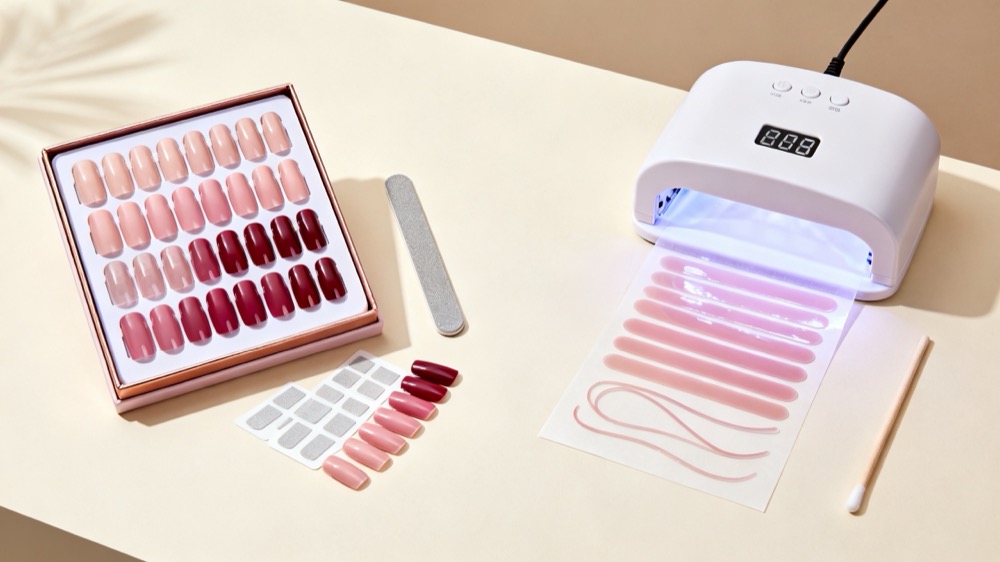
The following assessment is a manufacturing-led commercial judgment, not a claim that either category universally delivers higher sales or margins.
| Comparison factor | Press-on nails | Semi-cured gel nails |
|---|---|---|
| Product format | Preformed artificial nails | Flexible, partially cured gel strips |
| Application | Attach with the specified glue or adhesive tabs | Apply, trim, cure, and finish as directed |
| Curing lamp | Not required for conventional systems | Required; compatibility must be verified |
| Length transformation | Can add immediate length | Generally follows natural nail length |
| Main fit challenge | Width, curvature, and cuticle alignment | Strip width, placement, and edge sealing |
| Inventory challenge | Designs multiplied by lengths and shapes | Designs plus starter-kit and refill configurations |
| Customer education | Sizing, adhesion, and removal | Placement, curing, finishing, and removal |
| Commercial opportunity | Occasion bundles and style collections | Starter kits, replacement strips, and accessory bundles |
| Easier initial launch | Usually | Depends on system readiness |
Press-on nails are preformed nail coverings attached using the adhesive specified for the product. Their finished shape makes them suitable for customers seeking an immediate change in length, silhouette, or decoration.
For private label press-on nails, customization can include:
- Shape, length, color, and artwork.
- Surface finishes and decorative effects.
- Size assortment and packaging.
- Adhesive options and application accessories.
Fit remains essential. A design may photograph beautifully yet disappoint customers if its curvature or width does not match their natural nails.
Semi-cured gel nail strips are partially cured gel products that customers apply to their nails and finish under a suitable curing lamp.
They should not be confused with ordinary decorative nail stickers. Application includes a curing stage, and the required process depends on the specific product.
For example, published instructions from ohora and MoYou London describe different curing sequences. That variation matters commercially: a private label brand should validate its own strip-and-lamp combination rather than copy another supplier's timing.
A shopper can quickly understand a preformed nail: choose a style, check the fit, and attach it.
This makes press-ons a practical starting point for brands targeting occasion-based purchases, fashion experimentation, or customers unfamiliar with home gel systems.
However, "easy application" should never become an unsupported promise of effortless results. Customers still need guidance on preparation, sizing, adhesive use, and removal.
The product page should answer three questions immediately:
1. What comes in the box?
2. Which attachment method does this kit use?
3. How does the customer remove it correctly?
Semi-cured gel nails introduce an additional purchasing decision: does the customer need a lamp?
A returning user may already understand the process. A beginner may not recognize the difference between gel strips and non-curing nail wraps.
Separate starter-kit and refill listings help reduce confusion. Place the lamp requirement beside the purchase button, not only inside a long description.
For this category, clear instructions are part of the product experience—not an optional packaging extra.
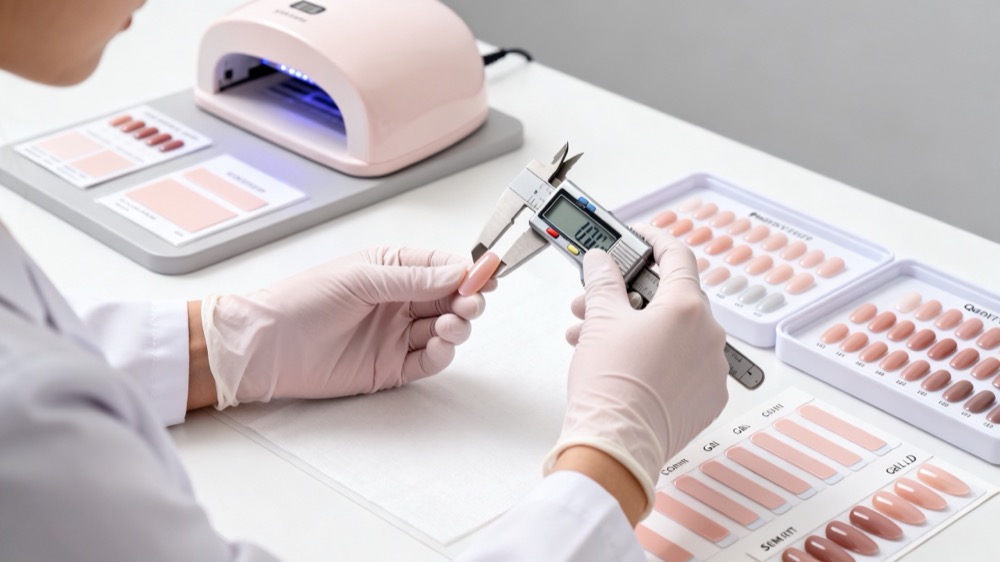
For OEM press-on nails, buyers should evaluate more than one attractive sample.
A production inspection plan should cover:
- Width and curvature across included sizes.
- Thickness consistency and edge smoothness.
- Color matching and artwork registration.
- Decoration attachment and surface defects.
- Correct size counts and accessory inclusion.
One frequently overlooked issue is assortment usefulness. A box can contain many pieces without providing enough practical options for different nail shapes.
Our manufacturing-led view is that size coverage deserves the same attention as artwork approval.
Semi-cured gel nail quality should be assessed together with packaging, storage instructions, and the intended curing lamp.
Relevant checks include strip flexibility, adhesive behavior, cutting accuracy, application performance, and the validated curing process.
A satisfactory appearance after curing does not, by itself, establish adequate polymerization. Suppliers should be able to explain how they validate their system and what supporting documentation is available.
Approve the product as a coordinated system. Do not select a lamp solely because it looks suitable for a gift set.
Press-on nails can create a large assortment quickly.
Consider an illustrative range:
- Eight designs.
- Three shapes.
- Two lengths.
That creates 48 sellable combinations before adding packaging variations or separate adhesive kits.
Semi-cured gel strips may avoid some shape-and-length multiplication, but complexity can reappear through starter kits, refills, lamp options, and accessory bundles.
The practical lesson is not that one category always needs fewer stock units. It is that each category expands differently.
For a new collection, begin with a controlled assortment and expand after observing demand, fit complaints, and repeat purchases. A broad launch is not automatically a scalable launch.
Neither product should be described as universally easier to ship without checking its contents and destination.
A plain nail set, a glue-containing kit, a remover bundle, and a battery-powered lamp package create different operational questions.
Before approving packaging, ask:
- Does the outer pack protect nails or strips from deformation?
- Are storage requirements clearly documented?
- Do adhesives or removers require special carrier review?
- Does the lamp need destination-specific electrical documentation?
- Can the warehouse distinguish starter kits from refills?
For semi-cured gel products, request evidence supporting the recommended storage conditions and shelf life.
For press-ons, check whether transport vibration damages embellishments or causes pieces to move inside the tray.
These are validation tasks, not assumptions to settle from product photographs.
The lower-cost product is not necessarily the easier product to scale.
A useful comparison is:
Contribution per order = net sales − product cost − fulfillment − payment fees − acquisition cost − expected service and refund costs.
Consider this hypothetical example:
| Per-order item | Press-on kit | Semi-cured starter kit |
|---|---|---|
| Net sales | $22.00 | $32.00 |
| Landed product cost | $5.00 | $11.00 |
| Fulfillment and payment costs | $5.00 | $6.00 |
| Customer acquisition | $7.00 | $8.00 |
| Service and refund allowance | $1.00 | $2.00 |
| Remaining contribution | $4.00 | $5.00 |
These are planning assumptions, not market benchmarks or YoungMei quotations.
The starter kit produces slightly more contribution here, but it also requires more inventory funding. Refill orders could change the economics again.
Compare first-order contribution, cash tied up in stock, and subsequent customer purchases separately.
Press-on nail brands can organize repeat purchases around occasions, coordinated outfits, seasonal artwork, or preferred shapes.
Potential merchandising approaches include:
- Short everyday collections.
- Bridal and event sets.
- Coordinated multi-set bundles.
- Limited design releases.
Reusability may strengthen the offer for suitable products, but it should be tested and qualified. Adhesive choice, removal technique, and decoration durability affect whether a particular set remains reusable.
Semi-cured gel nails offer a logical progression from a lamp-inclusive starter kit to replacement strip purchases.
However, owning a lamp does not guarantee retention. Customers must first achieve a satisfactory application and removal experience.
Useful retention content includes a first-use tutorial, troubleshooting guidance, and clear refill compatibility information.
Measure repeat purchases by customer cohort rather than treating the refill model as an automatic advantage.
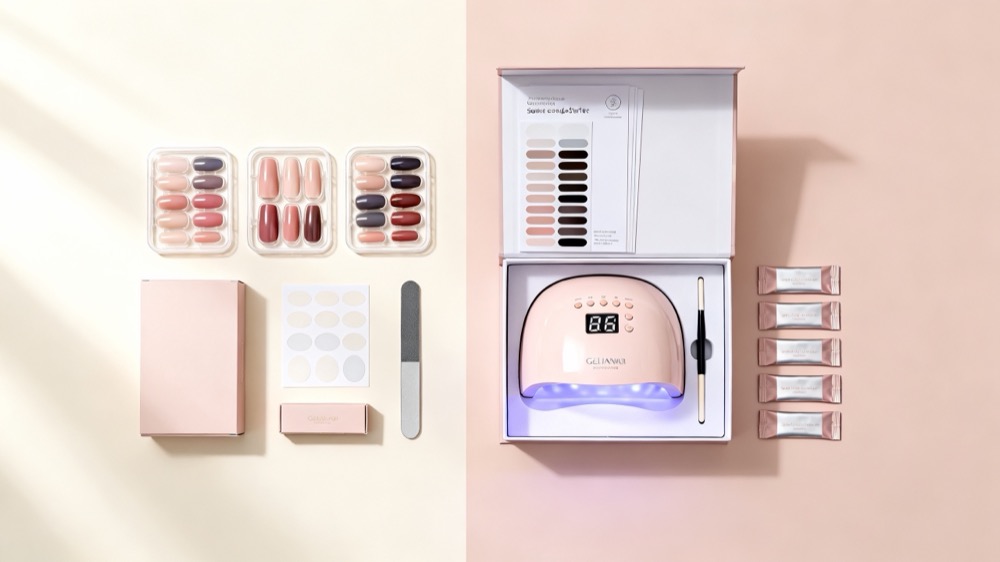
Both categories require careful instructions and restrained marketing claims.
The FDA notes that nail products can cause adverse reactions and that certain reactive ingredients can trigger sensitivity. Medical literature also documents allergic contact dermatitis associated with gel nail methacrylates.
Accordingly, brands should:
- Provide accurate ingredient information where applicable.
- Explain how to avoid skin contact during application.
- Supply product-specific curing and removal instructions.
- Avoid unsupported "allergy-free" or "damage-free" claims.
- Tell customers to discontinue use if irritation develops.
"HEMA-free" should not be presented as proof that a product cannot cause an allergic reaction.
Requirements also differ by destination and kit contents. Review the finished commercial offer—including adhesives, removers, and lamps—rather than assuming one document covers everything.
Before committing to a large order, run a controlled comparison.
Use comparable colors, design quality, and audience positioning. Otherwise, the winning artwork may be mistaken for the winning product category.
Give testers the actual packaging and instructions. Record where they hesitate, what they misunderstand, and whether they complete application without assistance.
Measure:
- Conversion and starter-kit selection.
- Application-related support requests.
- Fit, lifting, or curing complaints.
- Refunds, replacements, and contribution.
- Repeat orders over a suitable observation period.
Separate manufacturing defects from sizing issues, instruction gaps, and customer expectations.
A complaint labeled "does not last" is not yet a diagnosis.
Revise the product, instructions, or assortment before increasing volume.
This pilot framework is a proposed operating method, not a claim that YoungMei has conducted a published comparative trial.
Dongguan YoungMei Technology Co., Ltd. brings more than 15 years of nail-product manufacturing experience, an owned factory, and an established supply chain to OEM/ODM development.
Our services include product development, customization, rapid sampling, quality-focused production, and one-stop sourcing.
For buyers comparing press-on nails and semi-cured gel nails, the most useful starting point is a defined brief: target customer, sales market, intended price, launch quantity, packaging format, and accessory requirements.
Contact YoungMei with that brief to request a tailored sampling and quotation plan. Evaluate the samples, instructions, and commercial assumptions together before approving production.
Usually, they are easier for an initial launch because conventional attachment systems require no curing lamp. However, too many shapes and lengths can create substantial inventory complexity.
Yes. Follow the product's validated lamp requirements and curing instructions. Do not assume that every lamp or another brand's curing time is suitable.
Neither category guarantees better margins. Compare landed costs, acquisition spending, fulfillment, customer support, refunds, and repeat purchases—not just factory unit prices.
Some can, depending on their construction, adhesive, removal method, and condition afterward. Make reuse claims only when supported by testing for the specific product.
No. Semi-cured gel strips require a finishing cure. Ordinary decorative nail stickers may use a different construction and application process, so listings should identify the format clearly.
Request representative samples, product specifications, inspection criteria, relevant documentation, packaging details, and written application and removal instructions. For semi-cured products, include lamp compatibility and curing validation.
1. [U.S. Food and Drug Administration — Nail Care Products]. Regulatory background, ingredient sensitivity, and nail-product safety considerations. [fda]
2. [CVS — How to Apply Press-On Nails: A Step-by-Step Guide]. Application sequence, preparation, and sizing guidance. [cvs]
3. [ohora UK — How to Use]. Manufacturer-specific instructions for semi-cured gel strip preparation, application, curing, and finishing. [ohora]
4. [MoYou London — Gel Nail Wraps: How to Apply]. Product-specific curing and removal instructions. [moyou.co]
5. [The Journal of Allergy and Clinical Immunology: In Practice — Allergy to "Hypoallergenic" Gel Nail Polish]. Clinical discussion of methacrylate-related allergic contact dermatitis. [jaci-inpractice]