
- All
- Product Name
- Product Keyword
- Product Model
- Product Summary
- Product Description
- Multi Field Search
English
Views: 215 Author: Young Mei Publish Time: 10-20-2026 Origin: Site


Content Menu
● Soft Gel vs Hard Gel Nails: Quick Comparison
>> Are Soft Gel Nails the Same as Press-On Nails?
>> Is Builder Gel Always Soft Gel?
● Soft Gel vs Hard Gel: Strength, Flexibility, and Appearance
>> Which Is Stronger for Nail Extensions?
>> Which Works Better on Flexible Nails?
● Application and Removal: Where the Experience Changes
>> How Soft Gel Nails Are Applied
>> How Hard Gel Nails Are Applied
>> Soft Gel vs Hard Gel Removal
● Which Lasts Longer, and Which Costs More?
● Are Soft Gel or Hard Gel Nails Safer?
● A Practical Decision Framework for Consumers and Salons
>> Choose a Suitable Soft Gel System When:
● A Manufacturer's Checklist for Brands and Wholesale Buyers
>> 1. Define the Product Accurately
>> 2. Confirm the Complete Application System
>> 3. Evaluate Fit and Construction
>> 4. Request Relevant Documentation
>> 5. Validate Claims Before Printing
● A Sample-Testing Plan Before Launch
● Build a Nail Collection Around the Right Customer Experience
>> Can Soft Gel Be Used for Nail Extensions?
>> Can Hard Gel Be Removed With Acetone?
>> Is Soft Gel Better for Beginners?
>> Can Hard Gel and Soft Gel Be Layered Together?
>> Do Gel Nails Damage Natural Nails?
>> Which Option Is Better for a Retail Nail Brand?
Soft gel vs hard gel nails comes down to one essential difference: removal. Soft gel systems are designed to soak off with acetone, while traditional hard gel requires filing. However, choosing the right system also means considering flexibility, extension length, maintenance, application skill, and the experience your customers expect.
At Dongguan YoungMei Technology Co., Ltd., our perspective comes from more than 15 years of manufacturing press-on nails, nail stickers, and related nail products. We approach this comparison through product selection and customer experience—not as a substitute for a qualified nail technician's assessment.
For consumers, the goal is a suitable manicure. For brands, wholesalers, and retailers, it is also a clearly positioned product that customers can understand and use correctly.

| Comparison point | Soft gel nails | Hard gel nails |
|---|---|---|
| Defining characteristic | Designed for acetone soak-off | Generally requires file-off removal |
| Typical feel | Often more flexible; varies by formula | Typically more rigid and structural |
| Common applications | Gel polish, overlays, soak-off builders, certain extension systems | Structured overlays and sculpted extensions |
| Added length | Possible with appropriate builder or tip systems | Commonly selected for stronger structural support |
| Maintenance | Removal or infills, depending on the system | Usually maintained through infills and rebalancing |
| Application requirements | Product-compatible lamp and correct technique | Product-compatible lamp and structural application skills |
| Main selection priority | Removability and suitable flexibility | Structure and ongoing professional maintenance |
These are category-level distinctions, not guarantees. Formula, nail condition, architecture, and application quality can change the result.
Soft gel is a broad category of light-cured nail products that can be removed using an appropriate acetone-based process.
The term does not describe only one manicure. It can include:
- Soak-off gel polish that provides color and shine.
- Soak-off builder gel that adds structure.
- Soft gel extension systems using compatible full-cover tips.
This distinction matters because gel polish and structural builder gel do different jobs. A color coating should not be expected to provide the support of a properly designed extension system.
No. A soft gel extension service and a ready-to-wear press-on manicure may look similar, but their application methods can differ substantially.
Full-cover soft gel tips are often attached using a compatible light-cured gel. Press-on nails may instead use nail glue or adhesive tabs.
For a retail collection, specify the actual product format and attachment method. A finished nail sold as a "gel-look press-on" should not automatically be described as a soak-off soft gel extension.
Hard gel is a light-cured enhancement material used to create structured overlays and extensions. Unlike soak-off gel, traditional hard gel does not dissolve sufficiently in acetone for normal soak-off removal.
Technicians shape the material to provide support where the nail needs it. This includes building an appropriate apex—the reinforced area that helps distribute stress.
Hard gel is commonly chosen for clients who want structured nails and are comfortable returning for professional maintenance.
No. "Builder" describes a product's structural purpose, not its removal method.
A builder gel can be soak-off or file-off. Likewise, a bottle or pot does not reliably identify the category.
When comparing builder gel vs hard gel, check the manufacturer's instructions rather than assuming every builder product is removable with acetone.
Hard gel is often the practical choice when a technician needs a rigid, sculpted structure. However, "harder" does not automatically mean "better" for every nail.
Longer extensions create greater leverage. Their durability depends on the material, shape, thickness distribution, and maintenance—not simply the category name.
Appropriate soft gel builders and full-cover extension systems can also create length. The permitted length and construction should follow the specific system's guidance.
Both can produce a refined, natural-looking finish.
Soft gel is often associated with lightweight manicures, but hard gel does not have to look bulky. A skilled technician can create a balanced hard gel overlay without excessive thickness.
For product photography and packaging, show realistic side profiles as well as attractive top views. Customers need to understand the nail's shape, not just its color.
A suitable soft gel may accommodate some movement in the natural nail. However, very flexible, peeling, or damaged nails require individual assessment.
A rigid enhancement over an unsuitable foundation can create problems, but applying a flexible product does not automatically solve them.
Persistent splitting, pain, discoloration, or separation deserves professional evaluation rather than another coating.
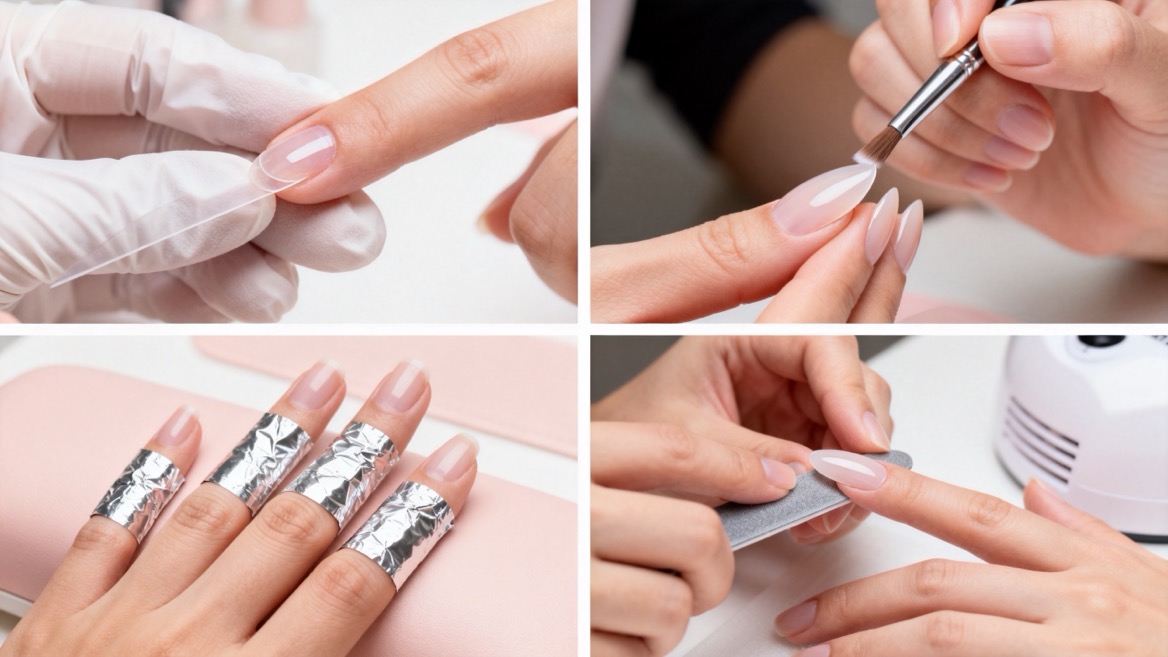
The exact sequence depends on the product, but a typical service involves:
1. Assessing the natural nails and surrounding skin.
2. Preparing the nail according to system instructions.
3. Applying compatible base, color, builder, or extension products.
4. Curing each required layer with the recommended lamp.
5. Finishing and checking the result.
Do not transfer curing times between unrelated systems. A lamp that works for one product is not automatically suitable for another.
Hard gel application adds a stronger emphasis on structure.
The technician controls placement, builds support, cures the material, and refines the shape. At maintenance appointments, they assess lifting and rebalance the enhancement as the natural nail grows.
This is why an ongoing hard gel service is different from repeatedly applying a fresh color coating.
For soft gel, follow the product-specific soak-off procedure. Some systems require reducing the surface layer before acetone can work effectively.
Hard gel generally requires controlled filing. Excessive filing can damage the natural nail, so professional removal is advisable.
Neither system should be peeled or forcibly pried away. If material resists removal, reassess the method rather than increasing force.
There is no reliable universal wear-time winner.
A thin gel polish manicure, a structured soft gel overlay, and a hard gel extension are different services. Comparing them without considering length and construction creates misleading expectations.
Wear depends on:
- Natural nail condition and preparation.
- Product compatibility and curing.
- Extension length and shape.
- Daily activities and mechanical stress.
- Timely maintenance.
Cost also varies by region, technician, design complexity, and service scope. Hard gel may involve more structural work, while some soft gel extension systems simplify application.
From a buyer's perspective, compare total service cost—including removal, maintenance, and repairs—not just the initial appointment.
Avoid publishing a fixed claim that one category is always cheaper or lasts a set number of weeks.
Neither category is automatically safer.
Both can involve reactive ingredients before curing. Skin contact with uncured product and insufficient curing can increase the risk of allergic sensitization.
A responsible routine includes:
- Keeping uncured gel off the skin.
- Using the recommended lamp and curing procedure.
- Avoiding excessive filing.
- Stopping use if itching, swelling, blistering, or nail separation develops.
- Seeking medical advice for a suspected reaction.
A "HEMA-free" label should not be interpreted as an allergy-free guarantee. Other ingredients may also cause reactions.
For lamp exposure, dermatologists recommend broad-spectrum, water-resistant SPF 30 or higher on the hands, or suitable dark, opaque fingerless protective gloves.
People with an existing nail-product allergy should consult a dermatologist rather than experimenting with alternative gels.
Instead of asking which gel is universally best, start with the service requirements.
- Soak-off removal is an important preference.
- The desired look is a color manicure or compatible structured overlay.
- The selected extension system supports the intended length.
- The customer understands the application and removal process.
- Structured overlays or sculpted extensions are the priority.
- The technician recommends a more rigid enhancement.
- The customer can attend regular maintenance appointments.
- Professional file-off removal is acceptable.
If the main requirement is a ready-to-wear manicure without a curing service, evaluate glue-on or adhesive-tab press-ons as a separate product category.
For us, the most useful comparison goes beyond salon terminology. A product must also be understandable on the shelf and consistent across orders.
Before approving a nail collection, we recommend a product brief covering five areas.
Specify whether the item is gel polish, builder gel, a full-cover extension tip, a finished press-on, or a nail sticker.
Avoid treating these formats as interchangeable.
Identify the required adhesive, preparation products, lamp where applicable, and removal method.
For finished press-ons, clarify whether the package includes glue, adhesive tabs, or neither.
Review sizing coverage, sidewall fit, curvature, thickness distribution, and edge finishing.
An attractive design cannot compensate for a poor fit.
Ask for product specifications, applicable ingredient and safety information, instructions, and documentation relevant to the destination market.
Documentation should match the actual product supplied, not a vaguely similar item.
Statements such as "damage-free," "hypoallergenic," or "lasts four weeks" need appropriate substantiation.
Our recommendation is to prioritize clear, supportable instructions over ambitious promises.
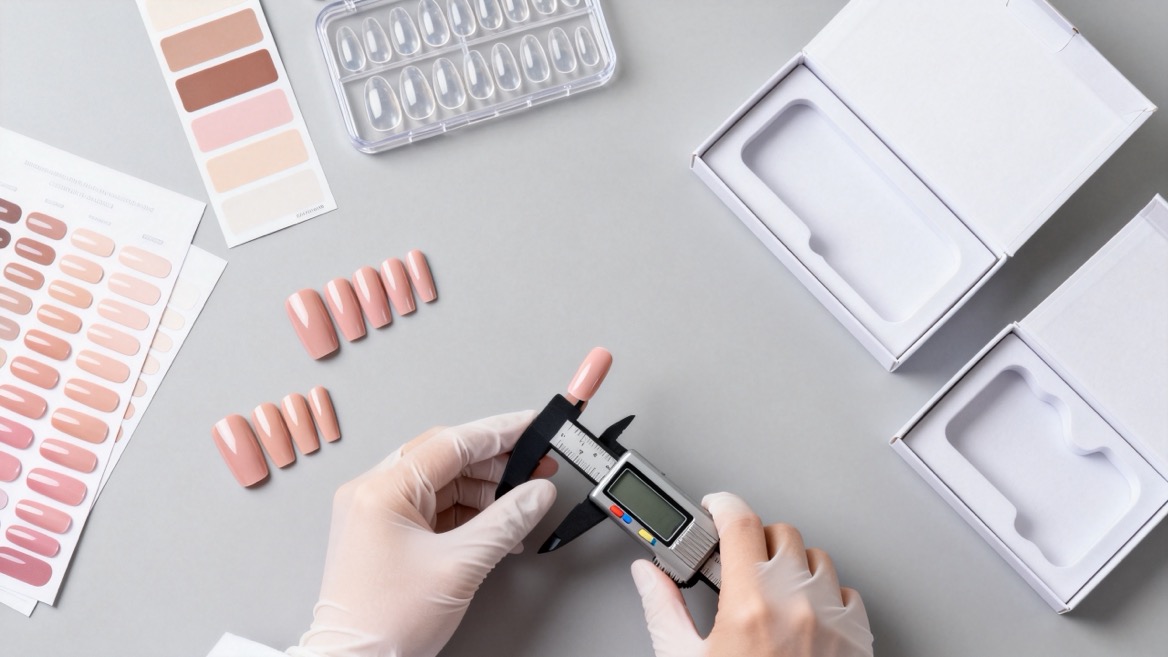
A useful pre-launch evaluation should reproduce the customer's actual journey.
1. Define the intended user, application method, and removal process.
2. Assess samples across representative nail sizes and shapes.
3. Record application difficulties, fit issues, lifting, cracking, and finish changes.
4. Check removal against the written instructions.
5. Review packaging with someone unfamiliar with the product.
6. Revise the specification before approving bulk production.
This is a proposed evaluation framework, not a claim about completed laboratory testing or customer results.
Its value is practical: it helps identify whether a problem comes from the product, its fit, its instructions, or an unrealistic marketing promise.
Soft gel and hard gel serve different priorities. The strongest product decision starts with the desired appearance, support, removal method, and level of professional involvement.
At Dongguan YoungMei Technology Co., Ltd., we support global brands, wholesalers, and chain retailers with OEM/ODM customization, rapid sampling, and one-stop sourcing for press-on nails, nail stickers, and related products.
Send us your target market, preferred product format, design references, packaging requirements, and estimated order quantity. We can use that brief to discuss a suitable sampling and customization plan.
Yes. Suitable soak-off builders and full-cover soft gel extension systems can add length. Standard gel polish alone is not a substitute for a structural extension product.
Traditional hard gel generally requires filing. If a product is labeled soak-off, follow its own instructions rather than relying on the word "hard" in promotional wording.
Not automatically. Some formats simplify application, but preparation, curing, and skin-contact control still require care. Light-cured extension systems should not be treated as risk-free beginner products.
Only when the manufacturers confirm compatibility and the application sequence. Differences in flexibility and adhesion can affect performance. Do not assume products are compatible because both are gels.
Damage can occur through over-filing, peeling, unsuitable application, or improper removal. Neither category guarantees damage-free wear, and an enhancement does not repair an underlying nail disorder.
That depends on the customer and sales channel. Professional enhancement systems require different instructions and support from finished press-ons. Define the intended application experience before selecting the product format.
- Paola Ponce Nails — "Soft Gel vs. Hard Gel Nails." Practitioner perspective on removal, service preferences, and application differences. Its individual pricing observations are not treated here as universal market data. [paolaponcenails]
- Paola Ponce Nails — "Defining All The Gel Nail Terms!" Clarifies that builder gels may be soak-off or non-soak-off. [paolaponcenails]
- OPI — "Introducing Diamond Gel: 3-in-1 Hard Gel System." Product-specific guidance on buff-off removal, infills, and compatibility limitations. [opi]
- OPI — "What Are Gel Nails? Your Guide to All Things Gel Manicure." Distinguishes decorative gel polish from structural builder gel. [opi]
- American Academy of Dermatology — "Gel Manicures: Tips for Healthy Nails." Guidance on removal, moisturizing, and protection during lamp exposure. [aad]
- British Association of Dermatologists — "Dermatologists Reiterate Artificial Nails Warning and Risk of At-Home Kits," April 14, 2023. Guidance on uncured-product contact, insufficient curing, and recommended lamps. [bad.org]
- DermNet — "Nail Cosmetics Allergy." Clinical background on allergic reactions associated with nail cosmetics and artificial nail materials. [dermnetnz]