
- All
- Product Name
- Product Keyword
- Product Model
- Product Summary
- Product Description
- Multi Field Search
English
Views: 258 Author: Young Mei Publish Time: 10-01-2026 Origin: Site


Content Menu
● UV vs LED Nail Lamps at a Glance
● What Do UV and LED Mean on a Nail Lamp?
● Which Lamp Cures Gel Nails Faster?
>> Why wattage is not a cure score
● Which Lamp Works With More Gel Products?
● What About UV Exposure and Skin Safety?
● Do Press-On Nails Need a UV or LED Lamp?
● A Manufacturer's Checklist for Kit Buyers
>> A simple validation scenario
● How to Choose the Right Lamp
● Build a Kit Customers Can Use Confidently
>> Is an LED nail lamp the same as a UV lamp?
>> Can any LED lamp cure any gel polish?
>> How long should gel cure in a UV versus LED lamp?
>> Is a higher-watt nail lamp always better?
>> Are LED nail lamps safer than fluorescent UV lamps?
>> Can I use gel adhesive under opaque press-on nails?
>> Do adhesive tabs or regular nail glue need a lamp?
Choosing between UV vs LED nail lamps is not simply a question of which device cures faster. The right lamp must deliver the light your gel formula needs, across every nail, for the time specified by its maker. If you sell gel kits or press-on nails, you also need to ask a prior question: Does the product need a lamp at all? This guide compares curing speed, compatibility, cost, maintenance, and exposure so you can choose a system that works in practice—not just on a product listing.

| Buying factor | Traditional UV fluorescent lamp | Modern UV-emitting LED lamp |
|---|---|---|
| Light source | Fluorescent tubes | Light-emitting diodes |
| Light spectrum | Generally broader output | More targeted output; varies by model |
| Gel compatibility | May work with a wider range of older formulas, if the maker confirms it | Works only when its output matches the gel; dual-wavelength models can cover more formulas |
| Typical cure time | Often longer | Often shorter for compatible gels |
| Upkeep | Tubes require inspection and replacement | Diodes generally avoid routine tube replacement; the unit still needs monitoring |
| Main purchasing risk | Slower workflow and aging bulbs | Assuming "LED" means universal compatibility |
| Best fit | A legacy gel system with validated fluorescent-lamp instructions | A current gel system with a specified, validated LED lamp |
Bottom line: Choose the lamp recommended for your gel system. Do not choose by the words "UV" or "LED" alone.
The terminology causes much of the confusion. UV describes the radiation; LED describes the component producing light. An LED nail lamp can emit ultraviolet A (UVA) light. It is not automatically a UV-free option. Some dual-wavelength lamps also emit near-violet light around 405 nm, just beyond the conventional 400 nm boundary of ultraviolet light.
A traditional UV nail lamp usually uses fluorescent tubes. Its broader output historically made it useful for certain gels that did not respond well to early, narrowly tuned LED units. A modern LED lamp uses diodes selected for particular wavelengths. A common dual-wavelength design combines output around 365 nm and 405 nm, but those numbers alone do not prove that every gel will cure under it.
Gel contains photoinitiators that respond to suitable light and start polymerization—the process that turns the applied material into a solid network. The gel formulation and lamp must function as a pair. Matching wavelength is necessary, but sufficient light must also reach the product for the required time. A hard-feeling top surface does not, by itself, verify the depth of cure.
For compatible products, an LED lamp often wins on speed. One documented product example illustrates the difference: Gelish instructs users to cure its Top It Off top coat for 30–45 seconds in a Gelish LED light or two minutes in a specified 36-watt UV light. These are instructions for that product and those lamp conditions—not universal timings for every base coat, color, or builder gel.
A shorter curing step can matter in a busy salon. If a service includes base, two color layers, and top coat, even modest savings per layer can improve chair time. Yet speed is valuable only when the cure is reliable. Dense pigment, thick builder-gel layers, an incorrectly positioned thumb, or a weak lamp may require the brand's different technique or timing.
Never shorten a published cure time simply because a lamp advertises more watts. Likewise, leaving an incompatible gel under a lamp for an arbitrary extra minute is not a validated fix. When a brand specifies a lamp model and process, follow that combination.
A lamp's watt rating mainly describes electrical input. It does not tell you exactly how much curing-relevant light reaches each nail. Output wavelength, irradiance at the nail surface, hand position, and exposure time all affect the result. The GelBottle, for example, describes a validated dual-wavelength lamp with an approximately 23-watt electrical design. That is a useful reminder that a higher printed watt number does not automatically mean a better cure.
For buyers comparing specifications, request the wavelength range and product-specific cure instructions, not just a wattage claim. For professional procurement, ask how the lamp's performance was checked with the exact gel shades and layer thicknesses in the proposed kit.
Traditional fluorescent UV lamps may accommodate some older or UV-only gel systems, but that does not make them universally compatible. LED lamps are efficient and convenient when the gel was designed and tested for their output. A dual-wavelength LED lamp can broaden compatibility, yet "dual-wavelength" is not a universal-cure guarantee.
To avoid guessing, start with the gel rather than the lamp:
1. Read the gel label. Identify the recommended lamp type, model, and time for each layer.
2. Check the complete system. Base, color, top coat, and builder gel may have different instructions.
3. Confirm cross-brand use. If a kit combines suppliers, obtain written compatibility guidance or arrange qualified cure validation.
4. Check physical coverage. Place a hand naturally in the chamber and see whether all nails, especially thumbs and outer fingers, receive appropriate coverage.
5. Keep the instructions with the kit. A consumer should not need to infer curing conditions from a lamp's advertising.
If a supplier cannot explain which gels its lamp was tested with, treat "works with all gel polish" as a marketing claim, not a technical specification.
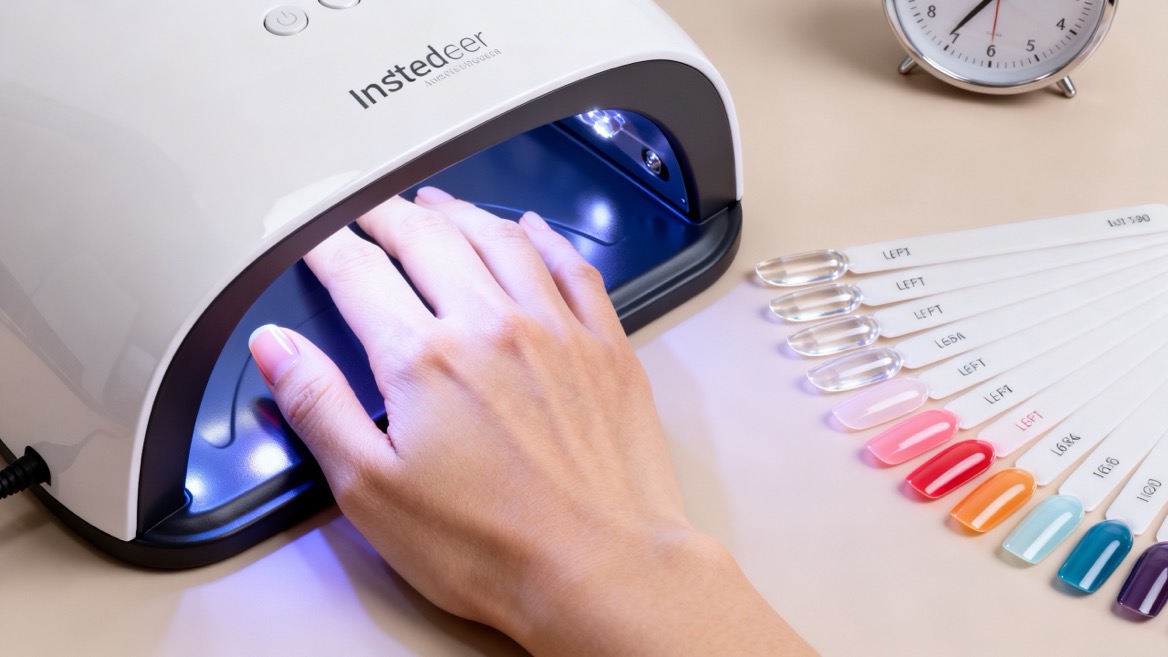
Both traditional UV and UV-emitting LED nail lamps can expose skin to UVA. Calling an LED lamp "UV-free" can therefore mislead customers. The amount delivered varies by device and use. A 2025 scientific review found that the available evidence does not establish a direct causal link between typical nail-lamp use and skin cancer, while noting that lamp output varies and long-term research remains limited.
A laboratory study found DNA damage and mutations in cells exposed to a nail dryer under experimental conditions. That result warrants care, but cell-culture exposure cannot be converted directly into a person's cancer risk during a normal manicure. Neither "completely harmless" nor "proven to cause cancer from routine use" is a sound blanket statement.
For a practical precaution, dermatologists recommend broad-spectrum, water-resistant SPF 30 or higher on the hands, or dark, opaque fingerless gloves, before a gel manicure. Follow the product's specified cure time; unnecessary repeat exposure offers no known service benefit. Customers with a history of unusual reactions or light sensitivity should seek individual medical advice rather than relying on a lamp's marketing description.
Allergy risk is a separate concern from light exposure. Uncured or incorrectly cured nail product can leave reactive material in contact with skin. Keep gel off the surrounding skin and do not use a lamp–gel combination that lacks credible curing guidance. If redness, itching, swelling, or nail changes occur, stop using the product and consult a healthcare professional.
Usually, ready-made press-on nails attached with standard adhesive tabs or conventional nail glue do not need light curing. That distinction matters for customers shopping by convenience. The nails may already have a finished design, while the attachment method sets without a nail lamp. Always follow the adhesive's own instructions.
A different process applies to clear or sheer tips attached using light-cured gel adhesive. Here, light must travel through the tip and reach the adhesive underneath. An opaque, heavily pigmented, or decorated press-on may block that light. The top of the nail can look finished while the material beneath remains inadequately cured.
From a product-development perspective, that creates two distinct kit concepts. A no-lamp press-on kit can focus on fit, design, adhesive choice, and removal guidance. A gel-extension kit needs compatible tips, an appropriate gel, a validated lamp, and detailed curing instructions. Do not market an opaque, prefinished press-on as suitable for gel-adhesive curing without product-specific validation.
This is where format choice can solve a problem that lamp choice cannot. For a shopper who wants a fast change of look without a curing device, a conventional press-on application may be the more suitable route than buying a stronger lamp.
For brands and wholesale buyers, comparing lamps is also a question of system design. At Dongguan YoungMei Technology Co., Ltd., our more than 15 years in nail-product manufacturing inform a practical starting point: define the customer's application first, then specify the components that belong together. This is an industry-facing purchasing framework, not a claim that any particular lamp or formula has passed tests that are not shown here.
Before placing an OEM or ODM order, ask a supplier for:
- A product map: Which items are finished press-ons, adhesive tabs, conventional glues, gel polishes, or light-cured gel adhesives?
- A compatibility matrix: Which specific formula and shade is intended for which lamp, at what layer thickness and curing time?
- A sample protocol: Are test samples evaluated on every finger position, including thumbs, rather than only at the center of the lamp?
- Instructions and warnings: Can end users distinguish no-lamp attachment from a light-cured service at a glance?
- After-sales planning: What happens if a lamp's output weakens, a component fails, or a gel formula changes?
A complete kit is more than a box of compatible-looking items. Its claims, components, and user instructions should describe the same real-world procedure. For multi-market retail programs, confirm applicable labeling and electrical requirements separately for each destination.
Imagine a retailer wants to sell a dark, opaque press-on set alongside gel adhesive and a small LED lamp. The customer may assume the bundle guarantees a firm, safe attachment. But the decoration can obstruct light before it reaches the adhesive. The sensible response is not to claim that a higher-watt lamp solves the issue. Instead, evaluate a standard no-lamp adhesive for the decorated set, or redesign the kit around clear tips and a tested gel-curing system.
That one decision can improve the buying experience, reduce confusing instructions, and make product claims easier to support. It also shows why press-on nail format belongs in the UV-versus-LED buying decision.
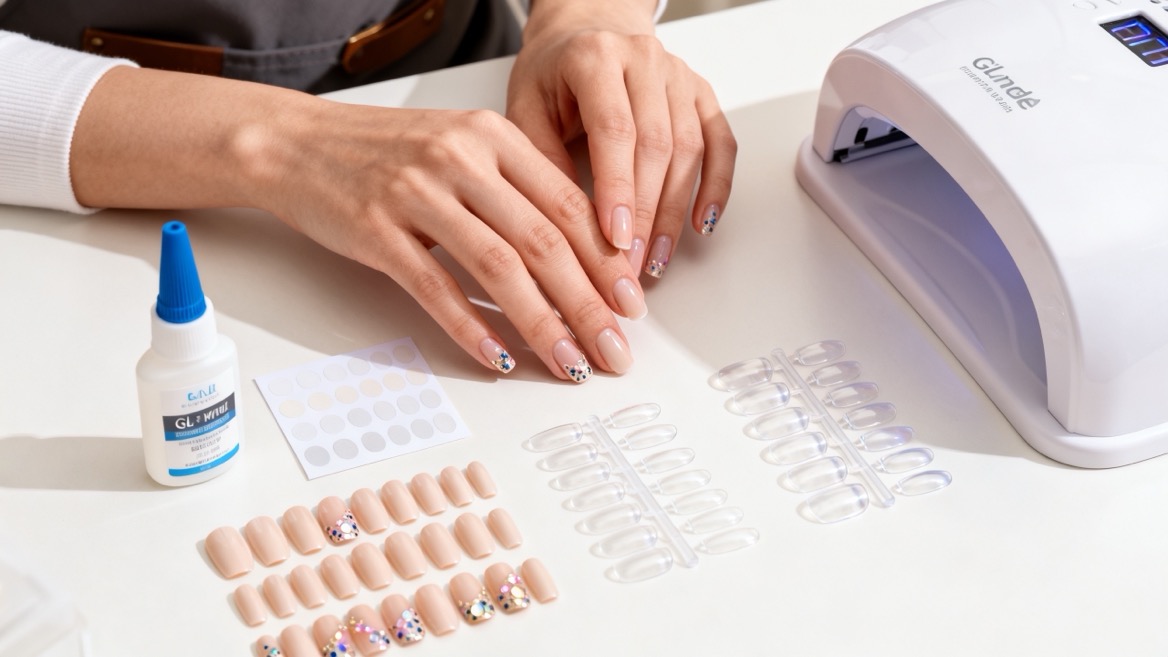
Use this decision sequence rather than starting with price or a wattage badge:
1. Identify the product. Is it ordinary polish, a finished press-on, or a gel that must be light-cured? Ordinary polish and standard press-on adhesives do not become gel products just because a lamp is available.
2. Find the maker's curing directions. For a gel, use the recommended lamp and follow the stated timing for each product layer.
3. Compare wavelength and coverage. If you must evaluate another lamp, ask for documented compatibility and check how the full hand sits inside it.
4. Assess the working routine. Consider cleaning instructions, reliable timers, hand clearance, power supply, replacement policy, and warranty.
5. Budget for the full system. Include compatible gels, appropriate tips or adhesives, user instructions, and maintenance—not only the device price.
Our recommendation: For a gel manicure, buy the lamp validated for the gel system you will actually use. For finished press-ons applied with standard glue or tabs, do not buy a curing lamp unless another product in the routine specifically requires one.
The best choice is not "UV" or "LED" in isolation. It is a documented match between product, application method, and curing instructions—or a clear no-lamp press-on option when curing is unnecessary. For a private-label launch, ask Dongguan YoungMei Technology Co., Ltd. for OEM/ODM sampling and a discussion of press-on designs, adhesive options, packaging, and kit instructions. Share your target market, preferred designs, order requirements, and intended application method so the proposed assortment starts with the right user experience.
Not exactly. "LED" names the light-producing component; "UV" names a range of light. Many LED nail lamps emit UVA, so an LED model is not necessarily UV-free. A fluorescent UV lamp uses a different light source.
No. The gel's photoinitiators must respond to the lamp's output, and the product must receive enough appropriate light for the recommended time. A dual-wavelength label alone does not verify every gel.
There is no reliable universal time. For one Gelish top coat, the listed instructions are 30–45 seconds in a specified LED light versus two minutes in a specified UV light. Check the exact directions for your own gel and lamp.
No. Electrical wattage does not measure the complete curing dose at the nail. Wavelength, delivered light, exposure time, and hand position matter more than a headline watt figure.
Do not treat either type as radiation-free. Exposure differs across devices, and a faster validated cure may reduce time under the light, but it does not establish zero risk. Follow directions and consider hand protection.
Do not assume so. An opaque tip may prevent curing light from reaching the adhesive beneath it. Use an attachment method suitable for the finished tip unless a complete system has been specifically tested for that design.
Standard adhesive tabs and conventional nail glue generally do not. Check the individual product instructions; light-cured gel adhesive is a different category and does require a compatible lamp.
- Paola Ponce Nails. ["Gel Nail Lamps: UV vs LED | How to Know Which One to Buy?"]. Competitor article used to identify the comparison topic; this article is independently written.
- The GelBottle. ["Illuminate Lamp FAQs."]. Technical explanation of wavelength, energy delivery, wattage, and product validation.
- Gelish. ["Top It Off Sealer Gel Top Coat."]. Product-specific LED and fluorescent UV cure instructions.
- Beylin, D., et al. ["Assessing the Health Implications of UV/LED Nail Lamp Radiation Exposure During Manicure and Pedicure Procedures: A Scoping Review."]. *International Journal of Dermatology*, 2025. Review of 17 publications and limits of the available evidence.
- Zhivagui, M., et al. ["DNA Damage and Somatic Mutations in Mammalian Cells After Irradiation With a Nail Polish Dryer."]. *Nature Communications*, 2023. Experimental cell study, not a direct estimate of human cancer risk.
- American Academy of Dermatology Association. ["Gel Manicures: Tips for Healthy Nails."]. Hand-protection and manicure guidance.
- U.S. Food and Drug Administration. ["Nail Care Products."]. Label directions, adverse reactions, and methacrylate discussion.
- POPSUGAR. ["Everything You Need to Know About Gel Curing Your Press-On Nails."]. Interviews with nail professionals about light transmission through press-on tips.